Definition: A protocol set of rules for communication
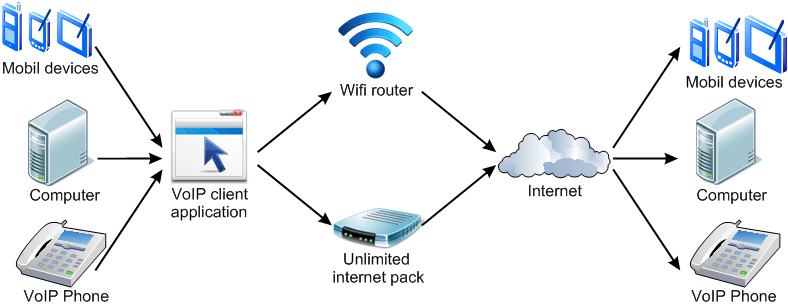
Definition: VOIP is the protocol which governs voice communication by sending the audio over the internet.
VOIP can be implemented by phone handsets which is connected to a computer network. Some popular apps also allow for VOIP, e.g Skype, Whatsapp, Discord, Telegram etc.
In this class, we use computational thinking to solve a mathematical problem.
Class Activity – Finding the sum of a range of numbers
Complete the following task in your ICT notebook showing all working
Task: Without the aid of your classmates, find the sum of all whole numbers from 1 to 200 inclusive.
(15 minutes)
Discovery: at least 3 different methods were found. One interesting solution was the addition of al the ones (1+11+21..+91 = 460) then all twos (2+12+22+…+92 = 470) etc.
Teacher Demonstration and Discussion
Practical: Observe students suggestions, pattern recognition, past algorithms, decomposition into sub problems
Demonstrate:
1+2+3+4+…………+197+198+199+200
Observe the sum of pairs from out going in always sum to 200.
Determine the number of pairs.
Note that the steps to solve this problem are:
Find the sum of the first and last numbers (1+200)
Find the number of pairs (200/2)
Multiply the results of 1 and 2.
Further Exersises and Discussion – Finding the Sum of a Range Of numbers
Homework:
Using a similar approach as shown above, write the set of steps to find the sum of numbers from 1 to 10
Write the steps to find the sum of any range of numbers from which form a complete number of pairs. (e.g 5 to 10)
Write the steps to find the sum of any range of numbers from which form an incomplete number of pairs. (e.g 5 to 11)
When solving a problem it is important to define what the problem is and identify the goal that must be achieved to solve the problem.
In doing so we must identify the possible ways of achieving the goal using the information available. To determine the possible ways, it is useful to produce a list of conditions that must be satisfied for the goal to be achieved.
Class Practical 1
In class demonstration: (Game: Wolf, Sheep, Cabbage)
Teacher Draws and Discusses the game with students with no prior information.
Homework
Create a list of conditions which must be satisfied when for solving the problem
Produce all possible, solutions to this problem
Class Practical 2
In this class we shall observe some logic games.
Preparation
Students are to divide their copybook page into two columns (page is folded vertically to quickly set up the scenario).
1 student is chosen at random to perform the task of solving the problem in the game. We call this student the “actor”.
All other students are instructed that they are not allowed to talk or assist during the exercise ( No blurting out “no” Prep students for self control)
The game is explained to the actor.
Discuss the first actions with the actor. Silent students must write their first action, the main student takes his own action.
As consequences emerge, students and the actor write down the rules.
Every reset, write down the steps.
Discussion
-Are there any students with a different solution?
Write down some of the rules for the games that you have played. Use the following format:
Game name
Goal(s)
Rules
Wolf, Sheep and Cabbage.
Main goal: Get all items safely across the river
Secondary Goals: Do not lose any items to ‘eating’
· Only one item is allowed in the boat
· The sheep and wolf should never be left alone
· The cabbage and the sheep should never be left alone.
In your notebook, complete at least 3 rows of the table. i.e the rules and goals for at least 3 logic games.
Updates to this post
22nd Apr 2024: Added “When solving a problem….” up to and including Class practical 1. This class practical is meant or use in a classroom with no lab .
The previous class practical was renamed to Class Practical 2 and is meant for use in a Computer lab.
Definition: A wiki is a website which allows users to add or edit content on its pages. Users of the wiki can collaborate on some or all pages of the wiki.
Definition: Collaboration[1] is when people work with each other to complete a task. It involves co-operation and teamwork and the sharing of ideas, knowledge and skills to reach the same objective. The objective is usually creative in nature.
A well-known example of a wiki is Wikipedia an online user edited encyclopedia.
Wikis can be used to collect and maintain information on a subject or topic. For example, a teacher can collaborate with students to collect and maintain information on the subject being studied in school.
Main Functions of a wiki
Wikis allow for :
Adding new content
Editing or Modifying existing content.
Deleting existing content (deleting pages)
Additional Features of a wiki
A wiki may be either private, public, or semiprivate.
Private wikis
Private wikis require users to register in order to create user accounts. The content on the wiki is only viewable and editable on by registered users.
Public wikis
Public wikis allow for the creation of user accounts but still allow for the public to view and edit information.
Semi Private wikis
Semi Private wikis allow for content to be viewable to the public and registered users.
Some topics may be locked for editing by unregistered users. However, unregistered users may add new pages and edit locked content.
Some topics may be only edited by small groups of specially selected registered users.
Advantages and Disadvantages of Wikis
Advantage
Disadvantage
Quick generation of a large information resource due to many collaborators
Users can add inaccurate or incorrect information
Easy to add and edit and improve on existing content
Difficult to manage and remove incorrect information
Wiki collaboration does not require all users to work at the same time.
biased information can be produced if the collaborator is biased.
Prone to vandalism, malicious users can intentionally distort information
UPDATES:
24th Sept 2022 – Fixed spelling error in title and changed url

 Island Class