
Part a)
AND Gate:
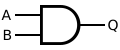
  A | B | A AND B
  ---------------
  0 | 0 |    0
  0 | 1 |    0
  1 | 0 |    0
  1 | 1 |    1
Or Gate:
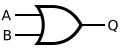
  A | B | A OR B
  ---------------
  0 | 0 |    0
  0 | 1 |    1
  1 | 0 |    1
  1 | 1 |    1
Not Gate:

  A | NOT A
  ---------
  0 |   1
  1 |   0
See this note1
Part b)
Suggested response:
XOR truth table:
| A | B | A XOR B |
| 0 | 0 | 0 |
| 0 | 1 | 1 |
| 1 | 0 | 1 |
| 1 | 1 | 0 |
Output is 1 in XOR for (NOT A AND B) OR (A AND NOT B)
Circuit:

Explanation
Assume we want to use an AND gate as a building block for our resulting circuit. Wherever we have an output of 1 it means that the inputs to that and gate should also be 1 .
If we imagine an AND gate being the last gate before the output, wherever there is a 1 we need to understand that the inputs to that gate would have to be 1.
| A | B | A XOR B |
|---|---|---|
| 0 | 0 | 0 |
| 0 | 1 | 1 |
| 1 | 0 | 1 |
| 1 | 1 | 0 |
-For each output that produces a 1, we modify the variable input to match the modded input listed in the specific row of the table:
| Row number | A | B | A XOR B | Desired output using AND Gate |
|---|---|---|---|---|
| i | 0 | 0 | 0 | |
| ii | 0 | 1 | 1 | NOT A AND B |
| iii | 1 | 0 | 1 | A AND NOT B |
| iv | 1 | 1 | 0 |
We see that either row ii) OR row iii) produces a 1, i.e
(NOT A AND B) OR (A AND NOT B)
From this expression, we draw the circuit as shown in the suggested response above.
Part c)

Data Lines (Input) are denoted as x1…x4, select line are denoted as s1 and s2, Output is denoted as f
Alternative Diagram in ASCII :
        _______________________
       |        4-to-1         |
D0 ----|      Multiplexer      |
       |                       |
D1 ----|                       |---> Output
       |                       |
D2 ----|                       |
       |                       |
D3 ----|_______________________|
              |         |
              |         |
              |         |
              |         |
              S1        S0
Data Lines (Input) are denoted as D0...D3, select line are denoted as S0 and S1.
See Note2
Part d) i)
16+8+0+2+1 =27
Explanation/Working:
(0×27)+(0×26)+(0×25)+(1×24)+(1×23)+(0×22)+(1×21)+(1×20)
0+0+0+16+8+0+2+1=27
Part d) ii)
0111 +
1110
———-
10101 ← this result cannot be stored in 4 bits.
Part d) iii)
Largest number = 0111 =7 (Show conversion)
Smallest number= 1111= -ve 7 (Show conversion)
Part d) iv)
Suggestion solution 1:
Algorithm, copy all numbers from LSB to MSB up to and including the first 1, then flip remaining bits in that order, i.e
5= 0101
Applying algorithm : 1011
Suggestion solution 2:
+5= 0101
Ones = 0101+1 = 1010
Twos = 1010+1 = 1011
Links to Notes
Attributions to media used in this post
Inductiveload, Public domain, via Wikimedia Commons
Footnotes
- https://islandclass.org/2021/10/20/logic-gates-formal-introduction/ ↩︎
- https://islandclass.org/2021/10/21/multiplexers/ ↩︎
© 2023 Vedesh Kungebeharry. All rights reserved.
 Island Class
