Stacks and Queues Discussion and Variant implementation

This post is intended for use in class and review. In this lesson we will observe some multiple choice question examples to provoke thoughts on the fundamental principles governing stack and queue operations.

Note that the multiple choice questions are not included on this website.

Discussion: Stacks and Queues

If a stack is implemented using a one-dimensional array and the top of the stack is always found at location 0 in the array, how would you implement push and pop?

That is, at the end of any push or pop operation, the top of the stack is stored at location 0.

Write separate algorithms for your push and pop operations.


After considering the scenario above do you think it’s possible to implement a stack using the wrap-around technique (that was used in the implementation of a queue ) to omit the intermediate copying of elements? Consider this scenario where the first element that was pushed onto the stack goes into location 0, and every time a pop operation occurs top is incremented (unless the stack is empty) , and every time a push operation occurs top is decremented.

Justify your conclusion.


Write an algorithm which can be used to reverse the elements of a queue by using a stack. Accomplish this task by only using valid stack and queue operations.


Assuming you are required to write a c program that must use two separate stacks and five separate queues , what modifications would you need to make to the coded implementations that will already demonstrated in class.


Write the algorithm for the dequeue operation in a traditional queue with no wrap around, i.e every time an element is dequeued , all elements of are copied down one location such that location 0 in the array stores the new head of the queue.


© 2020  Vedesh Kungebeharry. All rights reserved. 

Solution to Queue Exercise

Implementation using flowgorithm

Download the file here: https://drive.google.com/file/d/1adiH9SG9vbXVNBydWC5tKR1_9i9y9ZPj/view?usp=sharing

Coded Implementation in C

Code is split into 3 files:

main.c

#include <stdio.h>
#include <stdlib.h>
#include <string.h>

int main()
{
    char userInput[5];
    int data = -9999;


    puts("\nEnter a valid command: add, remove, peek , exit\n");
    scanf("%s", userInput);
    while(strcmp("exit",userInput)!=0)
    {
        if (strcmp("add",userInput)==0)
        {
            puts("\nEnter data to add to the end of the queue\n");
            scanf("%d", &data);
            enqueue(data);
        }
        else if (strcmp("remove",userInput)==0)
        {
            data = dequeue();
            printf("\nremoved %d from the front of the queue\n",data);
        }
        else if (strcmp("peek",userInput)==0)
        {
            data = peek();
            printf("\npeeking at front : %d\n",data);
        }
        else
        {
            puts("\nInvalid command entered. Ensure that your command is in lowercase\n");
        }

        puts("\nEnter a valid command: add, remove, peek , exit\n");
        scanf("%s", userInput);
    }
    puts("\nExiting Program...\n");


    return 0;
}

Queue.h

#include <stdio.h>
#ifndef QUEUE_H_INCLUDED
#define QUEUE_H_INCLUDED

void enqueue(int newData);
int dequeue();
int peek();


#endif // QUEUE_H_INCLUDED

Queue.c

#define MAX_SIZE 5

int sizeOfQueue = 0;
int head = 0;
int tail = -1;

int queueData[MAX_SIZE];


void enqueue(int newData)
{
    if (sizeOfQueue==MAX_SIZE)
        puts("Error in \"void enqueue(int newData)\". Queue is full" );
    else
    {
        queueData[++tail]= newData;
        sizeOfQueue++;
    }


}

int dequeue()
{
    int result=-999;
    if (sizeOfQueue==0)
        puts("error in \"int dequeue()\". Queue is empty, -999 returned");
    else
    {
        result=queueData[head++];
        sizeOfQueue--;
    }
    return result;

}

int peek()
{
    int result=-999;
    if (sizeOfQueue==0)
        puts("error in \"int peek()\". Queue is empty, -999 returned");
    else
        result=queueData[head];


    return result;

}


© 2020  Vedesh Kungebeharry. All rights reserved. 

Queues Closure – Discussion

  1. Queues have a head an a tail, also called a front and an end.
  2. Queue operations are add, remove and peek . add and remove are also referred to as enqueue and dequeue.
  3. When a queue is implemented with an array, what are the values of the head and tail at initialization?
  4. The head and tail are updated during queue operations. During which operations are the following indices updated?
    (a) head
    (b) tail
  5. Explain what is meant by the acronym FIFO.

© 2020  Vedesh Kungebeharry. All rights reserved. 

Queue Exercise

Implement a Queue with a maximum size of 5 elements using flowgorithm or a C program. The program must continuously prompt the user for an option:

add -if the user enters add, prompt the user to enter an integer and add it to the back of the queue.

remove -if the user enters remove, display the integer at the front of the queue and remove it

peek – If the user enters peek, display the integer at the front of the queue

exit – exits the program.

Use the following template in flowgorithm if necessary:

https://drive.google.com/file/d/1wFmReWDQbIYKV8z4kNXYvs9XarPIvnoo/view?usp=sharing

© 2020  Vedesh Kungebeharry. All rights reserved. 

Stack Assignment: Testing if a word is a palindrome.

Palindromes are words that are spelt the same way backward as they are forward.

Task

Create a program which accepts a string of text from the user and outputs whether or not the string is a palindrome. You may assume that the user always enters a single word for input, i.e no spaces are entered.

below are two examples of running the program. (User input is bolded)

Example 1Please enter a string

ken

ken is not a palindrome.
Example 2Please enter a string

deified

deified is a palindrome.
sample runs

You may use the code found in this post Stacks Implementations and Variations. A suitable example of a stack can be found in the zipped folder 05 U2 M1 S2 Stack-String ReversalErrorChecks.

Requirements

  1. Create a stack which uses the datatype char and is managed by a variable top which stores the index of the top of the stack.
  2. Use the stack to determine if an input string is a palindrome by first pushing all the characters of the string onto the stack, and then popping from the stack one at a time comparing each popped character to each character in the original string.

    That is, compare your first popped character to the 1st character of the string, your 2nd popped character to the 2nd character of the string….and so on until all characters are compared. If any comparison fails, then the string is not a palindrome. If all passes , then the word is a palindrome.

© 2020  Vedesh Kungebeharry. All rights reserved. 

Stacks Implementations and Variations

NB: This post is intended for use within our class. It serves as a rough guide for our discussion on the implementation and use of a stack.

For this post there are 2 important requirements:

  1. The prerequisite post which was an exercise in creating a stack from previously supplied code. It is imperative that you complete the tasks from that post found here: Stack Operations (Exercise)
  2. A Code Packet that you must scrutinize. You can download it from the file link : U2 M1 S02 – Stack Implementations-CodeBackup.zip

Guide


Step 1

Assumption: Attempts were made to complete the tasks in Stack Operations (Exercise)

We now look at a sample attempt in flowgorithm (Flowcharting graphical programming language) found within 02 Flowgorithm Stack Exercise of the code packet labeled U2 M1 S2 – StackOperations-01 using size to keep track of top.

Note that this attempt does not use a pointer to the top of the stack; instead we keep track of the size of the stack , much like our implementation found here : Stacks.

It is important to recognize that keeping track of the size of a stack is NOT THE MOST POPULAR implementation.

Still, take some time (~10-15 mins) to observe how the operations for push, pop and peek are accomplished

Step 2

Look at a sample attempt in flowgorithm (Flowcharting graphical programming language) found within 02 Flowgorithm Stack Exercise of the code packet labeled U2 M1 S2 – StackOperations-02 using top instead of size.

In this attempt, we keep track of the index of the item stored at the top of the stack.

Keeping track of top is the most popular accepted way to implement a stack.

Take some time (~10-15 mins) to observe how the operations for push, pop and peek are accomplished, and observe the differenced from the previous sample attempt.

Step 3 – Coded attempt in C (Sample)

Scrutinize the code and run the program found in 03 U2 M1 S2 Stack SimpleExercise. Note that error checking is minimal, and when edge cases are encountered dummy values are returned, e.g as in when we try pushing to an already full stack ( see the push function from more detail )

Although this method works, it’s not the most elegant solution.

Step 4 – Simple Error checking/handling based on Step 3

If we scrutinize the code found in 03.1 U2 M1 S2 Stack SimpleExerciseErrorChecks we find that error messages are added to our push operation and we added the ability for our push operation to return a boolean value. Previously no values were returned, push was void.

However, we now return true if a successful push was made and false (along with an error message) if a failed push was made (e.g our stack was already full when push is called).

Note that peek and pop will always need to return data, and in this case dummy values in error conditions will suffice , but we ensure that error messages are also displayed.

Step 5

Moving on from our exercise we consider the following problem:

Create a program which demonstrates a function which reverses a string (character array) in place , i.e the data of the character array is directly manipulated. Prompt the user to enter a string and output the string in reverse.

The solution to this problem can be found in 04 U2 M1 S2 Stack-String Reversal.

Examine how the code in the main function works. Note that it uses push and pop only to achieve it’s task.

The stack used to implement the solution to this problem is similar to our simple stack with minimal error handling ; only this time our datatype is set to char.

Step 6

if we observe the code in 05 U2 M1 S2 Stack-String ReversalErrorChecks we see that the overall logic for data processing remains the same , only this time we implement some basic error handling techniques.

Previously Recorded Classes on this Topic

Stack Implementations and Variations (Live Class – 2025-09-11_09-59-29)

Updates to this post:

2025-09-17: Added section for “Previously Recorded Classes”

© 2020  Vedesh Kungebeharry. All rights reserved. 

Stack Operations (Exercise)


After observing the code in this post (Stacks) , implement a stack with a maximum size of 5 elements using flowgorithm.

The program must continuously prompt the user for an option:

push -if the user enters push, prompt the user to enter an integer and push it onto the stack
pop -if the user enters pop, display the integer at the top of the stack and remove it
peek – If the user enters peek, display the integer at the top of the stack
exit – exits the program.

Ensure that the program works in all cases, e.g if the stack is full and and the user tries pushing another element, display an appropriate error message.

Updates to this post

2023-09-14 – Fixed broken link to stack code

© 2020  Vedesh Kungebeharry. All rights reserved. 

Properties of an ADT

Properties of an ADT

An ADT must possess the following characteristics:[1]

1. the facility to create a container to hold the data;

2. the facility to add a new element to the container;

3. the facility to remove/delete an element which satisfies some

criterion form the container;

4. the facility to find an element which satisfies some criterion within

the container;

5. the facility to destroy the container when it is no longer required.


[1] (Caribbean Examinations Council Computer Science Syllabus, 2015, p. 83)

Linear search

Introduction

In a linear search, each element of the array is traversed by using iteration.  Each element in the traversal is compared against a search key. If the key is found, the location of the array index is returned.  If the entire array is traversed without finding the key, dummy value is returned (e.g. -1)

Linear search Algorithm and Implementation

Given a list of items of a finite size and a Key we traverse the list to find the key and output the location of the key(s) found in the list.

Consider the scenario where we have a list with unique items (in an array) and we wish to find a key.

Demonstration in flowgorithm:

(Download the Demonstration file here)

We set up an Real array of size 10  named “list” and initialized with the following values:

array named “list” of size 10 with data values

We could implement a function as shown below:

Linear search function

Below is an example of how the function can be used:

Using linear search on the array “list” with data.

Exercises

  1. Identify the sentinel variables in the LinearSearch function.

  2. Show the trace table for all variables found within linear search when the following function calls are made using the array “list” initialized in the figure 1 above:

    a) LinearSearch(10,list,300)
    b) LinearSearch(10,list,19)
    c) LinearSearch(2,list,19)

Hint:
Use the following trace table format:

StepsizekeySearchResulti
1    
2    
3    
4    
5    
  • Note that an optional column, called “step” is used to keep track of each variable change such that a step is considered to be any time  time a variable is initialized or changed.  
  • You do not need to show the list array.
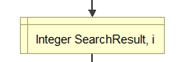
  • Assume that no value is assigned during a variable declaration.
    E.g


will not be shown as a step in the trace table.

As an example, this table has been filled to the 4th step for part a) above.

StepsizekeySearchResulti
110   
2 300  
3  -1 
4   0
 5    
Example trace table

Updates

2022/02/03 –

Added introductory paragraph: “In a linear search, each …… is returned (e.g. -1)”

Added heading “linear search algorithm…..”

© 2020  Vedesh Kungebeharry. All rights reserved.