
Semantic analysis checks that the code makes programmatic sense by making sure that variables , constructs, and expression are used in a correct way according with the programming language’s rules.
This is accomplished by using the parse tree ( generated from syntax analysis) and a symbol table to perform semantic checks.
Symbol Tables
A symbol (identifier) table is generated during semantic analysis which stores the attributes of each identifier including:
- name,
- datatype ,
- Scope: where in the source code it was declared (Global or within functions)
For example, for the line of code below,
x = 150;
the following table entry may be generated:
| Identifier | Type | Value | Memory Location | Scope |
| x | int | 150 | 0x1001 | Global |
Note that in practice, symbol tables may store more metadata – we have simplified the concept for easy understanding.
Symbol Table Example With A Full Program
Code
#include <stdio.h>

float PI = 3.14159265359;  // Define PI as a variable
//function declaration was omitted for simplicity.
float calculateArea(float radius) {
    return PI * radius * radius;
}

int main() {
    float radius;

    printf("Enter the radius of the circle: ");
    scanf("%f", &radius);

    float area = calculateArea(radius);

    printf("The area of the circle with radius %.2f is %.2f\n", radius, area);

    return 0;
}
Symbol Table
The following simplified symbol table is generated:
| Identifier | Type | Value | Memory Location | Scope |
| PI | float | 3.14159265359 | 0x1001 | Global |
| calculateArea | float() | Global | ||
| main | int() | Global | ||
| radius | float | 0x1002 | main | |
| area | float | 0x1003 | main |
Taking an overview in order to perform these checks, we observer some facts of compiler design:
- All parse trees and symbol tables are checked to see if they obey the rules of the language.
- There are rules for the structure of the parse tree;
- There are rules for the symbol table.
- Together, these rules enforce the semantic rules of the language.
In this set of examples , we consider a hypothetical compiler of our own design.
Recall the parse tree generated from example 1:
Line 1: Real D,b,a,c;
Line 2: D= b*b – 4*a*c;
The tokens making up the line 2 (shown below)….
| D | = | b | * | b | – | 4 | * | a | * | c | ; |
…will generate the following tree:

Example 2 – Check Symbol Tables for consistency
It is worth noting that another possible semantic check would be to see if all token identifiers have been declared. In our case for example 1:
Line 1: Real D,b,a,c;
Line 2: D= bb – 4*a*c;
we see that our typo could have seen our tokens read as
| D | = | bb | – | 4 | * | a | * | c | ; |
At this stage, we should be able to check that each token was declared. In this case , when we check our symbol table and see that it was not declared. The compiler can now record an error for this line stating that bb was not declared.
Example 3 – Check Parse tree for invalid operands (Type Mismatch)
Consider the following code:
Line 1: Real D,b,a,c
Line 2: D= “Fred”
Line 2 produces tokens:
| D | = | “Fred” |
Which produces the tree :
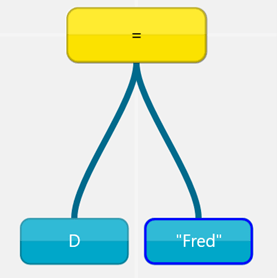
Note that D is of type real. We could implement a new rule for our compiler:
All child nodes on the same level must have the same data type found in the symbol table.
Thus after checking our tree , we can record a type mismatch error for our current line.
Symbol Table and Parse Tree Analysis Summary
- All symbol tables and trees are checked for rules which identify violation of rules in our source language.
- Every time an error is found, its line location is recorded with an appropriate message.
- After all symbols and trees are checked, generate a list of errors and stop compilation.
- If no errors were recorded, move on to the next step: Intermediate code generation
© 2024 Vedesh Kungebeharry. All rights reserved.
 Island Class