Great animation and games start with a great story. Story development is the process of turning a simple idea into a complete story with characters, a plot and a setting. A script is the written version of that story: it describes what happens and what the characters say, so the whole team can build it.
Steps in story development
- Idea (premise) – a one-sentence summary. For example: “A shy steelpan player must win a competition to save her community centre.”
- Research – learn about the setting, the culture and anything else your story needs.
- Characters – decide who the main character (protagonist) is, what they want, and who or what stands in their way (the antagonist).
- Outline – list the main events from beginning to end.
- Script – write the scenes, actions and dialogue.
- Storyboard – draw the key shots in order.
- Review and revise – share it, get feedback and improve it.
Basic storyboarding
A storyboard is a sequence of drawings, like a comic strip, that shows each shot of an animation or each key moment of a game’s story. Under each frame you add notes about action, dialogue, sound and camera movement. Stick figures are fine: a storyboard is for planning, not for final art. See also: Storyboards – Professional Video Creation (Part 1).

The story arc
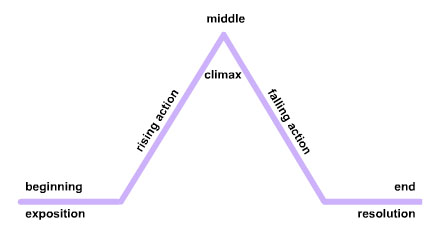
A story arc is the shape of a story from beginning to end. A common version, often drawn as a mountain, has five parts:
- Exposition – introduces the characters, setting and normal life.
- Rising action – a problem appears and things get more difficult.
- Climax – the most exciting or important moment, the turning point.
- Falling action – the results of the climax play out.
- Resolution – the problem is solved and a new normal begins.
Creative writing concepts
- Show, don’t tell – in a visual medium, show a character’s feelings through actions and expressions instead of explaining them.
- Conflict – every story needs a problem. No conflict, no story.
- Theme – the big idea behind the story, such as friendship or courage.
- Point of view and voice – whose eyes do we see the story through, and how do they speak?
Character development
Character development means creating believable characters and showing how they change during the story (their character arc). A simple character profile lists the character’s name, age, appearance, personality, goal, fear and strengths and weaknesses. Artists then draw a model sheet showing the character from different angles so everyone draws them the same way.

Script format: animation vs games
| Animation script | Game script |
| Follows one fixed order of scenes, from start to finish. | Can branch: the player’s choices may lead to different scenes and endings. |
| Written in screenplay format: scene heading (e.g. EXT. BEACH – DAY), action lines, character name and dialogue. | Often written in spreadsheets or special tools, with an ID for each line, the character, the dialogue and the condition that triggers it. |
| Action lines describe movement and expressions in detail because everything must be drawn or animated. | Includes cutscenes, in-game dialogue, short reactions (sometimes called “barks”), tutorial text and item descriptions. |
| One script leads to one storyboard and one finished film. | Must work together with the gameplay, level design and programming. |
A short animation script might look like this:
EXT. BEACH – SUNSETMAYA (12) drags a heavy steelpan across the sand. She stops and wipes her forehead.MAYA: One more practice. Just one.
For more on scripts, see The Video Script – Professional Video Creation (Part 4).
Example
Premise: “A young turtle must clean her polluted reef before the big storm.” Exposition: the turtle’s happy home. Rising action: plastic appears and fish get trapped. Climax: she frees the largest fish from a net as the storm arrives. Falling action: the fish help her. Resolution: the reef is clean. In the game version, the player could choose whether to fight the net or find a clever way around it, leading to two different scenes.
Watch the video below from Pixar in a Box by Khan Academy to learn more about story structure:
Exercise
- List the steps of story development in order.
- Write a one-sentence premise for a short animation, then plan it with the five parts of a story arc.
- Create a character profile and a simple three-view model sheet for your main character.
- Draw a six-frame storyboard for the opening of your story and write a half-page script for the same scene in screenplay format.
Syllabus link: This post is relevant to the CAPE® Animation and Game Design Syllabus, Unit 1: Fundamentals of Animation and Game Design, Module 2: Drawing and Layout – Specific Objective 8 (“identify the steps used for story development”); Specific Objective 9 (“apply concepts to design a script for animation and game design”).
Attributions to media used in this post:
Storyboard – Iván López Fuente.jpg – Iván López Fuente – CC BY-SA 4.0 (via Wikimedia Commons)

Plotmountain.jpg – Kaede4 – Public domain (via Wikimedia Commons)

Character Sintel-model-sheet.png – David Revoy / Blender Foundation – CC BY 3.0 (via Wikimedia Commons)

© 2026 Vedesh Kungebeharry. All rights reserved.
[…] Story Development and Scriptwriting we turned an idea into a premise. In this post you will turn a premise into a synopsis and a pitch […]
[…] basics of storyboarding were covered in Story Development and Scriptwriting and in Storyboards – Professional Video Creation (Part 1). This post focuses on the […]
[…] Story Development and Scriptwriting we met the basic “plot mountain”. This post compares three structures in practice, the […]
[…] lesson builds on three Unit 1 posts: Story Arcs: Five-Point, Eight-Point and Three-Act Structure, Story Development and Scriptwriting for Animation and Games and Storyboarding, Camera Angles and Shots. If you have not read them, start there. Here we focus […]
[…] story-building basics, see Story Development and Scriptwriting for Animation and Games and Story Arcs, Game Scripts and Storyboards for Interactive […]