Character design for games is the process of creating the look, proportions, movement and personality of the characters players control and meet. To design believable characters for different genres, artists study life drawing (drawing real people from observation), the skeleton (the framework of bones and joints), the muscle system (the muscles that shape and move the body) and facial character theory (how faces show emotion and personality).
Unit 1 introduced shape language and silhouettes in Character Design: Genre, Shape Language and Silhouette and gesture drawing in Motion and Figure Drawing for Animation and Games. This lesson goes under the skin: anatomy knowledge is what lets you exaggerate a character convincingly.
Designing for different genres
| Genre | Typical proportions and style | Why |
| Platformer / family | Big head (2–4 heads tall), large eyes, simple shapes, bright colours. | Readable at small sizes; appealing and expressive. |
| Action-adventure | Heroic proportions (7.5–8 heads tall), strong silhouette, clear gear. | Looks capable; poses and costume show abilities. |
| RPG | Varied body types and costumes that show class and culture. | Players must tell classes and factions apart instantly. |
| Puzzle / casual | Very simple, often non-human mascots. | Characters should support, not distract from, the puzzle. |
| Sports / simulation | Realistic proportions and motion. | Players expect believable bodies and movement. |
1. Life drawing
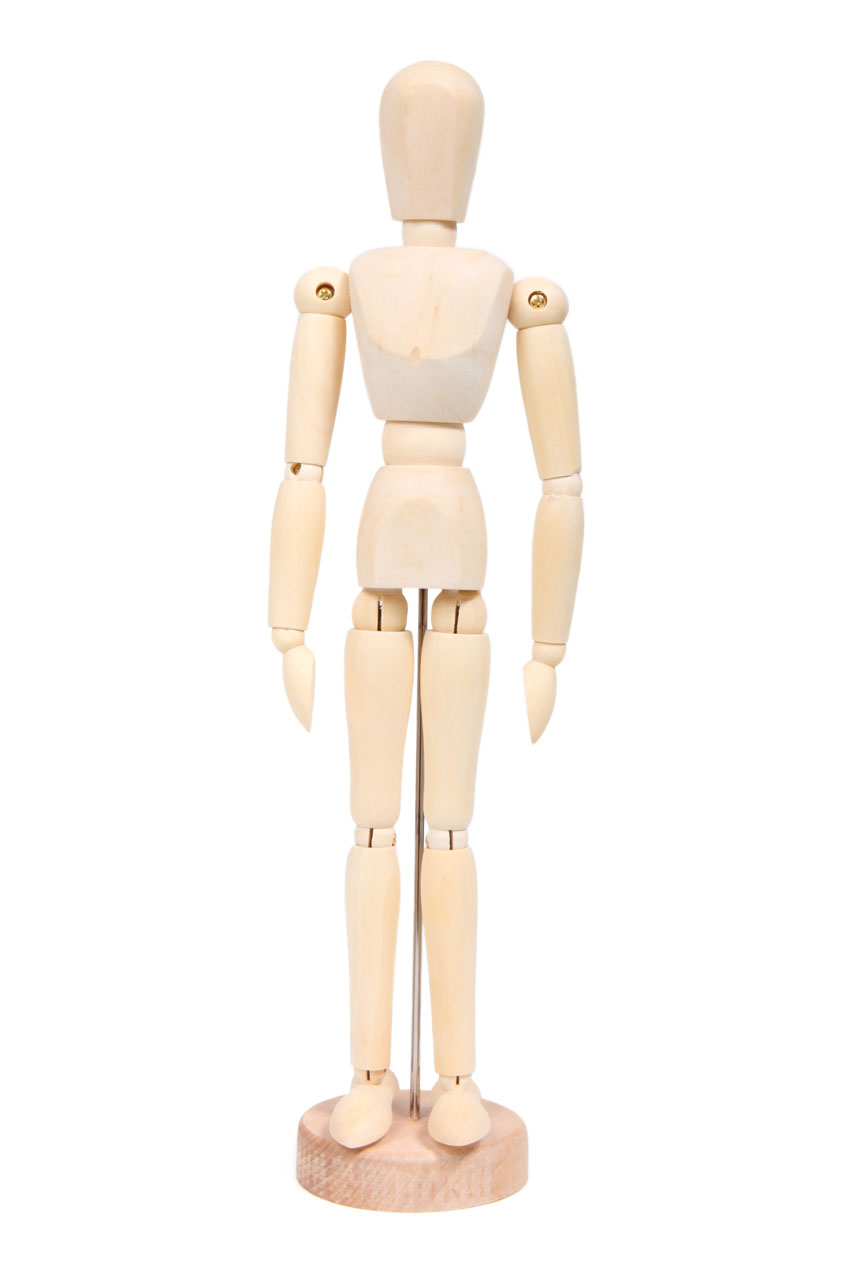
Life drawing means drawing the human figure from real observation. For school and home practice, draw clothed classmates or family members in short poses, people in public places, athletes on TV, or a wooden artist’s mannequin. Start with quick 30-second to 2-minute gesture drawings to capture movement, then longer drawings to study proportions. A common measuring unit is the head: an average adult is about 7.5 heads tall, the halfway point is near the hips, and the elbows line up with the waist.
2. The skeleton
The skeleton sets proportions and decides where the body can bend. Artists do not need every bone name, but should know the main masses and joints: the skull, rib cage and pelvis (the three big masses), the spine that links them, and the joints at the shoulders, elbows, wrists, hips, knees and ankles. In 3D games, animators build a digital rig – a simplified skeleton of “bones” – inside the character model to move it, so knowing where real joints sit prevents rubbery, unnatural bends.

3. The muscle system
Muscles sit over the skeleton and create the body’s surface shapes. Key groups to learn are the shoulders (deltoids), chest (pectorals), upper arms (biceps and triceps), back, stomach (abdominals), thighs (quadriceps and hamstrings) and calves. Muscles contract (shorten and bulge) and stretch as the body moves, which is why a bent arm looks different from a straight one. Game artists exaggerate muscles to show strength (a heavy brawler) or simplify them for a friendly cartoon look.
4. Facial character theory
Facial character theory is the study of how faces communicate emotion and personality. Research by psychologist Paul Ekman suggests that some basic expressions – happiness, sadness, anger, fear, surprise and disgust – are recognised across many cultures. Three zones do most of the work: the eyebrows (the most expressive feature), the eyes and eyelids, and the mouth. Muscles around the eyes and mouth pull these features into each expression.


Personality shows too: a character who often raises one eyebrow seems sceptical; one with soft, rounded features and wide eyes seems innocent. Designers create an expression sheet showing the character’s key emotions so all artists and animators draw them consistently.
Disney animator Aaron Blaise demonstrates how to draw simple, clear facial expressions:
Example
A student designs the same fisher character for two genres. For a family platformer, she is 3 heads tall with a round body, huge eyes, a bright yellow raincoat and simple muscle shapes; her expression sheet exaggerates joy and surprise. For an action-adventure, she is 7.5 heads tall with realistic proportions based on life drawings of a classmate in a raincoat; the student checks joint positions against a skeleton reference so her rope-throwing pose bends at the right points, and adds defined shoulder and forearm muscles to show years of hauling nets.
Exercise
- Do ten 1-minute gesture drawings of clothed people or a wooden mannequin, then one 10-minute drawing measured in head units.
- Draw a simplified skeleton (skull, rib cage, pelvis, spine and limb joints) in three action poses.
- Draw the same arm straight and bent. Show how the biceps and triceps change shape.
- Create an expression sheet for a game character showing the six basic emotions, then redesign the character for a different genre.
Next: Creating Game Environments: Layout, Composition, Colour and Foreground–Midground–Background Layers
Syllabus link: This post is relevant to the CAPE® Animation and Game Design Syllabus, Unit 2: Interactive Design and Game Development, Module 3: Animation for Games – Specific Objective 3 (“employ design skills to create characters for different genres of games”).
Attributions to media used in this post:
Wooden Mannequin.jpg – Petr Kratochvil – CC0 (via Wikimedia Commons)

Human skeleton; front and back views. Coloured line engravin Wellcome V0008004.jpg – Wellcome Collection – CC BY 4.0 (via Wikimedia Commons)

1106 Front and Side Views of the Muscles of Facial Expressions numbered.jpg – CNX Anatomy 2013 – CC BY 4.0 (via Wikimedia Commons)

Facial expressions – The Cartoonist's Art.jpg – J. Campbell Cory – Public domain (via Wikimedia Commons)

© 2026 Vedesh Kungebeharry. All rights reserved.