Designing Game Characters for Different Genres: Life Drawing, Skeleton, Muscles and Facial Expressions

Character design for games is the process of creating the look, proportions, movement and personality of the characters players control and meet. To design believable characters for different genres, artists study life drawing (drawing real people from observation), the skeleton (the framework of bones and joints), the muscle system (the muscles that shape and move the body) and facial character theory (how faces show emotion and personality).

Unit 1 introduced shape language and silhouettes in Character Design: Genre, Shape Language and Silhouette and gesture drawing in Motion and Figure Drawing for Animation and Games. This lesson goes under the skin: anatomy knowledge is what lets you exaggerate a character convincingly.

Designing for different genres

GenreTypical proportions and styleWhy
Platformer / familyBig head (2–4 heads tall), large eyes, simple shapes, bright colours.Readable at small sizes; appealing and expressive.
Action-adventureHeroic proportions (7.5–8 heads tall), strong silhouette, clear gear.Looks capable; poses and costume show abilities.
RPGVaried body types and costumes that show class and culture.Players must tell classes and factions apart instantly.
Puzzle / casualVery simple, often non-human mascots.Characters should support, not distract from, the puzzle.
Sports / simulationRealistic proportions and motion.Players expect believable bodies and movement.

1. Life drawing

Life drawing means drawing the human figure from real observation. For school and home practice, draw clothed classmates or family members in short poses, people in public places, athletes on TV, or a wooden artist’s mannequin. Start with quick 30-second to 2-minute gesture drawings to capture movement, then longer drawings to study proportions. A common measuring unit is the head: an average adult is about 7.5 heads tall, the halfway point is near the hips, and the elbows line up with the waist.
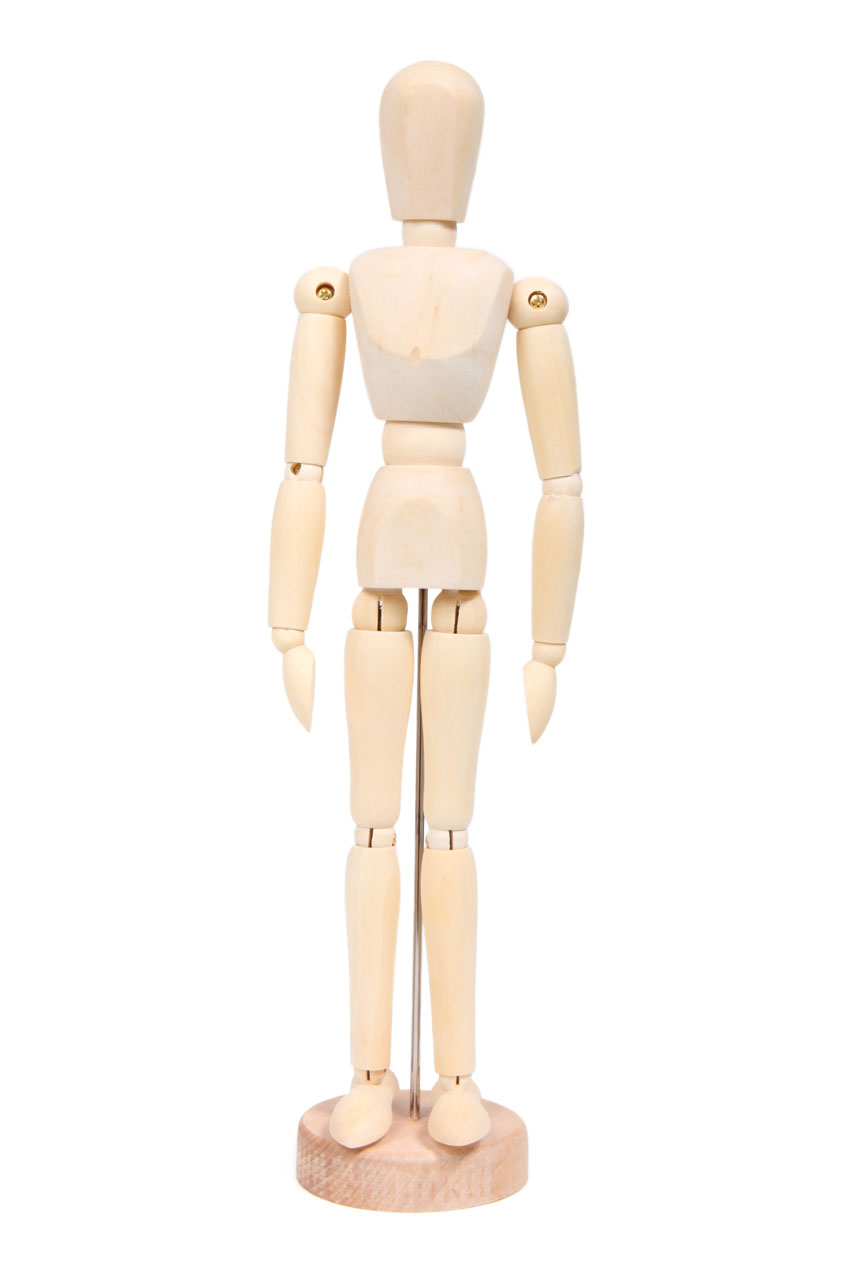
Light wooden artist’s mannequin standing upright
Figure 1 – An artist’s wooden mannequin. Its jointed limbs can be posed to study proportions and the angles of the body. Image: Petr Kratochvil, CC0, via Wikimedia Commons.

2. The skeleton

The skeleton sets proportions and decides where the body can bend. Artists do not need every bone name, but should know the main masses and joints: the skull, rib cage and pelvis (the three big masses), the spine that links them, and the joints at the shoulders, elbows, wrists, hips, knees and ankles. In 3D games, animators build a digital rig – a simplified skeleton of “bones” – inside the character model to move it, so knowing where real joints sit prevents rubbery, unnatural bends.

Historical engraving of two human skeletons seen from the front and the back
Figure 2 – Front and back views of the human skeleton (historical engraving). Notice the three big masses – skull, rib cage and pelvis – linked by the spine. Image: Wellcome Collection, CC BY 4.0, via Wikimedia Commons.

3. The muscle system

Muscles sit over the skeleton and create the body’s surface shapes. Key groups to learn are the shoulders (deltoids), chest (pectorals), upper arms (biceps and triceps), back, stomach (abdominals), thighs (quadriceps and hamstrings) and calves. Muscles contract (shorten and bulge) and stretch as the body moves, which is why a bent arm looks different from a straight one. Game artists exaggerate muscles to show strength (a heavy brawler) or simplify them for a friendly cartoon look.

4. Facial character theory

Facial character theory is the study of how faces communicate emotion and personality. Research by psychologist Paul Ekman suggests that some basic expressions – happiness, sadness, anger, fear, surprise and disgust – are recognised across many cultures. Three zones do most of the work: the eyebrows (the most expressive feature), the eyes and eyelids, and the mouth. Muscles around the eyes and mouth pull these features into each expression.

Medical illustration of the face showing numbered muscles around the forehead, eyes, cheeks and mouth
Figure 3 – Front and side views of the muscles of facial expression. Knowing where these muscles pull helps artists draw believable expressions. Image: CNX Anatomy 2013, CC BY 4.0, via Wikimedia Commons.
Sheet of black-and-white cartoon faces showing different expressions
Figure 4 – A page of cartoon facial expressions from J. Campbell Cory’s 1912 guide The Cartoonist’s Art. Cartoonists exaggerate the eyebrows, eyes and mouth so each emotion reads instantly. Image: J. Campbell Cory, Public domain, via Wikimedia Commons.

Personality shows too: a character who often raises one eyebrow seems sceptical; one with soft, rounded features and wide eyes seems innocent. Designers create an expression sheet showing the character’s key emotions so all artists and animators draw them consistently.

Disney animator Aaron Blaise demonstrates how to draw simple, clear facial expressions:

Example

A student designs the same fisher character for two genres. For a family platformer, she is 3 heads tall with a round body, huge eyes, a bright yellow raincoat and simple muscle shapes; her expression sheet exaggerates joy and surprise. For an action-adventure, she is 7.5 heads tall with realistic proportions based on life drawings of a classmate in a raincoat; the student checks joint positions against a skeleton reference so her rope-throwing pose bends at the right points, and adds defined shoulder and forearm muscles to show years of hauling nets.

Exercise

  1. Do ten 1-minute gesture drawings of clothed people or a wooden mannequin, then one 10-minute drawing measured in head units.
  2. Draw a simplified skeleton (skull, rib cage, pelvis, spine and limb joints) in three action poses.
  3. Draw the same arm straight and bent. Show how the biceps and triceps change shape.
  4. Create an expression sheet for a game character showing the six basic emotions, then redesign the character for a different genre.

Next: Creating Game Environments: Layout, Composition, Colour and Foreground–Midground–Background Layers

Syllabus link: This post is relevant to the CAPE® Animation and Game Design Syllabus, Unit 2: Interactive Design and Game Development, Module 3: Animation for Games – Specific Objective 3 (“employ design skills to create characters for different genres of games”).

Attributions to media used in this post:

Wooden Mannequin.jpg – Petr Kratochvil – CC0 (via Wikimedia Commons)

Human skeleton; front and back views. Coloured line engravin Wellcome V0008004.jpg – Wellcome Collection – CC BY 4.0 (via Wikimedia Commons)

1106 Front and Side Views of the Muscles of Facial Expressions numbered.jpg – CNX Anatomy 2013 – CC BY 4.0 (via Wikimedia Commons)

Facial expressions – The Cartoonist's Art.jpg – J. Campbell Cory – Public domain (via Wikimedia Commons)

© 2026 Vedesh Kungebeharry. All rights reserved.

Characters and Environments in Games: Archetypes, Scale, Time of Day and Camera

Game characters are the imaginary people, creatures or objects that players control, meet, help or fight. They are shaped by character design (how they look, move and behave) and by character archetypes – familiar story roles such as the hero, shadow, mentor, ally, guardian, trickster and herald. The game environment is the world those characters exist in, described by its scale, time of day, physical characteristics and camera view.

Visual character design was covered in Character Design: Genre, Shape Language and Silhouette and Character Turnarounds and Model Sheets; environment art in Environment Design, Genres and Digital Artwork and Conceptualising Environments: Layers and Depth of Field. Here we look at the role characters and environments play in a game’s design.

Character design for games

Game characters must work in ways film characters do not:

  • Readability: they must be recognisable at small sizes and in fast motion, so silhouettes and colours must be clear.
  • Gameplay fit: a heavy character should move heavily; a speedy character should look light. Appearance should hint at abilities.
  • Animation needs: every character needs a set of animations (idle, walk, run, jump, react), so designs should be practical to animate.
  • Player connection: a player character may be a blank slate the player projects onto, or a strong personality the player accompanies.

The seven character archetypes

Archetypes come from Joseph Campbell’s study of myths and Christopher Vogler’s The Writer’s Journey. They are roles, not fixed personalities – one character can play different roles at different times.

ArchetypeRole in the storyGame example of the role
Hero / protagonistThe main character who grows and drives the story; usually the player.The player character setting out to save the kingdom.
Shadow / villain / antagonistOpposes the hero and represents the main conflict.The final boss or a rival.
MentorGuides, teaches and gives gifts or advice to the hero.The tutorial character who explains the controls and gives the first tool.
AllyHelps the hero on the journey, offering friendship and support.A companion who fights alongside the player or gives hints.
Guardian (threshold guardian)Blocks the way and tests the hero before a new stage.A gatekeeper or mini-boss who must be beaten or convinced.
TricksterBrings humour, mischief and change; questions the rules.A cheeky sidekick or a folklore figure like Anansi.
HeraldAnnounces change and calls the hero to adventure.A messenger, letter or radio call that starts the quest.

Screenwriting teacher Christopher Vogler explains these character types in this interview:

Cartoon rabbit standing in a sunny forest clearing
Figure 1 – Big Buck Bunny in his forest. Scale (a big, round rabbit dwarfed by even bigger trees), time of day (soft daylight filtering through the leaves) and physical characteristics (grass, rocks, roots and tree trunks) all shape how the scene feels. Image: Blender Foundation / Project Peach, CC BY 3.0, via Wikimedia Commons.

Describing the game environment

Scale

Scale is the size of the world and objects compared to the player. Huge spaces make players feel small and adventurous; tight spaces feel tense or cosy. Scale also affects gameplay: a large open map needs fast travel or vehicles, while a small room suits a puzzle.

Time of day

Time of day changes light, colour and mood. Morning feels hopeful, midday is clear and easy to read, sunset is dramatic and night is mysterious. Some games have a day–night cycle that changes gameplay: certain characters appear only at night, or shops close in the evening.

Physical characteristics

Physical characteristics are the features of the place: terrain (hills, water, sand), weather, vegetation, buildings, materials and hazards. They should support both story and play – ice is slippery, deep water blocks the path, tall grass hides the player.

Camera view

The camera view decides how the environment is shown. A top-down view shows layout and routes; a side view emphasises jumping and height; a first-person view makes the world feel immediate. Environment artists design differently for each view – for example, the roofs matter a lot in top-down games but hardly at all in side-scrollers.

Painted concept art of a wooden hut surrounded by plants and props
Figure 2 – Concept art of a shaman’s hut. The physical characteristics – building materials, props and plants – tell players about the culture of the people who live there. Image: David Revoy / Blender Foundation, CC BY 3.0, via Wikimedia Commons.

Example

Here is a character and environment description for an adventure game called River of Lights:

  • Hero: Kai, a 12-year-old boat builder; small, quick and curious, with a bright red scarf for readability.
  • Mentor: Grandma Mira, who teaches Kai to read the stars.
  • Herald: a glowing firefly that appears on the first night and leads Kai away from the village.
  • Guardian: a giant river turtle who will only let Kai pass after solving her riddle.
  • Trickster: a mischievous monkey who steals items but sometimes reveals shortcuts.
  • Shadow: the Mist, a silent force that dims all light along the river.
  • Environment: a wide river valley (large scale), explored mostly at dusk and night (time of day), with mangroves, rapids and stilt houses (physical characteristics), shown from a third-person camera behind the boat (camera view).

Exercise

  1. Identify the seven archetypes in a game, film or folk tale you know. Is any character playing more than one role?
  2. Design a game character. Draw it and explain how its appearance tells players about its abilities and its archetype.
  3. Describe the environment of a game level using the four headings: scale, time of day, physical characteristics and camera view.
  4. Change one of those four features for the same level (for example, day to night). Explain how the gameplay and mood would change.

Next: The Game UI Design Process and How to Tell Good UI From Bad UI

Syllabus link: This post is relevant to the CAPE® Animation and Game Design Syllabus, Unit 2: Interactive Design and Game Development, Module 2: Game Design and Development – Specific Objective 12 (“describe the characters in a game”); Specific Objective 13 (“describe the environment in a game”).

Attributions to media used in this post:

Big Buck Bunny – forest.jpg – Blender Foundation / Project Peach – CC BY 3.0 (via Wikimedia Commons)

Environments-02-shaman-hut.png – David Revoy / Blender Foundation – CC BY 3.0 (via Wikimedia Commons)

© 2026 Vedesh Kungebeharry. All rights reserved.

Character Design for Different Genres: Shape Language, Silhouette, Colour, Props and Abilities

Character design is the process of creating how a character looks, moves and behaves so the audience understands who they are at a glance. Character theory is the set of ideas that explain why some designs communicate better than others, such as archetypes, shape language and silhouette. A good design also suits its genre: a hero for a pre-school game looks very different from a hero for a science-fiction adventure.

For anatomy and figure drawing, see Motion and Figure Drawing for Animation and Games. For characters inspired by folklore, see Folklore, Culture and Heritage in Animation and Game Design. This post is about design principles and genre.

Start with the role, not the drawing

Before sketching, decide what the character does in the story or game:

  • Archetype – a familiar role such as the hero, mentor, sidekick, trickster, guardian or villain. Archetypes help audiences understand a character quickly; your job is to add something fresh.
  • Personality – three key traits, a goal and a flaw.
  • Function in a game – player character, non-player character (NPC), enemy or boss. A game character’s abilities (jump, fly, climb, heal) must match the gameplay, and its design should hint at them.

Character design principles

Shape language

Shape language means using basic shapes to suggest personality:

  • Circles – soft, friendly, playful and safe. Common for young, cute or kind characters.
  • Squares and rectangles – solid, strong, stable and dependable, like a loyal protector.
  • Triangles – sharp, energetic, dynamic or dangerous. Pointing upwards they can suggest confidence; pointing downwards they can suggest menace.

Most designs mix shapes, with one shape in charge.

Cartoon mushroom creature with a big round red and white cap, large eyes and a wide smile
Figure 1 – Concept art of a mushroom sprite for the open movie Sprite Fright. Round shapes, big eyes and an oversized head make the character look small and friendly.

Silhouette

A strong character is recognisable even when filled in solid black. Test your design by filling the outline: can you still tell who it is and what they are doing? A clear silhouette is essential in games, where characters are often small on screen and must be recognised instantly.

Colourful cartoon character with green hair and sunglasses shown in several views, with black silhouettes below
Figure 2 – A character design sheet showing the character from several angles, a large action pose and, bottom left, black silhouettes used to check that the design reads clearly.

Proportion and exaggeration

Changing proportions changes how we read a character. Big heads, big eyes and short limbs look young and cute; long legs and a small head look elegant or powerful; a huge upper body looks strong. Decide how stylised your world is and keep every character in that style.

Colour

Choose a small palette of three to five main colours. Bright, saturated, warm colours feel cheerful and energetic; muted or cool colours feel calm, serious or mysterious. Make sure the character stands out against the backgrounds it will appear on (see Colour Theory, Texture, Composition and Layout). Remember that colour meanings vary between cultures.

Costume, props and abilities

Props (objects a character carries) and costumes tell us about a character’s job, culture and history. In games, a prop often shows an ability: a staff for magic, boots for speed, a lantern for exploring dark caves.

Sketch of a girl in winter clothes holding a tall carved staff, next to a small scruffy dog
Figure 3 – Concept art of Spring and her dog Autumn from the open movie Spring. Her tall staff is a prop that becomes part of her identity.

Designing for genre

Genre and audienceTypical design choices
Pre-school and young childrenRound shapes, big heads and eyes, bright friendly colours, simple silhouettes, no scary details.
Platformer and action-adventureClear silhouette, dynamic poses, one or two bold colours, visible abilities.
Fantasy and role-playingCostumes, armour and props that show class and culture; detailed but readable designs.
Science fictionTechnology built into costumes, clean geometric shapes, glowing accents.
ComedyStrong exaggeration, stretchy proportions and very expressive faces.
Horror (for older audiences)Unsettling proportions, sharp shapes, dark or desaturated colours.

Example

Brief: a hero for an adventure game for pre-schoolers (ages 3–5). Trinidad and Tobago is often called the “land of the hummingbird”, so the hero is Zuzu the Hummingbird.

  • Shapes – a round body and head (friendly), with a small triangular beak and tail so she still looks quick.
  • Proportion – a very large head and eyes for a cute, young look.
  • Colour – bright emerald green with a warm orange scarf that stands out against green forests.
  • Prop – a flower-petal backpack that carries seeds.
  • Special abilities – Hover (to reach high flowers), Zoom (a quick dash) and Seed Sprout (plants a seed that grows into a bridge or ladder).
  • Genre fit – Zuzu solves problems by helping and growing things, never by fighting, which suits young children.

Watch this video from Winged Canvas to see how studios use shape language:

Exercise

  1. Explain, with three examples from animations or games you know, how a character’s design matches its genre.
  2. Draw a simple character, then redesign it for two different genres. Label what changed (shapes, proportions, colour, props).
  3. Group activity: design a hero for a pre-schoolers’ adventure game. Write a short profile, draw six thumbnail silhouettes and choose the clearest one.
  4. Develop your chosen design with a colour palette, a prop and at least two special abilities. Label how each ability is used in the game.
  5. Keep your design. You will create a turnaround for it in the next lesson.

Next: How to Draw a Character Turnaround: Model Sheets, Views and Consistent Proportions

Syllabus link: This post is relevant to the CAPE® Animation and Game Design Syllabus, Unit 1: Fundamentals of Animation and Game Design, Module 3: Story and Character Development – Specific Objective 4 (“explain character design as it relates to genre”); Specific Objective 5 (“design genre-appropriate characters”).

Attributions to media used in this post:

Sprite Fright-concept art-sprite 01.jpg – Ricky Nierva / Blender Foundation – CC BY 4.0 (via Wikimedia Commons)

Fig. Character Design Model Sheet A (cc) 2017 01.jpg – Guilherme Silveira Dias – CC BY-SA 4.0 (via Wikimedia Commons)

Spring-concept art-Spring and Autumn 01.jpg – Blender Foundation (Spring open movie; uploaded by David Revoy) – CC BY 4.0 (via Wikimedia Commons)

© 2026 Vedesh Kungebeharry. All rights reserved.