Directed Numbers: Negative Numbers on the Number Line, Adding and Subtracting

On a cold morning in Canada the temperature might be 7 degrees below zero. A diver might be 20 metres below sea level. A bank account can be overdrawn by $50. To describe amounts like these, we use numbers with a direction: positive numbers (above zero) and negative numbers (below zero). Together they are called directed numbers. In this lesson you will place them on a number line, put them in order, and add and subtract them.

What are directed numbers?

A negative number is written with a minus sign in front: −7 (“negative seven”). A positive number can be written with a plus sign, +7, or just as 7. Zero is neither positive nor negative. Directed numbers describe opposites:

SituationPositiveNegative
Temperatureabove 0 °Cbelow 0 °C
Heightabove sea levelbelow sea level
Moneya deposit or profita withdrawal, debt or loss
Floors in a buildingabove the ground floorbasement levels
Footballgoals scoredgoals conceded
Lift buttons labelled 3, 2, 1, 0 and −1, −2
Figure 1 – Lift buttons in a hotel: 0 is the ground (exit) floor, and −1 and −2 are basement levels below it. Image: Tony Webster from Minneapolis, Minnesota, United States, CC BY 2.0, via Wikimedia Commons.

Directed numbers on the number line

On a horizontal number line, positive numbers are to the right of 0 and negative numbers to the left. A thermometer is a vertical number line: up is positive and down is negative. The further right (or higher) a number is, the bigger it is. So −1 is bigger than −5, even though 5 is bigger than 1. Think of temperature: −1 °C is warmer than −5 °C.
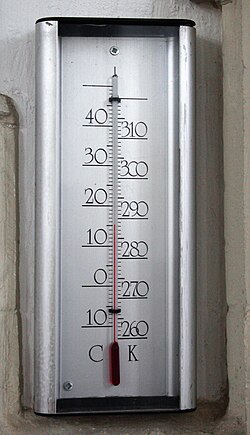
A wall thermometer with a Celsius scale running from below zero up to about 40 degrees, and a kelvin scale beside it
Figure 2 – A thermometer is a vertical number line. Readings below the 0 mark are negative temperatures. Image: Martinvl, CC BY-SA 3.0, via Wikimedia Commons.

Adding and subtracting directed numbers

Picture yourself standing on the number line, facing the positive direction:

  • Adding a positive number: move to the right. −3 + 5 = 2.
  • Subtracting a positive number: move to the left. 4 − 9 = −5.
  • Adding a negative number is the same as subtracting: −2 + (−6) = −2 − 6 = −8.
  • Subtracting a negative number is the same as adding: 3 − (−5) = 3 + 5 = 8. (Taking away a debt makes you richer!)

A handy summary: two signs next to each other that are the same (+ + or − −) become +; two different signs (+ − or − +) become −. Brackets help keep the signs clear.

TRY ITDirected numbers on a number line

Choose a starting number, add or subtract, and choose a second number (it can be negative). The arrow shows the move along the number line.

Number line from −20 to 20

Worked examples

Example 1: Temperature rise

Question: The temperature at dawn is −4 °C. By noon it has risen by 7 degrees. What is the noon temperature?

  1. Rising means adding: −4 + 7.
  2. Start at −4 and move 7 to the right: −3, −2, −1, 0, 1, 2, 3.

Answer: 3 °C.

Example 2: Subtracting past zero

Question: Work out 4 − 9.

  1. Start at 4 and move 9 to the left.
  2. 4 steps take you to 0, and 5 more take you to −5.

Answer: −5.

Example 3: Adding a negative

Question: Work out −2 + (−6).

  1. + (−) becomes −, so this is −2 − 6.
  2. Start at −2 and move 6 to the left.

Answer: −8.

Example 4: Subtracting a negative

Question: Work out −7 − (−2).

  1. − (−) becomes +, so this is −7 + 2.
  2. Start at −7 and move 2 to the right.

Answer: −5.

Example 5: Ordering

Question: Put 3, −5, 0, −1, 4, −8 in order, smallest first.

  1. Negative numbers come first; the one furthest from zero is the smallest.
  2. Then 0, then the positive numbers.

Answer: −8, −5, −1, 0, 3, 4.

Example 6: Highest and lowest

Question: The top of Mount Everest is about 8,849 m above sea level, and the shore of the Dead Sea is about 430 m below sea level (−430 m). What is the difference in height?

  1. Difference = higher − lower = 8,849 − (−430).
  2. = 8,849 + 430.

Answer: About 9,279 m.

Common mistakes

  • Thinking −8 is bigger than −2. On the number line −8 is further left, so it is smaller.
  • Ignoring the second sign. 3 − (−5) is 8, not −2.
  • Losing the minus sign in the answer when you pass zero: 4 − 9 is −5, not 5.
  • Mixing up “negative” and “subtract”. The minus sign in −5 tells you the direction; the one in 8 − 5 tells you to subtract.

Practice questions

Try these yourself first, then open each answer to check your working.

1. Write in ascending order: −2, 6, −9, 0, 1.

Show answer

−9, −2, 0, 1, 6.

2. Work out:
(a) −6 + 4
(b) 5 − 8
(c) −3 − 4
(d) −1 + (−5)
(e) 2 − (−7)
(f) −8 − (−3).

Show answer

(a) −2
(b) −3
(c) −7
(d) −6
(e) 9
(f) −5.

3. At midnight it is −3 °C. By 9 a.m. it is 8 degrees warmer. What is the temperature at 9 a.m.?

Show answer

−3 + 8 = 5 °C.

4. Ravi’s bank balance is −$35 (he is overdrawn). He pays in $50. What is his new balance?

Show answer

−35 + 50 = $15.

5. What is the difference between 2 °C and −3 °C?

Show answer

2 − (−3) = 5 degrees.

6. A diver is 15 m below sea level (−15 m). She rises 9 m, then dives 6 m. Where is she now?

Show answer

−15 + 9 − 6 = −12, so 12 m below sea level.

Quick check

1. Which is warmer, −2 °C or −10 °C?

Show answer

−2 °C.

2. What is 0 − 6?

Show answer

−6.

3. Is subtracting −4 the same as adding 4?

Show answer

Yes.

Next: Multiplying and Dividing Directed Numbers, and Substituting Them into Expressions

Curriculum link: This post is relevant to the Trinidad and Tobago National Lower Secondary (NCSE) Mathematics Curriculum – Form 1, Term 2, Strand 1.1 Number Operations and Number Theory, Topic 1.1.3 Directed Numbers – Learning Outcomes 1.1.3.1 (understanding directed numbers), 1.1.3.2 (positive and negative numbers on the number line) and 1.1.3.3 (operations on directed numbers – addition and subtraction here; multiplication and division in the next lesson).

Attributions to media used in this post:

Elevator Negative Floor Numbers in Ireland (16785350923).jpg – Tony Webster from Minneapolis, Minnesota, United States – CC BY 2.0 (via Wikimedia Commons)

CelsiusKelvinThermometer.jpg – Martinvl – CC BY-SA 3.0 (via Wikimedia Commons)

Updates

2026/10/25

– Put each lettered part of the questions and answers on its own line.

© 2026 Vedesh Kungebeharry. All rights reserved.

Fraction Problems: Adding, Subtracting, Multiplying and Dividing Fractions

Now that you can picture, name, simplify and compare fractions, it is time to calculate with them and use them to solve real problems: sharing a budget, measuring ingredients, cutting wood or working out how much of a job is left. This lesson covers finding a fraction of an amount and the four operations with fractions, then pulls them together with a simple problem-solving plan. You will need the ideas from Equivalent Fractions.

A plan for solving problems

The mathematician George Pólya suggested four steps that work for any problem:

  1. Understand – what do you know, and what are you asked to find?
  2. Plan – choose an operation or draw a diagram.
  3. Carry out the plan, showing each step.
  4. Look back – does the answer make sense? Check it another way.

A fraction of an amount

To find 35 of 40: divide by the denominator to find one fifth (40 ÷ 5 = 8), then multiply by the numerator (8 × 3 = 24). “Of” means multiply: 35 × 40 = 24.

Adding and subtracting fractions

  • If the denominators are the same, add or subtract the numerators and keep the denominator: 38 + 18 = 48 = 12.
  • If they are different, first change to equivalent fractions with a common denominator (use the LCM).
  • For mixed numbers, the safest method is to change them to improper fractions first, then change the answer back.
  • Always simplify the answer.

Multiplying and dividing fractions

  • Multiply: multiply the numerators together and the denominators together. You can cancel common factors first to keep the numbers small.
  • Divide: turn the second fraction upside down (its reciprocal) and multiply. Dividing by 38 asks “how many three-eighths fit into…?”.

Worked examples

Example 1: Adding with different denominators

Question: Work out 23 + 14.

  1. The LCM of 3 and 4 is 12.
  2. 23 = 812 and 14 = 312.
  3. 812 + 312 = 1112.

Answer: 1112.

Example 2: Subtracting

Question: Work out 56 − 14.

  1. The LCM of 6 and 4 is 12.
  2. 56 = 1012 and 14 = 312.
  3. 1012 − 312 = 712.

Answer: 712.

Example 3: Mixed numbers

Question: Work out 314 − 123.

  1. Change to improper fractions: 314 = 134 and 123 = 53.
  2. Common denominator 12: 3912 − 2012 = 1912.
  3. 1912 = 1712.

Answer: 1712. (Check: 123 + 1712 = 314.)

Example 4: Multiplying

Question: Work out 23 × 910.

  1. Cancel: 9 and 3 share a factor of 3 (9 → 3, 3 → 1); 2 and 10 share a factor of 2 (2 → 1, 10 → 5).
  2. Multiply what is left: 1 × 31 × 5 = 35.

Answer: 35.

Example 5: Dividing

Question: A jug holds 34 litre. How many 38-litre cups can it fill?

  1. Work out 34 ÷ 38 = 34 × 83.
  2. = 2412 = 2.

Answer: 2 cups.

Example 6: A word problem

Question: Keisha has $600. She spends 12 of it on rent and 13 on food. How much is left?

  1. Understand: find what is left after two fractions of $600 are spent.
  2. Plan: fraction spent = 12 + 13 = 36 + 26 = 56, so 16 is left.
  3. Carry out: 16 of $600 = 600 ÷ 6 = $100.
  4. Look back: rent $300 + food $200 + left $100 = $600. ✓

Answer: $100 is left.

Common mistakes

  • Adding the denominators. 12 + 13 is not 25; it is 56.
  • Finding a common denominator when multiplying. You do not need one – just multiply across.
  • Flipping the wrong fraction when dividing. Only the second fraction (the divisor) is turned upside down.
  • Leaving answers unsimplified or as improper fractions when a mixed number is wanted.

Practice questions

Try these yourself first, then open each answer to check your working.

1. Find 27 of 35.

Show answer

35 ÷ 7 = 5, and 5 × 2 = 10.

2. Work out 38 + 18.

Show answer

48 = 12.

3. Work out 12 + 13.

Show answer

36 + 26 = 56.

4. Work out 710 − 25.

Show answer

710 − 410 = 310.

5. Work out 112 + 214.

Show answer

64 + 94 = 154 = 334.

6. Work out 45 × 1516.

Show answer

Cancel 4 with 16 and 5 with 15: 14 × 31 = 34.

7. How many 16-hour lessons fit into 23 of an hour?

Show answer

23 ÷ 16 = 23 × 6 = 4.

8. In a class of 40, 14 walk to school and 25 come by bus. The rest come by car. What fraction come by car, and how many students is that?

Show answer

1 − 520 − 820 = 720; 720 of 40 = 14 students.

Quick check

1. What must fractions have before you add them?

Show answer

The same (common) denominator.

2. What is 12 of 12?

Show answer

14.

3. What is the reciprocal of 25?

Show answer

52.

Next: Directed Numbers: Negative Numbers on the Number Line, Adding and Subtracting

Curriculum link: This post is relevant to the Trinidad and Tobago National Lower Secondary (NCSE) Mathematics Curriculum – Form 1, Term 2, Strand 1.1 Number Operations and Number Theory, Topic 1.1.2 Fractions – Learning Outcome 1.1.2.8 (solving problems involving fractions, including with a problem-solving approach such as Pólya’s).

© 2026 Vedesh Kungebeharry. All rights reserved.

Equivalent Fractions: Simplifying, Comparing and Ordering Fractions

Cut a pizza into 2 equal halves and eat one. Now imagine the same pizza cut into 4 quarters, and you eat two. You have eaten exactly the same amount: 12 = 24. Fractions that look different but have the same value are called equivalent fractions. They are the key to simplifying fractions, comparing them and putting them in order. This lesson builds on What Are Fractions? and uses the HCF and LCM from HCF and LCM.

Making equivalent fractions

Multiply (or divide) the numerator and the denominator by the same number (not zero). The value does not change, because you are really multiplying by 22, 33 and so on, which all equal 1.

23 = 46 (× 2) = 69 (× 3) = 812 (× 4) = 1015 (× 5) …

Simplifying fractions (lowest terms)

To simplify, divide the numerator and denominator by a common factor. A fraction is in its simplest form (lowest terms) when the only common factor left is 1. The quickest way is to divide by the HCF in one step.

Comparing and ordering fractions

  • Same denominator: compare the numerators. 59 > 49.
  • Same numerator: the one with the smaller denominator is bigger (bigger pieces). 35 > 38.
  • Different denominators: change both to equivalent fractions with a common denominator (the LCM of the denominators is best), then compare the numerators.

Ascending order means smallest first; descending order means largest first. The symbols are < (is less than) and > (is greater than).

TRY ITCompare two fractions

Type two fractions. The bars show them side by side, and the steps show how a common denominator decides which is bigger.

First fraction:
Second fraction:

Fraction bars

Whole numbers and fractions

Every whole number can be written as a fraction: 5 = 51 = 102 = 153. Numbers that can be written as a ÷ b, a fraction ab where a and b are whole numbers and b is not 0, are called rational numbers. So all whole numbers are rational numbers, but not all rational numbers are whole numbers.

The fraction bar means divide, so a fraction is also the answer to a division: 3 ÷ 4 = 34 (share 3 pizzas equally among 4 people and each gets three quarters of a pizza), and 7 ÷ 3 = 73 = 213.

Worked examples

Example 1: Simplify

Question: Write 1824 in its simplest form.

  1. Find the HCF of 18 and 24: factors of 18 are 1, 2, 3, 6, 9, 18 and of 24 are 1, 2, 3, 4, 6, 8, 12, 24. The HCF is 6.
  2. Divide both by 6: 18 ÷ 6 = 3 and 24 ÷ 6 = 4.

Answer: 1824 = 34.

Example 2: Compare

Question: Which is bigger, 35 or 47?

  1. The LCM of 5 and 7 is 35.
  2. 35 = 2135 (× 7) and 47 = 2035 (× 5).
  3. 21 > 20.

Answer: 35 > 47 – but only just!

Example 3: Order

Question: Put 34, 23, 56 and 712 in ascending order.

  1. The LCM of 4, 3, 6 and 12 is 12.
  2. Convert: 34 = 912, 23 = 812, 56 = 1012, 712 stays 712.
  3. Order the numerators: 7, 8, 9, 10.

Answer: 712, 23, 34, 56.

Example 4: Division as a fraction

Question: Seven metres of ribbon are shared equally among 3 people. How much does each get?

  1. 7 ÷ 3 = 73.
  2. 7 ÷ 3 = 2 remainder 1, so 73 = 213.

Answer: 213 metres each.

Common mistakes

  • Adding instead of multiplying. 23 is not equal to 45 (adding 2 to the top and bottom changes the value).
  • Changing only one number. Whatever you do to the numerator, do to the denominator.
  • Comparing denominators only. 58 is bigger than 12, even though 8 is bigger than 2 – convert first.
  • Stopping too early when simplifying. 1218 → 69 is not finished; 69 → 23. Dividing by the HCF (6) avoids this.

Practice questions

Try these yourself first, then open each answer to check your working.

1. Fill in the missing numbers: 56 = 20? = ?24.

Show answer

Both are × 4: 2024 (the two blanks are 24 and 20).

2. Simplify 1525.

Show answer

HCF 5: 35.

3. Simplify 2842.

Show answer

HCF 14: 23.

4. Which is bigger, 58 or 35?

Show answer

In fortieths: 2540 and 2440, so 58 is bigger.

5. Write in descending order: 12, 25, 710, 34.

Show answer

In twentieths: 10, 8, 14, 15. Descending: 34, 710, 12, 25.

6. Write 4 as a fraction with denominator 6.

Show answer

246 (because 4 × 6 = 24).

7. Eleven cakes are shared equally among 4 people. How much does each person get?

Show answer

11 ÷ 4 = 114 = 234 cakes.

8. In a class of 18, 12 students walk to school. What fraction walk, in simplest form?

Show answer

1218 = 23.

Quick check

1. Are 34 and 912 equivalent?

Show answer

Yes – multiply the top and bottom of 34 by 3.

2. Is 71 a whole number?

Show answer

Yes – it equals 7.

3. What is the best common denominator for comparing 16 and 14?

Show answer

12, the LCM of 6 and 4.

Next: Fraction Problems: Adding, Subtracting, Multiplying and Dividing Fractions

Curriculum link: This post is relevant to the Trinidad and Tobago National Lower Secondary (NCSE) Mathematics Curriculum – Form 1, Term 2, Strand 1.1 Number Operations and Number Theory, Topic 1.1.2 Fractions – Learning Outcomes 1.1.2.5 (creating equivalent fractions), 1.1.2.6 (comparing and ordering fractions using equivalent fractions) and 1.1.2.7 (the relationship between rational numbers and whole numbers).

© 2026 Vedesh Kungebeharry. All rights reserved.

What Are Fractions? Numerators, Denominators, Proper and Improper Fractions and Mixed Numbers

A fraction describes part of a whole. If a cake is cut into 4 equal slices and you eat 3 of them, you have eaten 34 (three quarters) of the cake. Fractions are everywhere: half-time in a football match, a quarter of an hour, three-quarter-length sleeves, and “two-thirds of the class passed”. In this lesson you will learn what the two numbers in a fraction mean, three ways to picture a fraction, how to name fractions in words, and how to change between improper fractions and mixed numbers.

The parts of a fraction

In the fraction 34:

  • The bottom number, 4, is the denominator. It tells you how many equal parts the whole is divided into (it “names” the parts: quarters).
  • The top number, 3, is the numerator. It tells you how many of those parts you have (it “numbers” them).
  • The line between them is the fraction bar. It also means “divided by”: 34 = 3 ÷ 4.

The parts must be equal. A pizza cut into 4 pieces of different sizes is not cut into quarters.

Three ways to picture a fraction

  • Area model – shade part of a shape. A bar split into 5 equal parts with 2 shaded shows 25.
  • Linear model (number line) – split the distance from 0 to 1 into equal steps. 25 is the point 2 steps along when 0 to 1 is split into 5 steps.
  • Set model – part of a group of objects. If 8 of 12 counters are red, then 812 of the set is red (which is the same as 23).
Eleven circles, each cut into equal sectors from halves to twelfths, with one sector of each shaded green
Figure 1 – Unit fractions from 12 to 112 shown as area models. The bigger the denominator, the smaller each part. Image: Zapotz, CC0, via Wikimedia Commons.

TRY ITFraction model explorer

Change the numerator and the denominator. The same fraction is drawn three ways – as part of a shape, as a point on a number line and as part of a set – and named in words.

Area model (each bar is one whole):

Area model

Number line (linear model):

Number line

Set model (shaded counters out of groups of the denominator):

Set model

Naming fractions in words

Say the numerator as a normal number and the denominator as an ordinal word (third, fifth, tenth…), with an “s” if the numerator is more than 1. Two special names: 2 parts are halves and 4 parts are quarters (or fourths).

SymbolIn words
12one half
34three quarters
23two thirds
58five eighths
710seven tenths
1112eleven twelfths

Proper fractions, improper fractions and mixed numbers

  • A proper fraction has a numerator smaller than its denominator, such as 35. It is less than 1.
  • An improper fraction has a numerator equal to or bigger than its denominator, such as 74 or 55. It is 1 or more.
  • A mixed number is a whole number and a proper fraction together, such as 134 (“one and three quarters”).

Improper fraction → mixed number: divide the numerator by the denominator. The answer is the whole number and the remainder is the new numerator. Mixed number → improper fraction: multiply the whole number by the denominator, add the numerator, and keep the same denominator.

Worked examples

Example 1: Improper to mixed

Question: Write 175 as a mixed number.

  1. Divide: 17 ÷ 5 = 3 remainder 2 (because 3 × 5 = 15 and 17 − 15 = 2).
  2. The whole number is 3, and 2 fifths are left over.

Answer: 175 = 325.

Example 2: Mixed to improper

Question: Write 238 as an improper fraction.

  1. Each whole is 8 eighths, so 2 wholes = 2 × 8 = 16 eighths.
  2. Add the 3 eighths: 16 + 3 = 19 eighths.

Answer: 238 = 198.

Example 3: An improper fraction that is a whole number

Question: Write 124 more simply.

  1. 12 ÷ 4 = 3 with no remainder.

Answer: 124 = 3 – three whole ones.

Example 4: A set model

Question: A tray holds 12 eggs. 8 are brown. What fraction of the eggs are brown?

  1. The whole set is 12 eggs, so the denominator is 12.
  2. 8 are brown, so the numerator is 8.

Answer: 812 of the eggs are brown (you will see in the next lesson that this equals 23).

Common mistakes

  • Unequal parts. A shape cut into 4 unequal pieces does not show quarters.
  • Swapping numerator and denominator. “3 out of 4” is 34, not 43.
  • Forgetting to add the numerator when changing 238 to an improper fraction: it is 198, not 168.
  • Thinking a bigger denominator means a bigger fraction. 18 is smaller than 14 – the whole is cut into more, smaller pieces.

Practice questions

Try these yourself first, then open each answer to check your working.

1. Write “five sixths” in symbols, and 49 in words.

Show answer

56; four ninths.

2. Sort into proper fractions, improper fractions and mixed numbers: 94, 27, 312, 66, 1112.

Show answer

Proper: 27, 1112. Improper: 94, 66. Mixed: 312.

3. Write 236 as a mixed number.

Show answer

23 ÷ 6 = 3 remainder 5, so 356.

4. Write 523 as an improper fraction.

Show answer

5 × 3 + 2 = 17, so 173.

5. Write 307 as a mixed number.

Show answer

30 ÷ 7 = 4 remainder 2, so 427.

6. A bar is split into 8 equal parts and 3 are shaded. What fraction is not shaded?

Show answer

8 − 3 = 5 parts are not shaded, so 58.

7. How many eggs is 512 of a box of 12?

Show answer

12 ÷ 12 × 5 = 5 eggs.

8. On a number line from 0 to 2 split into quarters, how many steps from 0 is 134?

Show answer

134 = 74, so 7 steps.

Quick check

1. In 58, what does the 8 tell you?

Show answer

The whole is split into 8 equal parts (eighths).

2. Is 99 proper or improper?

Show answer

Improper – the numerator equals the denominator, and it is equal to 1.

3. Which is bigger: 13 or 15?

Show answer

13 – thirds are bigger pieces than fifths.

Next: Equivalent Fractions: Simplifying, Comparing and Ordering Fractions

Curriculum link: This post is relevant to the Trinidad and Tobago National Lower Secondary (NCSE) Mathematics Curriculum – Form 1, Term 2, Strand 1.1 Number Operations and Number Theory, Topic 1.1.2 Fractions – Learning Outcomes 1.1.2.1 (representing fractions with area, linear and set models), 1.1.2.2 (naming fractions in words and symbols), 1.1.2.3 (proper fractions, improper fractions and mixed numbers) and 1.1.2.4 (converting between improper fractions and mixed numbers).

Attributions to media used in this post:

Fraction Circles Shaded.png – Zapotz – CC0 (via Wikimedia Commons)

© 2026 Vedesh Kungebeharry. All rights reserved.

3D Shapes: Faces, Edges, Vertices and Nets (and How to Make a Solid From Its Net)

A solid (or 3D shape) has three dimensions: length, width and height. Boxes, tins, dice, balls and ice-cream cones are all solids. In this lesson you will describe solids by their faces, edges and vertices, sort them into groups, and learn about nets – the flat patterns that fold up to make a solid.

The faces of many solids are the polygons from Polygons and Tessellations.

Faces, edges and vertices

  • A face is a surface of the solid. It can be flat (like the side of a box) or curved (like the side of a tin).
  • An edge is a line where two faces meet.
  • A vertex (plural vertices) is a corner where edges meet. The pointed top of a cone or pyramid is called its apex.
Four coloured 3D shapes: a pink cube, a blue square-based pyramid, a dark blue cone and a purple cuboid
Figure 1 – A cube, a square-based pyramid, a cone and a cuboid. Image: MamtaRani, CC BY 4.0, via Wikimedia Commons.
SolidFacesEdgesVerticesWhat the faces are
Cube61286 equal squares
Cuboid61286 rectangles (opposite faces equal)
Triangular prism5962 triangles, 3 rectangles
Square-based pyramid5851 square, 4 triangles
Triangular pyramid (tetrahedron)4644 triangles
Cylinder3202 flat circles, 1 curved surface
Cone2111 flat circle, 1 curved surface
Sphere1001 curved surface
Table 1 – Properties of common solids. (Some textbooks say a cylinder has 3 “surfaces” and do not count curved edges; follow your teacher’s convention.)

Classifying solids

  • Polyhedra have only flat faces, which are polygons (cubes, cuboids, prisms, pyramids). Solids with curved surfaces (cylinders, cones, spheres) are not polyhedra.
  • A prism has the same shape all the way through (its cross-section), with two identical end faces joined by rectangles. It is named after its end face: triangular prism, hexagonal prism. A cuboid is a rectangular prism.
  • A pyramid has a polygon base and triangular faces that meet at an apex. It is named after its base: square-based pyramid, triangular pyramid.
  • For any prism with an n-sided end face: faces = n + 2, edges = 3n, vertices = 2n. For any pyramid with an n-sided base: faces = n + 1, edges = 2n, vertices = n + 1.
  • Euler’s rule: for every polyhedron, faces + vertices − edges = 2. Check the cube: 6 + 8 − 12 = 2 ✔. It is a great way to check your counting.

Nets of solids

A net is a flat (2D) shape that can be cut out and folded to make a solid. Open out a cereal box carefully and you will see its net. Each face of the solid appears once in the net.

SolidIts net is made of
Cube6 equal squares
Cuboid6 rectangles in 3 matching pairs
Triangular prism2 triangles and 3 rectangles
Square-based pyramid1 square with 4 triangles around it
Cylinder2 circles and 1 rectangle (the rectangle wraps around the circles exactly)
Cone1 circle and a sector (a “fan” shape cut from a larger circle)
Eleven different arrangements of six squares, each of which folds into a cube
Figure 2 – The 11 different nets of a cube. Any other arrangement of six squares will not fold into a cube. Image: BergerGießen, CC BY-SA 4.0, via Wikimedia Commons.

Not every arrangement of six squares makes a cube. A straight row of six squares does not work, and neither does a 2 × 3 block of squares – when you fold them, faces overlap and some sides are left open. A quick test: imagine folding, and make sure no two squares land on the same face.

How to make a solid from its net

  1. Draw the net accurately on card with a ruler (for a cube, use squares of side 5 cm).
  2. Add small tabs (flaps) on alternate edges so the faces can be glued together.
  3. Cut out the net, including the tabs.
  4. Score the fold lines lightly with a ruler and the back of scissors, then fold along every line.
  5. Glue or tape each tab inside the next face and hold it until it sticks.
  6. Check your solid: count its faces, edges and vertices and test Euler’s rule.

Worked examples

Example 1: Counting a hexagonal prism

Question: Find the number of faces, edges and vertices of a hexagonal prism, and check with Euler’s rule.

  1. The end faces are hexagons, so n = 6.
  2. Faces = 2 hexagons + 6 rectangles = 8. Edges = 6 + 6 + 6 = 18 (top, bottom and the sides joining them). Vertices = 6 on top + 6 on the bottom = 12.
  3. Euler’s rule: 8 + 12 − 18 = 2 ✔

Answer: 8 faces, 18 edges and 12 vertices.

Example 2: A pyramid with an octagonal base

Question: How many faces, edges and vertices does an octagonal pyramid have?

  1. Base: 1 octagon. Sides: 8 triangles. Faces = 9.
  2. Edges: 8 around the base + 8 going up to the apex = 16.
  3. Vertices: 8 around the base + 1 apex = 9.

Answer: 9 faces, 16 edges, 9 vertices (and 9 + 9 − 16 = 2 ✔).

Example 3: Card needed for a cube

Question: A net for a cube is drawn with squares of side 5 cm. What area of card does the net use (ignoring the tabs)?

  1. Each square: 5 × 5 = 25 cm2.
  2. A cube has 6 faces: 6 × 25 = 150 cm2.

Answer: 150 cm2. This is also the surface area of the cube.

Common mistakes

  • Missing hidden faces and edges. In a drawing you cannot see the back. Use a real object or a net, or the prism and pyramid rules, to count.
  • Thinking any 6 squares make a cube net. Only 11 arrangements work.
  • Mixing up faces and vertices. A square-based pyramid has 5 faces and also 5 vertices – but 8 edges.
  • Forgetting the base of a pyramid when counting faces.

Practice questions

Try these yourself first, then open each answer to check your working.

1. How many faces, edges and vertices does a triangular prism have?

Show answer

5 faces, 9 edges, 6 vertices (5 + 6 − 9 = 2 ✔).

2. A net is made of 1 square and 4 triangles. What solid does it make?

Show answer

A square-based pyramid.

3. Find the faces, edges and vertices of a pentagonal prism.

Show answer

n = 5: faces 5 + 2 = 7, edges 3 × 5 = 15, vertices 2 × 5 = 10.

4. A polyhedron has 6 faces and 12 edges. Use Euler’s rule to find its number of vertices.

Show answer

F + V − E = 2, so 6 + V − 12 = 2 and V = 8. (It could be a cube or cuboid.)

5. Describe the net of a cuboid 5 cm long, 3 cm wide and 2 cm high, and find the area of card it needs.

Show answer

Two 5 × 3 rectangles (15 cm2 each), two 5 × 2 rectangles (10 cm2 each) and two 3 × 2 rectangles (6 cm2 each). Total = 2 × (15 + 10 + 6) = 62 cm2.

6. Which solids have no vertices?

Show answer

The sphere and the cylinder. (A cone has 1 – its apex.)

Quick check

1. What is the difference between a face and an edge?

Show answer

A face is a surface; an edge is a line where two faces meet.

2. What is a net?

Show answer

A flat shape that folds up to make a solid.

3. How many different nets does a cube have?

Show answer

11.

4. Is a cylinder a polyhedron? Why?

Show answer

No – it has curved surfaces, and polyhedra have only flat polygon faces.

Next: What Are Fractions? Proper and Improper Fractions and Mixed Numbers

Curriculum link: This post is relevant to the Trinidad and Tobago National Lower Secondary (NCSE) Mathematics Curriculum – Form 1, Term 1, Strand 1.4 Geometry, Topic 1.4.1 Solids and Plane Shapes – Learning Outcomes 1.4.1.1 (classifying solids by their properties), 1.4.1.2 (drawing the net of a solid), 1.4.1.3 (creating a solid from its net) and 1.4.1.6 (solving problems involving solids and plane shapes).

Attributions to media used in this post:

3D Shapes.png – MamtaRani – CC BY 4.0 (via Wikimedia Commons)

Cube net pic.png – BergerGießen – CC BY-SA 4.0 (via Wikimedia Commons)

© 2026 Vedesh Kungebeharry. All rights reserved.

Polygons and Tessellations: Names, Properties and How to Make Tessellating Patterns

A plane shape is a flat, two-dimensional (2D) shape. A polygon is a plane shape that is closed and made only of straight sides. Triangles, squares and hexagons are polygons; a circle is not (it is curved), and an open shape with a gap is not either. In this lesson you will name and classify polygons by their properties, and then use them to make tessellations – patterns that cover a surface with no gaps and no overlaps, like floor tiles or a honeycomb.

Naming polygons

Polygons are named by their number of sides. The number of vertices (corners) is always the same as the number of sides.

SidesNameEveryday example
3trianglea slice of pizza, a warning sign
4quadrilaterala page, a door, a kite
5pentagonthe outline of a simple house shape
6hexagona cell of a honeycomb, a nut for a bolt
7heptagon
8octagona STOP sign
9nonagon
10decagon
12dodecagonthe outline of the UK £1 coin

Classifying polygons by their properties

  • A regular polygon has all sides equal and all angles equal (for example a square or an equilateral triangle). An irregular polygon does not.
  • Count the sides and vertices, look for equal sides (often marked with small dashes), right angles (marked with a small square) and parallel sides (marked with arrows).
  • A diagonal joins two vertices that are not next to each other. A polygon with n sides has n(n − 3) ÷ 2 diagonals.
  • A convex polygon has every corner pointing outwards. A concave polygon has at least one corner pointing inwards, like an arrowhead.
  • You will study triangles and quadrilaterals in much more detail in Term 2.

Tessellations

A tessellation (or tiling) is a pattern of shapes that fit together to cover a flat surface completely, with no gaps and no overlaps. You can see tessellations in floor and wall tiles, brick walls, paving stones, honeycombs, patchwork quilts, fabric and gift-wrap patterns, and in the famous tilings of the Alhambra palace in Spain.

Close-up of a honeycomb made of many six-sided wax cells fitting together
Figure 1 – Bees build honeycomb from hexagons. Hexagons tessellate with no wasted space between the cells. Image: Merdal at Turkish Wikipedia, CC BY-SA 3.0, via Wikimedia Commons.

Which shapes tessellate?

Where the corners of the shapes meet at a point, the angles must add up to exactly 360° (a full turn). The corner angle of a regular triangle is 60°, of a square 90°, of a regular pentagon 108° and of a regular hexagon 120°.

  • Equilateral triangles: 6 × 60° = 360° ✔
  • Squares: 4 × 90° = 360° ✔
  • Regular hexagons: 3 × 120° = 360° ✔
  • Regular pentagons: 3 × 10⁸° = 324°, which leaves a 36° gap, and 4 × 10⁸° = 432° overlaps ✘

So only three regular polygons tessellate on their own: the equilateral triangle, the square and the regular hexagon. These are called regular tessellations. Two or more different regular polygons can also tessellate together – for example regular octagons and squares (135° + 135° + 90° = 360°), a pattern you often see on bathroom floors. And any triangle or any quadrilateral, even an irregular one, will tessellate if you rotate copies of it.

TRY ITRegular polygon and tessellation explorer

Move the slider to change the number of sides. Then press “Try to tessellate” to see whether copies of the shape fit together with no gaps.

Regular polygon

Wall covered in colourful interlocking geometric tiles in shades of green, blue, black and white
Figure 2 – A tessellation in the Alhambra, Granada, Spain. The artist M. C. Escher sketched this tiling in 1936 and it inspired his own famous interlocking designs. Image: gruban, CC BY-SA 2.0, via Wikimedia Commons.

Make your own tessellating tile

  1. Start with a square of card (about 6 cm by 6 cm).
  2. Cut a shape (a “nibble”) out of the top edge.
  3. Slide the piece straight down – do not turn it – and tape it to the bottom edge.
  4. Do the same from the left edge to the right edge if you like.
  5. Trace around your new tile over and over, fitting each copy against the last. Colour the pattern – maybe the tiles look like fish, birds or hibiscus flowers!

This works because whatever was removed from one side is added to the opposite side, so the tiles still fit together exactly, just like the original squares.

Worked examples

Example 1: Classifying a polygon

Question: A shape has 8 equal sides and 8 equal angles. Name it and state its number of vertices and diagonals.

  1. 8 sides → octagon. Equal sides and equal angles → regular.
  2. Vertices = number of sides = 8.
  3. Diagonals = 8 × (8 − 3) ÷ 2 = 8 × 5 ÷ 2 = 20.

Answer: A regular octagon with 8 vertices and 20 diagonals.

Example 2: Why regular pentagons do not tessellate

Question: Explain why regular pentagons cannot tessellate on their own.

  1. Each corner angle of a regular pentagon is 108°.
  2. Three pentagons at a point: 3 × 10⁸° = 324°, which is less than 360°, so there is a 36° gap.
  3. Four pentagons: 4 × 10⁸° = 432°, which is more than 360°, so they overlap.

Answer: No whole number of 108° angles makes exactly 360°, so there is always a gap or an overlap.

Example 3: A tiling problem

Question: A floor measures 3 m by 2 m. How many square tiles of side 25 cm are needed to cover it?

  1. Use the same units: 3 m = 300 cm and 2 m = 200 cm.
  2. Tiles along the length: 300 ÷ 25 = 12. Tiles along the width: 200 ÷ 25 = 8.
  3. Total: 12 × 8 = 96. (Check with areas: 60,000 cm2 ÷ 625 cm2 = 96 ✔)

Answer: 96 tiles.

Common mistakes

  • Calling a circle a polygon. Polygons have only straight sides.
  • Calling every 4-sided shape a “square”. A square is one special quadrilateral; rectangles, kites and trapeziums are quadrilaterals too.
  • Thinking all regular polygons tessellate. Only triangles, squares and hexagons do on their own.
  • Leaving tiny gaps when drawing a tessellation. Every edge must meet another edge exactly.

Practice questions

Try these yourself first, then open each answer to check your working.

1. Name a polygon with
(a) 7 sides
(b) 10 sides.

Show answer

(a) heptagon
(b) decagon.

2. How many vertices does a hexagon have?

Show answer

6.

3. Which of these tessellate on their own: regular hexagon, regular pentagon, square, regular octagon, any triangle?

Show answer

Regular hexagon, square and any triangle.

4. In a square tiling, how many squares meet at each corner point, and what do their angles add up to?

Show answer

4 squares; 4 × 90° = 360°.

5. How many diagonals does a pentagon have?

Show answer

5 × (5 − 3) ÷ 2 = 5.

6. A wall 4 m wide and 3 m high is covered with square tiles of side 20 cm. How many tiles are needed?

Show answer

400 ÷ 20 = 20 tiles across and 300 ÷ 20 = 15 tiles up, so 20 × 15 = 300 tiles.

Quick check

1. What makes a shape a polygon?

Show answer

It is flat, closed and made only of straight sides.

2. What is a regular polygon?

Show answer

One with all sides equal and all angles equal.

3. What two rules must a tessellation follow?

Show answer

No gaps and no overlaps.

4. Why can hexagons tessellate?

Show answer

Three 120° corners make exactly 360° at each point.

Next: 3D Shapes: Faces, Edges, Vertices and Nets

Curriculum link: This post is relevant to the Trinidad and Tobago National Lower Secondary (NCSE) Mathematics Curriculum – Form 1, Term 1, Strand 1.4 Geometry, Topic 1.4.1 Solids and Plane Shapes – Learning Outcomes 1.4.1.4 (classifying polygons by their properties), 1.4.1.5 (creating tessellating patterns with plane shapes) and 1.4.1.6 (solving problems involving solids and plane shapes).

Attributions to media used in this post:

Honey comb.jpg – Merdal at Turkish Wikipedia – CC BY-SA 3.0 (via Wikimedia Commons)

Tassellatura alhambra.jpg – gruban – CC BY-SA 2.0 (via Wikimedia Commons)

Updates

2026/10/25

– Put each lettered part of the questions and answers on its own line.

© 2026 Vedesh Kungebeharry. All rights reserved.

Perimeter and Area: Squares, Rectangles, Triangles and Compound Shapes

Perimeter is the total distance around the outside of a shape – the length of fence needed to go around a garden, or of ribbon to go around a picture frame. It is a length, so it is measured in units such as cm, m or km. Area is the amount of surface a shape covers – how much grass, paint or tiles you need. It is measured in square units such as cm2 (square centimetres) and m2 (square metres). In this lesson you will find the perimeter and area of squares, rectangles and triangles, and the perimeter of compound (L-shaped) figures.

You will need the length conversions from Units of Measurement, and the formulas use the algebra from Introduction to Algebra.

Perimeter

To find the perimeter of any shape with straight sides, add the lengths of all the sides. For common shapes there are shortcuts:

ShapePerimeterWhy
Square with side sP = 4sFour equal sides.
Rectangle with length l and width wP = 2l + 2w = 2(l + w)Two lengths and two widths.
Triangle with sides a, b, cP = a + b + cAdd the three sides.
Any polygonAdd every sideMark each side as you add it so you do not miss one.

Area

Area tells you how many unit squares fit inside a shape. A square that is 1 cm by 1 cm has an area of 1 cm2. On a grid you can find area by counting squares. For a shape with curved or uneven edges, estimate: count the whole squares, then count each square that is half or more covered as one, and ignore squares that are less than half covered.

  • Units: mm2 for tiny areas (a stamp), cm2 for a page, m2 for a room or a garden, and km2 for an island. (Trinidad and Tobago covers roughly 5,100 km2.) Large plots of land are often measured in hectares: 1 hectare = 100 m × 100 m = 10,000 m2.
  • Rectangle: A = l × w. A 6 cm by 4 cm rectangle holds 6 squares in each of 4 rows, so 24 cm2.
  • Square: A = s × s = s2.
  • Triangle: A = ½ × base × height, where the height is measured at a right angle (perpendicular) to the base. Any triangle is exactly half of a rectangle with the same base and height.

TRY ITPerimeter and area on a grid

Drag the sliders (or use the arrow keys) to change the rectangle. Watch how the perimeter and the area change – they are not the same thing!

Rectangle on a centimetre grid

Worked examples

Example 1: A rectangle

Question: Find the perimeter and area of a rectangle 9 cm long and 5 cm wide.

  1. P = 2(l + w) = 2 × (9 + 5) = 2 × 14 = 28 cm.
  2. A = l × w = 9 × 5 = 45 cm2.

Answer: Perimeter 28 cm, area 45 cm2.

Example 2: A square

Question: Find the perimeter and area of a square of side 7 m.

  1. P = 4 × 7 = 28 m.
  2. A = 7 × 7 = 49 m2.

Answer: Perimeter 28 m, area 49 m2. Notice: this square and the rectangle in Example 1 have the same perimeter number (28) but different areas.

Example 3: A right-angled triangle

Question: A triangle has sides 6 cm, 8 cm and 10 cm. The 6 cm and 8 cm sides meet at a right angle. Find its perimeter and area.

  1. P = 6 + 8 + 10 = 24 cm.
  2. The two sides that meet at the right angle are the base and the perpendicular height: base 8 cm, height 6 cm.
  3. A = ½ × 8 × 6 = ½ × 48 = 24 cm2.

Answer: Perimeter 24 cm, area 24 cm2.

Example 4: Area of any triangle

Question: A triangle has a base of 12 cm and a perpendicular height of 5 cm. Find its area.

  1. A = ½ × base × height = ½ × 12 × 5.
  2. ½ × 60 = 30.

Answer: 30 cm2. (The slanted sides are not needed for the area.)

Example 5: An L-shaped (compound) figure

Question: A garden is a 10 m by 8 m rectangle with a 4 m by 3 m rectangle cut out of one corner. Find its perimeter and area.

  1. Work out the missing sides: going around, the sides are 10 m (bottom), 5 m (right, 8 − 3), 4 m (step in), 3 m (up), 6 m (top, 10 − 4) and 8 m (left).
  2. Perimeter = 10 + 5 + 4 + 3 + 6 + 8 = 36 m. (Shortcut: cutting a corner out of a rectangle does not change its perimeter – it is still 2 × (10 + 8) = 36 m.)
  3. Area method 1 (subtract): 10 × 8 − 4 × 3 = 80 − 12 = 68 m2.
  4. Area method 2 (split): a 10 × 5 strip plus a 6 × 3 piece = 50 + 18 = 68 m2 ✔

Answer: Perimeter 36 m, area 68 m2.

Example 6: A real-life problem

Question: A rectangular garden is 12 m long and 7.5 m wide. Fencing costs $45 per metre, and one bag of grass seed covers 20 m2. Find the cost of the fence and the number of bags of seed needed.

  1. Perimeter = 2 × (12 + 7.5) = 2 × 19.5 = 39 m. Cost = 39 × $45 = $1,755.
  2. Area = 12 × 7.5 = 90 m2. Bags = 90 ÷ 20 = 4.5.
  3. You cannot buy half a bag, and 4 bags would not be enough, so round up.

Answer: The fence costs $1,755 and 5 bags of seed are needed.

Example 7: Finding a missing side

Question: A rectangle has an area of 54 cm2 and a length of 9 cm. Find its width.

  1. A = l × w, so 54 = 9 × w.
  2. w = 54 ÷ 9 = 6.

Answer: 6 cm.

Common mistakes

  • Wrong units. Perimeter is a length (cm); area is in square units (cm2). Writing “45 cm” for an area loses marks.
  • Adding only two sides. The perimeter of a 9 cm by 5 cm rectangle is 28 cm, not 14 cm.
  • Forgetting the ½ for a triangle, or using a slanted side instead of the perpendicular height.
  • Mixing units. Change everything to the same unit before calculating (for example 2 m by 50 cm → 200 cm by 50 cm).
  • Thinking a bigger perimeter always means a bigger area. A 9 × 1 rectangle has perimeter 20 but area only 9; a 5 × 5 square also has perimeter 20 but area 25.

Practice questions

Try these yourself first, then open each answer to check your working.

1. Find the perimeter and area of a rectangle 15 cm by 4 cm.

Show answer

Perimeter = 2 × (15 + 4) = 38 cm. Area = 15 × 4 = 60 cm2.

2. A square has a perimeter of 36 cm. Find its side and its area.

Show answer

Side = 36 ÷ 4 = 9 cm. Area = 9 × 9 = 81 cm2.

3. A triangle has a base of 10 m and a perpendicular height of 7 m. Find its area.

Show answer

½ × 10 × 7 = 35 m2.

4. Find the area of a rectangle 2 m long and 50 cm wide, in cm2.

Show answer

2 m = 200 cm, so 200 × 50 = 10,000 cm2. (That is 1 m2 – which shows that 1 m2 = 10,000 cm2, not 100!)

5. A floor is 5 m by 4 m. How many square tiles of side 50 cm are needed to cover it?

Show answer

Floor area = 20 m2; each tile = 0.5 × 0.5 = 0.25 m2; 20 ÷ 0.25 = 80 tiles. (Or: 10 tiles along the 5 m side × 8 along the 4 m side = 80.)

6. A 12 m by 9 m rectangle has a 5 m by 4 m rectangle cut from one corner. Find the perimeter and area of the shape that is left.

Show answer

Perimeter = 2 × (12 + 9) = 42 m (cutting a corner does not change it). Area = 108 − 20 = 88 m2.

7. Draw (or describe) three different rectangles with whole-number sides and a perimeter of 20 cm. Which has the biggest area?

Show answer

For example 9 × 1 (area 9 cm2), 6 × 4 (24 cm2) and 5 × 5 (25 cm2). The square has the biggest area.

8. A hectare is the area of a 100 m by 100 m square. How many square metres is that?

Show answer

100 × 100 = 10,000 m2.

Quick check

1. What is the difference between perimeter and area?

Show answer

Perimeter is the distance around a shape (a length); area is the surface inside it (square units).

2. Write the formula for the area of a triangle.

Show answer

Area = ½ × base × perpendicular height.

3. Which unit would you use for the area of a classroom floor?

Show answer

Square metres (m2).

4. A shape on a grid covers 9 whole squares and 4 squares that are more than half covered. Estimate its area in square units.

Show answer

About 9 + 4 = 13 square units.

Next: Polygons and Tessellations: Names, Properties and Patterns

Curriculum link: This post is relevant to the Trinidad and Tobago National Lower Secondary (NCSE) Mathematics Curriculum – Form 1, Term 1, Strand 1.5 Measurement, Topic 1.5.3 Perimeter – Learning Outcomes 1.5.3.1 (identifying the perimeter of plane shapes), 1.5.3.2 (calculating perimeter) and 1.5.3.3 (solving perimeter problems to a stated degree of accuracy); and Topic 1.5.4 Area – Learning Outcomes 1.5.4.1 (the concept of area), 1.5.4.2 (units for area), 1.5.4.3 (measuring and estimating surface area) and 1.5.4.4 (the area of triangles, squares and rectangles).

© 2026 Vedesh Kungebeharry. All rights reserved.

Units of Measurement: Standard Units, Metric vs Imperial, and Converting mm, cm, m and km

To measure something is to compare it with a fixed amount called a unit. When you say a desk is 75 centimetres high, you mean it is as tall as 75 lots of one centimetre. In this lesson you will see why the world needed standard units, compare the metric and imperial systems, discover how the metric system works just like our base-ten number system, and practise measuring and converting lengths in millimetres, centimetres, metres and kilometres.

Why we need standard units

Long ago people measured with their bodies: a hand span, a foot, a pace, or a cubit (elbow to fingertip). These are non-standard units. They are handy, but everyone’s hand and foot are different sizes. Try it: measure the length of your desk in hand spans, then ask a friend to do the same. You will probably get different answers for the same desk!

Standard units are agreed by everyone and do not change from person to person, such as the metre, the kilogram and the second. With standard units, a carpenter in Trinidad, a factory in China and a builder in Canada all mean exactly the same length when they say “2 metres”. That makes fair trade, safe building and science possible.

Metric and imperial units

Two systems of standard units are still in use. The metric system (officially the International System of Units, SI) is used by almost every country, including Trinidad and Tobago and the rest of the Caribbean. The older imperial system came from Britain and is still used every day in the United States – and you will still hear it in the Caribbean too, for example when people give their height in feet and inches or buy lumber by the foot.

QuantityMetric unitsImperial unitsRough comparison
Lengthmillimetre, centimetre, metre, kilometreinch, foot, yard, mile1 inch = 2.54 cm exactly; 1 m is a little more than 1 yard (about 1.09 yd); 1 km is a little more than half a mile (about 0.62 mile)
Massgram, kilogram, tonneounce, pound, (long) ton1 kg is a little more than 2 pounds (about 2.2 lb); an imperial ton (about 1,016 kg) is a little more than a metric tonne (1,000 kg)
Capacitymillilitre, litrefluid ounce, pint, gallon1 UK gallon is about 4.5 litres; 1 US gallon is about 3.8 litres
Close-up of a tape measure marked in inches along one edge and centimetres along the other, with two coins for scale
Figure 1 – A tape measure with imperial units (inches, top) and metric units (centimetres, bottom). Notice that one inch is about two and a half centimetres. Image: Stilfehler, Public domain, via Wikimedia Commons.

The metric system works like place value

The metric system is built on tens, just like the denary number system from Place Value and Number Names. Each unit is 10, 100 or 1,000 times another, and the prefix tells you how many:

Prefixkilo-hecto-deca-(base unit)deci-centi-milli-
Meaning× 1,000× 100× 101÷ 10÷ 100÷ 1,000
Lengthkilometre (km)hectometre (hm)decametre (dam)metre (m)decimetre (dm)centimetre (cm)millimetre (mm)
Masskilogram (kg)hgdaggram (g)dgcgmilligram (mg)
Table 2 – Metric prefixes. Each step to the right is 10 times smaller, exactly like moving one place to the right in a place-value chart. The units used most in everyday life are km, m, cm and mm (and kg, g and mg).

So: 10 mm = 1 cm, 100 cm = 1 m, 1,000 mm = 1 m and 1,000 m = 1 km. Because every step is a power of ten, converting is just a matter of moving the decimal point.

Measuring length

Choose a sensible instrument and unit for the job:

  • Ruler (marked in cm and mm) – short lengths such as a pencil (about 17 cm) or the thickness of a book (mm).
  • Metre rule – heights of people and lengths of desks, in m and cm.
  • Measuring tape – rooms, gardens and long curved objects; it bends around corners.
  • Trundle wheel – long distances on the ground such as a sports field. Most school trundle wheels click once for every metre rolled.
  • For distances between towns, use kilometres (from a map or a car’s odometer).
A yellow measuring wheel with a long handle standing on a concrete road
Figure 2 – A surveyor’s measuring wheel (trundle wheel). Each full turn of the wheel covers a fixed distance, and a counter adds up the total. Image: FBenjr123, CC BY-SA 4.0, via Wikimedia Commons.

When measuring with a ruler, line the zero mark up with one end of the object (not the end of the ruler) and look straight down at the scale. Lengths can be recorded in more than one way: 3 m 10 cm = 3.1 m = 310 cm.

Converting between units

  • Changing to a smaller unit (for example m → cm)? You will need more of them, so multiply.
  • Changing to a bigger unit (for example m → km)? You will need fewer of them, so divide.
  • Multiplying by 10, 100 or 1,000 moves the decimal point 1, 2 or 3 places to the right; dividing moves it to the left.

TRY ITMetric length converter (with the working shown)

Type a length, choose the units, and see the answer together with the rule used to get it.

Key facts: 10 mm = 1 cm · 100 cm = 1 m · 1 000 mm = 1 m · 1 000 m = 1 km. Going to a smaller unit, multiply; going to a bigger unit, divide.

Worked examples

Example 1: Metres to centimetres

Question: Convert 4.5 m to centimetres.

  1. 1 m = 100 cm, and cm are smaller, so multiply by 100.
  2. 4.5 × 100 = 450 (move the decimal point 2 places right).

Answer: 450 cm.

Example 2: Metres to kilometres

Question: Convert 2,750 m to kilometres.

  1. 1 km = 1,000 m, and km are bigger, so divide by 1,000.
  2. 2,750 ÷ 1,000 = 2.75 (move the decimal point 3 places left).

Answer: 2.75 km.

Example 3: Millimetres to centimetres

Question: Convert 86 mm to centimetres.

  1. 10 mm = 1 cm, so divide by 10.
  2. 86 ÷ 10 = 8.6.

Answer: 8.6 cm.

Example 4: Mixed units

Question: Write 3 m 10 cm
(a) in metres
(b) in centimetres.

  1. (a) 10 cm = 10 ÷ 100 m = 0.1 m, so 3 m 10 cm = 3 + 0.1 = 3.1 m.
  2. (b) 3 m = 300 cm, so 3 m 10 cm = 300 + 10 = 310 cm.

Answer: 3.1 m; 310 cm.

Example 5: Adding lengths in different units

Question: A jogger runs 1.2 km, then 650 m, then 3,400 cm. How far is that in metres?

  1. Convert everything to metres first: 1.2 km = 1,200 m; 650 m stays 650 m; 3,400 cm = 3,400 ÷ 100 = 34 m.
  2. Add: 1,200 + 650 + 34 = 1,884.

Answer: 1,884 m (about 1.9 km).

Example 6: A length problem

Question: A roll of ribbon is 5 m long. How many 35 cm pieces can be cut from it, and how much ribbon is left over?

  1. Use the same unit: 5 m = 500 cm.
  2. 500 ÷ 35 = 14 remainder 10 (because 14 × 35 = 490, and 500 − 490 = 10).

Answer: 14 pieces, with 10 cm left over.

Common mistakes

  • Multiplying when you should divide. Ask: is the new unit bigger or smaller? 2,750 m is not 2,750,000 km!
  • Using the wrong number. There are 100 cm in a metre (not 1,000) and 1,000 m in a kilometre (not 100).
  • Adding different units. 2 m + 50 cm is 2.5 m (or 250 cm), not 52.
  • Measuring from the end of the ruler instead of from the zero mark.

Practice questions

Try these yourself first, then open each answer to check your working.

1. Convert 7 m to centimetres.

Show answer

7 × 100 = 700 cm.

2. Convert 45 cm to metres.

Show answer

45 ÷ 100 = 0.45 m.

3. Convert 3.08 km to metres.

Show answer

3.08 × 1,000 = 3,080 m.

4. Convert 1,250 mm to metres.

Show answer

1,250 ÷ 1,000 = 1.25 m.

5. Put these lengths in order, smallest first: 1.5 m, 140 cm, 1,450 mm, 0.0016 km.

Show answer

In centimetres they are 150, 140, 145 and 160. So the order is 140 cm, 1,450 mm, 1.5 m, 0.0016 km.

6. A running track is 400 m around. How many laps make 5 km?

Show answer

5 km = 5,000 m, and 5,000 ÷ 400 = 12.5 laps.

7. Which unit would you use for
(a) the thickness of a coin
(b) the length of a football field
(c) the distance between two cities?

Show answer

(a) millimetres
(b) metres
(c) kilometres.

8. Roughly how many miles is a 10 km race? (1 km ≈ 0.62 mile)

Show answer

About 10 × 0.62 = 6.2 miles.

Quick check

1. Why are hand spans not a good unit for building a house?

Show answer

They are non-standard – different people’s hands are different sizes, so measurements would not agree.

2. What does the prefix “centi-” mean?

Show answer

One hundredth (÷ 100). A centimetre is one hundredth of a metre.

3. Which is longer: 1 metre or 1 yard?

Show answer

1 metre (about 1.09 yards).

4. To change kilometres to metres, do you multiply or divide by 1,000?

Show answer

Multiply – metres are smaller, so you need more of them.

Next: Perimeter and Area: Squares, Rectangles, Triangles and Compound Shapes

Curriculum link: This post is relevant to the Trinidad and Tobago National Lower Secondary (NCSE) Mathematics Curriculum – Form 1, Term 1, Strand 1.5 Measurement, Topic 1.5.1 Introducing Measurement – Learning Outcomes 1.5.1.1 (why standard units are needed), 1.5.1.2 (standard and non-standard units), 1.5.1.3 (comparing equivalent metric and imperial measures) and 1.5.1.4 (the metric system and the denary system); and Topic 1.5.2 Linear Measure – Learning Outcomes 1.5.2.1 (measuring length with suitable units and instruments), 1.5.2.2 (converting between mm, cm, m and km) and 1.5.2.3 (solving problems involving length).

Attributions to media used in this post:

Measuring Tape Inch+CM.jpg – Stilfehler – Public domain (via Wikimedia Commons)

Surveyor’s wheel 01.jpg – FBenjr123 – CC BY-SA 4.0 (via Wikimedia Commons)

Updates

2026/10/25

– Put each lettered part of the questions and answers on its own line.

© 2026 Vedesh Kungebeharry. All rights reserved.

Simplifying Algebraic Expressions: Like Terms, the Four Operations and the Distributive Law

To simplify an algebraic expression means to write it in a shorter, neater form that has exactly the same value for every number you substitute. 3x + 5x and 8x are equal for every value of x, but 8x is simpler. In this lesson you will learn to spot like terms, collect them, multiply and divide terms, and use the distributive law to expand brackets.

This lesson builds on Introduction to Algebra: Variables, Constants, Expressions and Substitution.

Like and unlike terms

Like terms have exactly the same letters, with the same powers. Only the numbers in front (the coefficients) may differ.

Like termsUnlike terms
3x and 7x3x and 3y (different letters)
2ab and 5ba (ab = ba)x and x2 (different powers)
y2 and 4y24a and 4 (one has a letter, one does not)

Think of it like money: you can add 3 five-dollar notes and 7 five-dollar notes to get 10 five-dollar notes, but 3 five-dollar notes plus 3 ten-dollar notes is not “6 fifteen-dollar notes”.

Adding and subtracting: collect like terms

  • Add or subtract the coefficients of like terms; the letters stay the same: 3x + 5x = 8x and 7y − 2y = 5y.
  • Remember an invisible 1: x means 1x, so 5x − x = 4x.
  • Group like terms together, keeping each term’s sign with it: 4a + 3b + 2a − b = (4a + 2a) + (3b − b) = 6a + 2b.
  • Unlike terms cannot be combined: 6a + 2b is already as simple as it gets.

Multiplying and dividing terms

Unlike adding, you can multiply or divide any terms. Multiply (or divide) the numbers, then deal with the letters.

  • 3a × 4b = 3 × 4 × a × b = 12ab
  • 2x × 5x = 2 × 5 × x × x = 10x2
  • 12ab ÷ 3a = 12ab3a = 4b (12 ÷ 3 = 4, and the a on top cancels with the a below)
  • 10x ÷ 5 = 2x

The distributive law: expanding brackets

The distributive law says that a number outside a bracket multiplies every term inside it: a(b + c) = ab + ac. You already use it in mental arithmetic: 3 × 14 = 3 × (10 + 4) = 30 + 12 = 42.

Area model: a rectangle 3 high and x plus 4 long is split into a 3 by x part and a 3 by 4 partx433x123(x + 4) = 3x + 12
Figure 1 – The area model: a rectangle 3 units tall and (x + 4) units long has area 3 × x plus 3 × 4.

Worked examples

Example 1: Expanding one bracket

Question: Expand
(a) 3(x + 4)
(b) 5(2y − 3)
(c) a(a + 3)

  1. (a) 3 × x + 3 × 4 = 3x + 12
  2. (b) 5 × 2y − 5 × 3 = 10y − 15
  3. (c) a × a + a × 3 = a2 + 3a

Answer: 3x + 12; 10y − 15; a2 + 3a.

Example 2: Expand and simplify

Question: Simplify 2(3x + 1) + 4(x + 5).

  1. Expand each bracket: 2(3x + 1) = 6x + 2 and 4(x + 5) = 4x + 20.
  2. Write it all out: 6x + 2 + 4x + 20.
  3. Collect like terms: (6x + 4x) + (2 + 20) = 10x + 22.
  4. Check by substituting x = 1: the original gives 2 × 4 + 4 × 6 = 8 + 24 = 32, and 10 × 1 + 22 = 32 ✔

Answer: 10x + 22.

Example 3: Two letters

Question: Simplify 3(2a + b) + 2(a + 4b).

  1. Expand: 6a + 3b + 2a + 8b.
  2. Collect the a terms: 6a + 2a = 8a. Collect the b terms: 3b + 8b = 11b.

Answer: 8a + 11b.

Example 4: Subtracting a bracket

Question: Simplify 4(2m + 3) − 3(m + 1).

  1. Expand the first bracket: 8m + 12.
  2. The minus sign in front of the second bracket means we subtract all of 3(m + 1) = 3m + 3. So we subtract 3m and subtract 3: 8m + 12 − 3m − 3.
  3. Collect like terms: 8m − 3m = 5m and 12 − 3 = 9.

Answer: 5m + 9.

Common mistakes

  • Adding unlike terms. 3x + 2y cannot be simplified – it is not 5xy.
  • Adding letters as powers. x + x = 2x, but x × x = x2.
  • Multiplying only the first term. 3(x + 4) = 3x + 12, not 3x + 4.
  • Forgetting the power. 2x × 3x = 6x2, not 6x.
  • Losing the invisible 1. 5x − x = 4x, not 5.

Practice questions

Try these yourself first, then open each answer to check your working.

1. From the list 4p, 3q, 7p, pq, 2qp, p2, pick out the pairs of like terms.

Show answer

4p and 7p; pq and 2qp. (3q and p2 have no partner.)

2. Simplify 6m + 3n − 2m + 5n.

Show answer

4m + 8n.

3. Simplify
(a) 4x × 3y
(b) 5a × 2a
(c) 18pq ÷ 6q

Show answer

(a) 12xy
(b) 10a2
(c) 3p

4. Expand
(a) 4(3k + 2)
(b) 7(2 − x)

Show answer

(a) 12k + 8
(b) 14 − 7x

5. Expand and simplify 3(2x + 5) + 2(x + 1).

Show answer

6x + 15 + 2x + 2 = 8x + 17.

6. Expand and simplify 5(a + 2b) − 2(a + b).

Show answer

5a + 10b − 2a − 2b = 3a + 8b.

7. Use x = 2 to show that 3(x + 4) is not equal to 3x + 4.

Show answer

3(2 + 4) = 3 × 6 = 18, but 3 × 2 + 4 = 10. Different values, so they are not equal. (The correct expansion is 3x + 12, which gives 18.)

8. A rectangle has length 3x + 4 and width x + 2. Write and simplify an expression for its perimeter, then find it when x = 5.

Show answer

2(3x + 4) + 2(x + 2) = 6x + 8 + 2x + 4 = 8x + 12. When x = 5: 52. (Check: length 19, width 7, perimeter 2 × 26 = 52 ✔)

Quick check

1. Are 5xy and 3yx like terms?

Show answer

Yes – xy and yx are the same product.

2. Simplify a + a + a.

Show answer

3a.

3. State the distributive law.

Show answer

a(b + c) = ab + ac: the number outside multiplies every term inside the bracket.

4. How can you check that a simplification is correct?

Show answer

Substitute the same number into the original and the simplified expression – both must give the same value.

Next: Units of Measurement: Metric vs Imperial and Converting mm, cm, m and km

Curriculum link: This post is relevant to the Trinidad and Tobago National Lower Secondary (NCSE) Mathematics Curriculum – Form 1, Term 1, Strand 1.6 Algebra, Topic 1.6.1 Introducing Algebra – Learning Outcomes 1.6.1.7 (identifying like and unlike terms), 1.6.1.8 (simplifying expressions involving the four operations) and 1.6.1.9 (simplifying expressions using the distributive law).

Updates

2026/10/25

– Put each lettered part of the questions and answers on its own line.

© 2026 Vedesh Kungebeharry. All rights reserved.

Introduction to Algebra: Variables, Constants, Expressions and Substitution

Algebra is a way of doing maths with letters that stand for numbers. It lets us write rules that work for any number, solve puzzles where a number is unknown, and describe patterns in science, business and computing. The big idea is simple: a letter such as n is just a number we either do not know yet or that can change. In this lesson you will learn the language of algebra – variables, constants, terms and expressions – how to turn words into algebra, and how to substitute numbers into an expression.

Varying quantities, variables and constants

Many quantities in everyday life vary (change): the temperature during the day, the price of a taxi ride as the distance increases, your height as you grow, the credit left on a phone as you use it. Other quantities stay the same: there are always 7 days in a week and 60 minutes in an hour.

  • A variable is a quantity that can change or is unknown. We represent it with a letter: t for temperature, d for distance, n for “a number”.
  • A constant is a quantity that does not change. In the expression 5 + 3k, the number 5 is a constant and k is a variable.
  • Any letter can be used, but choosing a letter that reminds you of the quantity (h for height, c for cost) makes the algebra easier to read. A letter always stands for a number – a means “the number of apples”, not “apples”.

How algebra is written

In arithmetic languageIn algebraNote
3 × n3nLeave out the × sign and write the number first.
a × babLetters are usually written in alphabetical order.
1 × xxWe do not write the 1.
y × yy2“y squared”.
n ÷ 4n4 or n/4Division is usually written as a fraction.

Terms, expressions and equations

  • A term is a single number, a single letter, or numbers and letters multiplied (or divided) together: 7, x, 5y, 3ab, p2.
  • The number in front of a letter is its coefficient: in 5y the coefficient is 5.
  • An expression is one or more terms joined by + or − signs: 4a − 2b + 7 is an expression with three terms. The sign in front of a term belongs to that term.
  • An equation contains an equals sign: 3x + 5 = 11. An expression has no equals sign. (You will solve equations in Term 3.)

Turning words into expressions

WordsExpression
5 more than nn + 5
5 less than nn − 5 (not 5 − n!)
n subtracted from 2020 − n
twice n / double n2n
the product of a and bab
n shared equally among 4n4
3 times the sum of x and 23(x + 2)
the square of yy2

Tip: “more than” and “less than” describe what happens to n. “5 less than n” starts with n and takes 5 away. Test it with a number: 5 less than 12 is 7, and 12 − 5 = 7 ✔

Substitution

To substitute means to replace each letter with a given number and then work out the value. Put the number in brackets if it helps, and follow the order of operations: Brackets, Orders (powers), Division and Multiplication, Addition and Subtraction (BODMAS, also called BIDMAS or PEMDAS).

Worked examples

Example 1: Substituting into expressions

Question: If a = 3, b = 5 and c = 2, find the value of
(a) 4a + b
(b) 2ab
(c) 5b − 3c
(d) a(b + c)
(e) a + bc
(f) a2 + b

  1. (a) 4a + b = 4 × 3 + 5 = 12 + 5 = 17
  2. (b) 2ab = 2 × 3 × 5 = 30
  3. (c) 5b − 3c = 5 × 5 − 3 × 2 = 25 − 6 = 19
  4. (d) a(b + c) = 3 × (5 + 2) = 3 × 7 = 21 (brackets first)
  5. (e) (a + b) ÷ c = (3 + 5) ÷ 2 = 8 ÷ 2 = 4 (the fraction line acts like brackets)
  6. (f) a2 + b = 3 × 3 + 5 = 9 + 5 = 14

Answer: 17, 30, 19, 21, 4, 14.

Example 2: An expression from a real situation

Question: A taxi charges a $5 pick-up fee plus $3 for every kilometre. Write an expression for the fare for k km, and find the fare for a 7 km ride.

  1. Cost of the kilometres: 3 × k = 3k dollars. Add the fixed fee: 5 + 3k.
  2. Here 5 is a constant and k is the variable.
  3. Substitute k = 7: 5 + 3 × 7 = 5 + 21 = 26.

Answer: Fare = $(5 + 3k); a 7 km ride costs $26.

Example 3: Writing an expression

Question: Phone credit starts at $100 and $15 is used each week. Write an expression for the credit left after k weeks. How much is left after 4 weeks?

  1. Credit used after k weeks: 15k. Credit left: 100 − 15k.
  2. Substitute k = 4: 100 − 15 × 4 = 100 − 60 = 40.

Answer: 100 − 15k dollars; $40 after 4 weeks.

Common mistakes

  • Treating 3a as a two-digit number. If a = 4, then 3a = 3 × 4 = 12, not 34.
  • Reversing “less than”. “7 less than y” is y − 7, not 7 − y.
  • Ignoring the order of operations. With b = 5 and c = 2, 5b − 3c = 25 − 6 = 19. Working left to right without care gives wrong answers.
  • Calling an equation an expression. If there is an = sign, it is an equation.
  • Thinking a letter is an object. In 3a + 2b, the letters stand for numbers (such as the cost of an apple), not for “apples” and “bananas”.

Practice questions

Try these yourself first, then open each answer to check your working.

1. Constant or variable?
(a) the number of hours in a day
(b) your height
(c) the price of a litre of gasoline

Show answer

(a) Constant (always 24).
(b) Variable.
(c) Variable (prices change).

2. Write as expressions:
(a) 7 less than y
(b) the sum of p and q, divided by 2
(c) 4 times m, plus 9

Show answer

(a) y − 7
(b) p + q2
(c) 4m + 9

3. (a) Is 3x + 5 = 11 an expression or an equation?
(b) How many terms are in 4a − 2b + 7?
(c) What is the coefficient of b in 4a − 2b + 7?

Show answer

(a) An equation (it has an = sign).
(b) Three terms: 4a, −2b and 7.
(c) −2 (the sign belongs to the term; you will meet negative numbers properly in Term 2).

4. If x = 6 and y = 2, find
(a) 3x − 4y
(b) xy3
(c) 2(x + y)
(d) x2 − y2

Show answer

(a) 18 − 8 = 10
(b) 12 ÷ 3 = 4
(c) 2 × 8 = 16
(d) 36 − 4 = 32

5. Pens cost $p each and a notebook costs $12. Write an expression for the cost of 6 pens and one notebook. Find the cost when p = 4.

Show answer

6p + 12. When p = 4: 24 + 12 = $36.

6. A rectangle has length l and width w. Write an expression for its perimeter and find it when l = 9 cm and w = 4 cm.

Show answer

2l + 2w (or 2(l + w)). 18 + 8 = 26 cm.

7. Ana is n years old. Her brother is 3 years older than she is, and her grandmother is five times her age. Write expressions for their ages, then find them when n = 12.

Show answer

Brother: n + 3 = 15. Grandmother: 5n = 60.

Quick check

1. What is a variable?

Show answer

A quantity that can change or is unknown, represented by a letter.

2. What is the difference between an expression and an equation?

Show answer

An equation has an equals sign; an expression does not.

3. Write “n divided by 5” in algebra.

Show answer

n5 (or n/5).

4. If t = 10, what is 4t?

Show answer

40.

Next: Simplifying Algebraic Expressions: Like Terms and the Distributive Law

Curriculum link: This post is relevant to the Trinidad and Tobago National Lower Secondary (NCSE) Mathematics Curriculum – Form 1, Term 1, Strand 1.6 Algebra, Topic 1.6.1 Introducing Algebra – Learning Outcomes 1.6.1.1 (investigating varying quantities), 1.6.1.2 (constants and variables), 1.6.1.3 (using symbols for unknown quantities), 1.6.1.4 (translating word statements into expressions), 1.6.1.5 (identifying an expression) and 1.6.1.6 (substituting whole numbers for variables).

Updates

2026/10/25

– Put each lettered part of the questions and answers on its own line.

© 2026 Vedesh Kungebeharry. All rights reserved.