Patterns are all around us. Today we will see dot patterns, like on a dice, and find patterns that repeat.
A pile of dice. Can you tell how many dots are on a face without counting? Photo: Dietmar Rabich, CC BY-SA 4.0, via Wikimedia Commons.
Dot patterns
Look at the dots on a dice. You can see how many dots at a glance, without counting one by one.
⚀ ⚁ ⚂ ⚃ ⚄
One, two, three, four, five. Four dots look like a square. Five dots look like four with one in the middle.
Patterns that repeat
A repeating pattern has a part that comes again and again.
🔴🔵 🔴🔵 🔴🔵
Red, blue repeats. There are two things in the part that repeats, so we call it a two pattern.
🍎🍌🍇 🍎🍌🍇
Apple, banana, grapes repeats. This is a three pattern.
Spot the mistake
Say a pattern out loud to check it. Red, blue, red, blue, blue, blue. Oops! One blue does not fit.
🔴🔵🔴🔵🔵🔵
If there is no part that repeats, it is not a repeating pattern.
Try it
TRY ITDots and patterns
Swipe the picture row sideways if you cannot see all of it. Read from left to right.
Pick a game. Then tap your answer.
Let’s practise
Point, say or draw. Use toys if you like. Open each answer after trying.
1. ⚃ How many dots? Try not to count one by one.
Show answer
Four.
2. 🔴🔵🔴🔵🔴 ❓ What comes next?
Show answer
🔵 Blue.
3. 🐟🐢🦀🐟🐢🦀 Is this a two pattern or a three pattern?
Show answer
A three pattern. Fish, turtle, crab repeats.
4. Which one is a repeating pattern? (a) ⭐🌙⭐🌙⭐🌙 (b) ⭐⭐🌙⭐🌙🌙 (c) 🌙⭐⭐⭐🌙🌙
Show answer
(a) Star, moon repeats.
Quick check
Try these three on your own first. An adult may read the words.
1. How many dots? ⚄
Three
Four
Five
Show answer
Five. Four corner dots and one middle dot make five.
2. Star, moon, star, moon, star. What comes next?
Star ⭐
Moon 🌙
Sun ☀️
Show answer
Moon 🌙. Star, moon is the part that repeats.
3. Apple, banana, grapes repeats. What kind of pattern?
A two pattern
No repeating pattern
A three pattern
Show answer
A three pattern. Three things are in the part that repeats.
When JavaScript is off, use these questions and celebrate finishing together. Progress cannot be saved here.
My completion badge
Help and retries are welcome. This badge celebrates finishing, not a test score. Discuss the answers, then save it.
To print this worksheet, tap the button. To save it as a PDF instead, look in the print window for an option like Save as PDF, Save to PDF, Print to PDF or Download. The name is a little different on each phone, tablet and computer.
Maths lesson 8: Dot Patterns and Repeating Patterns — worksheet
Point, draw or tell an adult. Use real objects first.
Draw five dots: four corners and one in the middle.
Draw a circle, a square, a circle, a square. Draw the next two shapes.
Make your own three pattern. Repeat its part twice.
Say these words with an adult. Can you use each one in a sentence?
dots · pattern · repeat · repeating unit · two pattern · three pattern · next · mistake
Try it at home
Roll a dice. Your child says how many dots without counting.
Make a pattern with spoons and forks: spoon, fork, spoon, fork. What comes next?
Clap, stamp, tap. Repeat that three-part pattern together.
For parents and teachers
After this lesson, your child should be able to:
recognise a dot picture of up to five without counting each dot
continue a two pattern and a three pattern by adding the next item
find and correct one item that breaks a repeating pattern
Seeing small numbers at a glance (subitising) builds quick number sense. Use beads, beans or toys so patterns can be touched and changed.
Accept pointing, speaking or communication aids. An adult can scribe. Observe the hands-on work as well as the Quick check; the badge records supported completion only.
2026/11/11 – Restored four practice tasks and a separate Quick check. – Added a worksheet-only print button and device-only completion progress. – Kept the original games and credited photos; improved phone layout and parent guidance.
2026/11/08 – Replaced written practice and quick check with four supported picture questions and a completion badge. – Improved image sizing and caption readability on laptops and phones.
Count on and count back with numbers up to 10 000, by ones, tens, hundreds and thousands.
Read four-digit numbers and write them in numerals and in words.
Find the missing numbers in a counting sequence.
In Standard 2 you worked with numbers up to 1 000. Now the numbers get bigger! In this lesson you will count all the way to 10 000. That is about the number of people who can sit in a big cricket ground. You will learn to say, read and write these big numbers, and you will build them with base ten blocks.
The Queen’s Park Oval in Port of Spain. A crowd at a big match can be thousands of people. Photo: Dominic Sayers, CC BY 2.0, via Wikimedia Commons.
Counting past 1 000
Counting with big numbers works just like counting with small numbers. When you count on by ones, the ones digit goes up each time. When the ones reach 9, the next number makes a new ten.
Watch what happens when we count on from 997:
997, 998, 999, 1 000, 1 001, 1 002
After 999 comes 1 000 (one thousand). The same thing happens at every thousand: 2 999 is followed by 3 000, and 9 999 is followed by 10 000 (ten thousand).
To count back, you go down by one each time: 4 002, 4 001, 4 000, 3 999, 3 998.
We write a space after the thousands digit, like this: 4 521. The space helps you read the number. It is still one number!
Skip counting by 10, 100 and 1 000
Skip counting is a quick way to count. You jump the same amount each time.
Count on in tens and only the tens digit changes, until it passes 9: 2 470, 2 480, 2 490, 2 500.
Count on in hundreds and the hundreds digit changes: 1 600, 1 700, 1 800, 1 900, 2 000.
Count on in thousands and the thousands digit changes. Look at this pattern: 1 340, 2 340, 3 340, 4 340. The other digits stay the same.
Worked example
Count on in hundreds from 1 650. Write the next four numbers.
Show me how
Only the hundreds digit changes. It goes up by 1 each time.
1 650, 1 750, 1 850, 1 950.
The next jump passes nine hundreds. 1 950 + 100 = 2 050, so the thousands digit goes up to 2.
Answer: 1 750, 1 850, 1 950, 2 050.
Reading and writing big numbers
To read a four-digit number, read the thousands first, then the hundreds, then the last two digits. A place value chart helps.
Th
H
T
O
4
5
2
1
4 521 is read as four thousand, five hundred and twenty-one.
When a number has a zero, we do not say that part. 3 005 is three thousand and five. There are no hundreds and no tens, but the zeros must still be written. They hold the places.
Worked example
Write six thousand and forty in numerals.
Show me how
Six thousand: the thousands digit is 6.
There are no hundreds, so the hundreds digit is 0.
Forty is 4 tens and 0 ones.
Answer: 6 040.
Watch out! A common mistake
Some children write three thousand and five as 30005 or 305. Both are wrong. A number in the thousands has four digits. Put a zero in each empty place: 3 005.
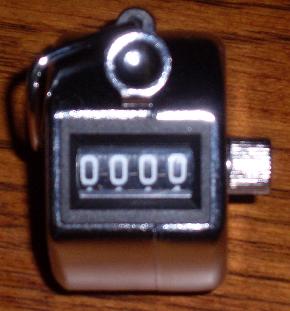
A tally counter like this clicks up by one each time you press the button. It can count up to 9 999. Photo: Scottinglis, public domain, via Wikimedia Commons.
Counting with base ten blocks
Base ten blocks help you see big numbers. Ten ones make a ten (a rod). Ten tens make a hundred (a flat). Ten hundreds make a thousand (a big cube).
If you have 2 thousand cubes, 3 hundred flats, 1 ten rod and 6 ones, the number is 2 316.
To find a missing number in a sequence, first find the jump. In 5 200, 5 300, ____, 5 500 the numbers go up by 100 each time, so the missing number is 5 400.
Try it
TRY ITPlace-value builder
Press + and − to add or take away thousands, hundreds, tens and ones. The builder shows your number in numerals, in words and in expanded form.
TRY ITCounting challenge
Choose a game. Tap the right answer. Then press Next question.
Let’s practise
Work out each one in your copybook. Open Hint if you are stuck, then open Show answer to check your working.
To print this worksheet, tap the button. To save it as a PDF instead, look in the print window for an option like Save as PDF, Save to PDF, Print to PDF or Download. The name is a little different on each phone, tablet and computer.
1. Count on by ones. Write the next three numbers: 5 997, 5 998, ____, ____, ____
Hint
After 5 999 comes a new thousand.
Show answer
5 999, 6 000, 6 001.
2. Count back by tens. Write the next three numbers: 3 030, 3 020, ____, ____, ____
8. Skip count by thousands: 1 250, 2 250, 3 250, … What comes next?
9. The number after 9 999 is 1 000.
True or False? Circle one: True / False
10. Which number has 5 thousands, 0 hundreds, 7 tens and 3 ones?
(a) 573
(b) 5 073
(c) 5 703
(d) 5 730
Answers (for the adult)
Part A
1. 5 999, 6 000, 6 001.
2. 3 010, 3 000, 2 990.
3. 4 340, 5 340.
4. 4 217.
5. Seven thousand and sixty-eight.
6. The jump is 100, so the missing number is 8 800.
7. 9 052.
8. (a) 10 000 (b) 3 999 (c) 6 100
Part B
1. (b) 3 000
2. 6 999
3. (c) 5 000
4. (c) 3 005
5. 8 460
6. True
7. (b) 2 500
8. 4 250
9. False
10. (b) 5 073
Recap
When you count on past 999, 1 999, 2 999 and so on, you reach a new thousand.
Skip counting by 10, 100 or 1 000 changes the tens, hundreds or thousands digit.
Read big numbers from the thousands down: 4 521 is four thousand, five hundred and twenty-one.
Zeros hold empty places: three thousand and five is 3 005.
To find a missing number, work out the jump first.
Words to know
thousand
Ten hundreds. It is written 1 000. Example: There are about one thousand pages in that big dictionary.
numeral
A number written with digits, like 2 316. Example: The numeral for two thousand is 2 000.
digit
One of the symbols 0 to 9 that we use to write numbers. Example: The number 7 068 has four digits.
sequence
Numbers in an order that follows a rule. Example: 2 470, 2 480, 2 490 is a sequence that goes up by ten.
skip count
To count by jumping the same amount each time. Example: We can skip count by hundreds: 300, 400, 500.
Try it at home
Find big numbers at home or outside: on a calendar (the year 2026), a car number plate, a receipt or a sign. Read each one aloud to an adult.
Mini project: make a counting strip. Start at 1 900 and count on in tens to 2 100. Write each number on a strip of paper and hang it on the wall.
Play “What comes next?” One person says a number and a jump, like “3 400, jump 100”. The other says the next three numbers.
Test tips
Tips for class tests
Always check how many digits your answer has. Numbers from 1 000 to 9 999 have four digits.
When writing a number from words, write a zero for any place that is not mentioned.
In a missing-number question, check the jump between two numbers you know before you fill the gap.
For parents and teachers
After this lesson, your child should be able to:
count on and back by ones, tens, hundreds and thousands up to 10 000, including across a thousand (for example 2 998, 2 999, 3 000);
read and write numbers to 10 000 in numerals and in words;
find missing numbers in a counting sequence.
Ask your child to read numbers seen every day, such as prices and the year. Most mistakes happen when crossing a thousand (999 to 1 000, 4 999 to 5 000), so practise counting on and back around those numbers.
Quiz scores and badges are saved only in this browser on this device. Nothing is sent anywhere. If the browser data is cleared, or another device is used, the badges will be lost.
2026/11/11 – Quick check answers can now be checked on screen, with friendly feedback and retries. – Added a completion badge that is saved in this browser on this device (no login). – Added a link back to the Infants 1 Maths page.
2026/10/30 – First version of this lesson (draft).
2026/11/11 – Quick check answers can now be checked on screen, with friendly feedback and retries. – Added a completion badge that is saved in this browser on this device (no login). – Added a link back to the Infants 1 Maths page.
2026/10/30 – First version of this lesson (draft).
Hello! Today we are going to count all the way to 100. We will also learn to count in 2s and 5s. Get ready to count out loud!
Counting forward to 100
When we count forward, each number is one more than the number before it.
1, 2, 3, 4, 5, 6, 7, 8, 9, 10 …
After 10 comes 11, 12, 13 … all the way up to 100. A hundred chart helps us. Each row has 10 numbers. The numbers in a row go up by one. The numbers in a column go up by ten.
You can start counting from any number. Try starting at 37: 37, 38, 39, 40, 41.
Scarlet ibis birds in the Caroni Swamp, Trinidad. Each red spot is a bird. There are lots and lots! When there are many things, counting in 2s or 5s is quicker. Photo: Charles J. Sharp, CC BY-SA 4.0, via Wikimedia Commons.
Counting backward
When we count backward, each number is one less. It is like a rocket getting ready to blast off!
10, 9, 8, 7, 6, 5, 4, 3, 2, 1, 0 – blast off! 🚀
Try counting back from 64: 64, 63, 62, 61, 60, 59.
Counting in 2s and 5s
Skip counting is a quick way to count. We jump over some numbers.
In 2s from 0: 0, 2, 4, 6, 8, 10, 12, 14, 16, 18, 20
In 2s from 1: 1, 3, 5, 7, 9, 11, 13, 15, 17, 19
In 5s from 0: 0, 5, 10, 15, 20
Count your shoes in 2s. Count your fingers in 5s. Two hands make 10 fingers!
TRY ITHundred chart and “What comes next?”
Look at the numbers. What number comes next? Tap your answer.
Tap any number on the chart to hear it.
Let’s practise
Try each one. Then tap Show answer to check.
1. What number comes after 29?
Show answer
30. 29 and one more is 30.
2. What number comes before 70?
Show answer
69.
3. Count on: 46, 47, 48, ___
Show answer
49.
4. Count back: 83, 82, 81, ___
Show answer
80.
5. Count in 2s: 8, 10, 12, ___
Show answer
14.
6. Count in 5s: 5, 10, 15, ___
Show answer
20.
7. Count back in 2s: 20, 18, 16, ___
Show answer
14.
Quick check
1. What number comes after 99?
Show answer
100 – one hundred!
2. Count in 2s from 1: 1, 3, 5, ___, ___
Show answer
7, 9.
3. How many fingers are on 4 hands? Count in 5s.
Show answer
5, 10, 15, 20. There are 20 fingers.
Maths words
Say these words with a grown-up. Can you use each one in a sentence?
count forward · count backward · one more · one less · hundred · skip count · next
Try it at home
Count the steps as you walk up the stairs. Count back as you walk down.
Count pairs of socks in 2s.
Do a “rocket count” from 20 back to 0. Jump up at zero!
Say the numbers from 50 to 100 while a grown-up points to them on a calendar or a chart.
For parents and teachers
After this lesson, your child should be able to:
count forwards and backwards in ones from any number up to 100
use a hundred chart to find the next and the previous number
count in 2s (from 0 and from 1) and in 5s (from 0) up to 20 and back
Tip: start counting from different numbers (e.g. 47, not always 1). The jump from 29 to 30 or from 69 to 70 is often the tricky part.