Rounding and Estimating – Standard 3 Maths

What you will learn

  • Round numbers to the nearest 10, 100 and 1 000.
  • Use a number line to see which ten, hundred or thousand a number is nearest to.
  • Estimate how many things there are, using a group of 100 as a guide, then count to check.

Sometimes we do not need an exact number. “About 3 000 people came to the show” is easier to say and to remember than “2 963 people came”. A number that is close but easier to use is called a rounded number. In this lesson you will learn how to round and how to make a good estimate.

The Hasely Crawford Stadium in Port of Spain, with rows of blue seats, a covered stand and white tents on the track
The Hasely Crawford Stadium in Port of Spain has thousands of seats. How could you estimate how many there are without counting every one? Photo: Paul Lowry, CC BY 2.0, via Wikimedia Commons.

Rounding to the nearest 10

The number 2 463 is between 2 460 and 2 470. Picture a number line from 2 460 to 2 470. The middle is 2 465.

2 463 is before the middle, so it is nearer to 2 460. We say 2 463 rounded to the nearest ten is 2 460.

What about 2 465, exactly in the middle? The rule is: halfway rounds up. So 2 465 rounds to 2 470.

A quick way: look at the ones digit. If it is 0, 1, 2, 3 or 4, round down. If it is 5, 6, 7, 8 or 9, round up.

Rounding to the nearest 100 and 1 000

To round to the nearest hundred, look at the tens digit. To round to the nearest thousand, look at the hundreds digit. Use the same rule: 5 or more rounds up.

Worked example

Round 5 739 to (a) the nearest 100 (b) the nearest 1 000.

Show me how

(a) 5 739 is between 5 700 and 5 800. The tens digit is 3, which is less than 5. So round down: 5 700.

(b) 5 739 is between 5 000 and 6 000. The hundreds digit is 7, which is 5 or more. So round up: 6 000.

Watch out! A common mistake

When you round, the digits after the place you round to all become zeros. 4 382 rounded to the nearest hundred is 4 400, not 4 482 or 4 480. And remember: 2 650 rounds to 2 700, because halfway rounds up.

Estimating with 100 as a guide

An estimate is a good guess that uses what you know. One useful thing to know is what 100 things look like.

Imagine a jar of red beans. You count 100 beans into a cup. The jar holds about 4 cups. So there are about 400 beans in the jar. This is called mental grouping: in your head, you split the big amount into groups of 100.

After you estimate, you can count to check. If you count 386 beans, your estimate of 400 was very good!

Worked example

A page of a book has about 100 words. A story has 9 pages. About how many words is the story?

Show me how

Each page is about 100 words.

9 groups of 100 is 900.

Answer: about 900 words.

Try it

TRY ITNumber-line rounder

Look at where the number sits on the line. The red mark shows the middle. Tap the end that the number is nearer to.

TRY ITEstimate the dots

The small box has exactly 100 dots. The dots in the long box are packed the same way. Use the small box to estimate how many there are. Then the game counts them to check.

Let’s practise

Work out each one in your copybook. Open Hint if you are stuck, then open Show answer to check your working.

1. Round 3 476 to the nearest 10.

Hint

Look at the ones digit.

Show answer

3 476 is between 3 470 and 3 480. The ones digit is 6, so round up: 3 480.

2. Round 3 476 to the nearest 100.

Hint

Look at the tens digit.

Show answer

The tens digit is 7, so round up: 3 500.

3. Round 3 476 to the nearest 1 000.

Hint

Look at the hundreds digit.

Show answer

The hundreds digit is 4, so round down: 3 000.

4. Round 6 250 to the nearest 100.

Hint

It is exactly halfway between 6 200 and 6 300.

Show answer

Halfway rounds up: 6 300.

5. (a) Round 8 049 to the nearest 10.
(b) Round 8 049 to the nearest 100.
(c) Round 8 049 to the nearest 1 000.

Hint

Each time, look at the digit to the right of the place.

Show answer

(a) 8 050
(b) 8 000
(c) 8 000

6. Which numbers round to 700 when rounded to the nearest 100: 649, 651, 748, 750?

Hint

Which numbers are between 650 and 749?

Show answer

651 and 748. 649 rounds to 600 and 750 rounds to 800.

7. A bag holds about 100 marbles. Aaliyah has 6 full bags. About how many marbles does she have?

Hint

Count the groups of 100.

Show answer

About 600 marbles.

8. At a match, one stand holds about 1 000 people. There are 7 stands, all full. Estimate the crowd.

Hint

7 groups of 1 000.

Show answer

About 7 000 people.

Quiz

Lesson quiz: 10 questions

Answer every question, then press Check my answers. Score 8 or more to earn the Rounding Ranger badge.

Recap

  • To round, find the two tens, hundreds or thousands the number is between, and choose the nearer one.
  • Look at the digit to the right of the place you are rounding to. 0 to 4 rounds down. 5 to 9 rounds up.
  • Halfway always rounds up.
  • When you round, the digits after that place become zeros.
  • Knowing what 100 things look like helps you estimate bigger amounts. Count to check your estimate.

Words to know

round
To change a number to a nearby ten, hundred or thousand that is easier to use.
Example: 2 463 rounded to the nearest ten is 2 460.
nearest
The closest.
Example: 5 739 to the nearest thousand is 6 000.
estimate
A careful guess that is close to the real amount.
Example: My estimate was about 400 beans.
benchmark
A number you know well that you use to help you estimate.
Example: We used 100 as a benchmark to estimate the beans.
halfway
Exactly in the middle.
Example: 2 465 is halfway between 2 460 and 2 470.

Try it at home

  • Count out 100 grains of rice, dried peas or beans. Look closely at how much space they take. Then estimate a bigger amount using your 100 as a guide, and count to check.
  • Mini project: look at the prices on a shop receipt or in a flyer. Round each price to the nearest 10 dollars and add up the rounded prices to estimate the total.

Test tips

Tips for class tests

  • Underline the digit you need to look at before you round.
  • Check your answer has zeros after the place you rounded to.
  • For estimates, the question often says “about”. You do not need an exact answer.

For parents and teachers

After this lesson, your child should be able to:

  • round numbers to the nearest 10, 100 and 1 000;
  • explain rounding using a number line;
  • estimate quantities using 100 as a benchmark, and check by counting.

Children often forget that halfway (for example 6 250 to the nearest 100) rounds up, or they change only one digit. Using a drawn number line helps. Everyday estimating (people in a queue, beans in a jar) builds good number sense.

Quiz scores and badges are saved only in this browser on this device. Nothing is sent anywhere. If the browser data is cleared, or another device is used, the badges will be lost.

Previous: Compare and Order Numbers – Standard 3 Maths
Next: Number Patterns and Rules – Standard 3 Maths
Course: Standard 3 Maths

Updates

2026/11/03
– First version of this lesson.

Attributions to media used in this post:

Hasely Crawford Stadium, Trinidad.jpg – Paul Lowry from New York – CC BY 2.0 (via Wikimedia Commons)

© 2026 Vedesh Kungebeharry. All rights reserved.

Solving Inequalities and Showing Answers on a Number Line and in Set Builder Notation

FORM 2 • TERM 1 • LESSON 12

In the last lesson you wrote inequalities from words. Now you will solve them, show them on a number line, and write the answers in set builder notation. Solving an inequality is very like solving an equation – the answer is just a whole range of numbers instead of one number.

Learning outcomes

By the end of this lesson you should be able to:

  • 2.6.4.5 – Solve simple linear inequalities.
  • 2.6.4.6 – Show linear inequalities on a number line.
  • 2.6.4.7 – Show the solutions of linear inequalities on a number line.
  • 2.6.4.8 – Write the solutions of inequalities in set builder notation.

Inequalities on a number line

A number line shows every number that makes an inequality true:

  • An open circle (○) at the end means the end number is not included. Use it for < and >.
  • A closed (filled) circle (●) means the end number is included. Use it for ≤ and ≥.
  • A thick line with an arrow shows that the numbers go on for ever in that direction.
Number line showing x greater than 2: an open circle at 2 with an arrow to the right −5 −4 −3 −2 −1 0 1 2 3 4 5
Figure 1 – x > 2. The open circle shows that 2 itself is not included.
Number line showing x less than or equal to minus 1: a closed circle at minus 1 with an arrow to the left −5 −4 −3 −2 −1 0 1 2 3 4 5
Figure 2 – x ≤ −1. The closed circle shows that −1 is included.

An inequality with two signs, such as −2 < x ≤ 3, is drawn as a line segment between the two ends:

Number line showing minus 2 less than x less than or equal to 3: an open circle at minus 2, a closed circle at 3, joined by a thick line −5 −4 −3 −2 −1 0 1 2 3 4 5
Figure 3 – −2 < x ≤ 3.

If x must be an integer, draw separate dots instead of a line. For −2 < x ≤ 3 the integers are −1, 0, 1, 2 and 3:

Number line with dots at minus 1, 0, 1, 2 and 3 −5 −4 −3 −2 −1 0 1 2 3 4 5
Figure 4 – The integers that satisfy −2 < x ≤ 3.

Solving an inequality

Use the balance method, exactly as for equations: do the same thing to both sides. Adding or subtracting the same number, and multiplying or dividing by the same positive number, keeps the inequality true.

For 3x − 2 ≤ 13: add 2 to both sides to get 3x ≤ 15, then divide by 3 to get x ≤ 5.

Looking ahead: multiplying or dividing both sides by a negative number reverses the sign. For example 2 < 5, but −2 > −5. In this lesson we keep the letter terms positive (subtract the smaller letter term from both sides), so you will not need this rule yet.

Set builder notation

Set builder notation describes a solution set by its rule instead of listing it. It is read “the set of all x such that …”.

SolutionSet builder notationRead as
x > 3{x : x > 3}the set of all x such that x is greater than 3
x ≤ 4, x an integer{x : x ≤ 4, x ∈ ℤ}the set of all integers x that are at most 4
−1 ≤ x < 2{x : −1 ≤ x < 2}the set of all x from −1 up to (not including) 2

The symbol ∈ means “is a member of”, and ℤ stands for the integers. Some books use a vertical line instead of a colon: {x | x > 3}. When the answer is a small set of integers you can also list it: {−1, 0, 1}.

TRY ITSolve and draw an inequality

Build an inequality of the form ax + b ☐ c, then see it solved, drawn on a number line and written in set builder notation.

Number line from −10 to 10

Worked examples

Example 1: A one-step inequality

Question: Solve x + 5 > 9 and show the answer on a number line.

  1. Subtract 5 from both sides: x > 4.
  2. Draw an open circle at 4 with an arrow to the right.

Answer: x > 4, or {x : x > 4}.

Example 2: A two-step inequality

Question: Solve 4x + 7 < 3.

  1. Subtract 7: 4x < −4.
  2. Divide by 4: x < −1.

Answer: x < −1, or {x : x < −1}.

Example 3: A decimal boundary

Question: Solve 2x + 1 ≥ 8.

  1. Subtract 1: 2x ≥ 7.
  2. Divide by 2: x ≥ 3.5.
  3. Draw a closed circle halfway between 3 and 4, with an arrow to the right.

Answer: x ≥ 3.5, or {x : x ≥ 3.5}.

Example 4: Letters on both sides

Question: Solve 5x − 3 > 2x + 9.

  1. Subtract 2x: 3x − 3 > 9.
  2. Add 3: 3x > 12.
  3. Divide by 3: x > 4.

Answer: x > 4, or {x : x > 4}.

Example 5: Integer solutions

Question: Find the integers that satisfy −3 ≤ x < 2 and write them as a set.

  1. −3 is included (≤); 2 is not (<).
  2. Count up from −3: −3, −2, −1, 0, 1.

Answer: {−3, −2, −1, 0, 1}, or {x : −3 ≤ x < 2, x ∈ ℤ}.

Example 6: Back to the word problem

Question: Jenna has $150 and tickets cost $35 each, so 35t ≤ 150. Solve this and find the greatest number of tickets she can buy.

  1. Divide both sides by 35: t ≤ 150 ÷ 35 = 4.28…
  2. t must be a whole number, so t ≤ 4.

Answer: She can buy at most 4 tickets: t ∈ {0, 1, 2, 3, 4}.

Common mistakes

  • Using the wrong circle. Open for < and >, closed for ≤ and ≥.
  • Drawing the arrow the wrong way. x > 4 points to the right (bigger numbers); x < 4 points to the left.
  • Writing an equals sign in the answer. The answer to 3x ≤ 15 is x ≤ 5, not x = 5.
  • Joining dots for integer solutions. If x must be an integer, draw separate dots, not a solid line.
  • Forgetting that ∈ means “is a member of”. x ∈ ℤ says x is an integer.

Practice questions

Try these yourself first, then open each answer to check your working.

1. Draw each on a number line:
(a) x < 3
(b) x ≥ −2
(c) −4 < x < 1.

Show answer

(a) Open circle at 3, arrow left.
(b) Closed circle at −2, arrow right.
(c) Open circles at −4 and 1, joined by a thick line.

2. Write the inequality shown:
(a) closed circle at 6, arrow to the left
(b) open circle at −3, arrow to the right.

Show answer

(a) x ≤ 6
(b) x > −3.

3. Solve:
(a) x − 4 ≥ 2
(b) 5x < 35
(c) 3x + 8 > 2.

Show answer

(a) x ≥ 6
(b) x < 7
(c) 3x > −6, so x > −2.

4. Solve:
(a) 2x − 5 ≤ 6
(b) 4x + 1 > 19
(c) 6x − 2 ≥ 4x + 10.

Show answer

(a) x ≤ 5.5
(b) x > 4.5
(c) 2x ≥ 12, so x ≥ 6.

5. Write in set builder notation:
(a) x < 8
(b) x ≥ −1 where x is an integer
(c) 0 < x ≤ 5.

Show answer

(a) {x : x < 8}
(b) {x : x ≥ −1, x ∈ ℤ}
(c) {x : 0 < x ≤ 5}.

6. List the integers that satisfy:
(a) −2 ≤ x ≤ 2
(b) 1 < x < 6
(c) −5 < x ≤ −1.

Show answer

(a) {−2, −1, 0, 1, 2}
(b) {2, 3, 4, 5}
(c) {−4, −3, −2, −1}.

7. Solve 3x − 4 < 11, then list the positive integers that satisfy it.

Show answer

3x < 15, so x < 5. Positive integers: {1, 2, 3, 4}.

8. Dev has $100 and books cost $12 each (12b ≤ 100). What is the greatest number of books he can buy?

Show answer

b ≤ 100 ÷ 12 = 8.33…, so at most 8 books.

Quick check

1. Which circle do you use for x ≥ 4?

Show answer

A closed (filled) circle.

2. Solve 2x < 10.

Show answer

x < 5.

3. Read {x : x > 1} aloud.

Show answer

The set of all x such that x is greater than 1.

Previous: Inequalities: Symbols, Real-Life Meaning and Writing Word Problems as Inequalities

Next: Sets: Union, Intersection and Solving Two-Set Venn Diagram Problems

Curriculum link: This post is relevant to the Trinidad and Tobago National Lower Secondary (NCSE) Mathematics Curriculum – Form 2, Term 1, Strand 2.6 Algebra, Topic 2.6.4 Solution of Linear Inequalities – Learning Outcomes 2.6.4.5 (solving simple inequalities), 2.6.4.6 (inequalities on the number line), 2.6.4.7 (solutions on the number line) and 2.6.4.8 (set builder notation).

Updates

2026/10/23

– First version of this lesson.

2026/10/25

– Put each lettered part of the questions and answers on its own line.

© 2026 Vedesh Kungebeharry. All rights reserved.

Integers: Natural Numbers, Whole Numbers and Integers, and Ordering Them on the Number Line

FORM 2 • TERM 1 • LESSON 01

When we first learn to count we use 1, 2, 3, 4 and so on. Later we add 0 for “nothing”, and in Form 1 we met negative numbers such as −5 °C or 20 m below sea level. In this lesson you will sort numbers into three families – natural numbers, whole numbers and integers – see how the families fit inside each other, and use a number line to put integers in order.

Learning outcomes

By the end of this lesson you should be able to:

  • 2.1.1.1 – Tell natural numbers, whole numbers and integers apart and see how they relate.
  • 2.1.1.2 – Put positive and negative integers in order, using a number line.

Three families of numbers

  • Natural numbers are the counting numbers: 1, 2, 3, 4, 5, … They go on for ever, but they start at 1.
  • Whole numbers are the natural numbers together with zero: 0, 1, 2, 3, 4, …
  • Integers are the whole numbers together with their negatives: …, −3, −2, −1, 0, 1, 2, 3, … They go on for ever in both directions.

So there are three kinds of integer: positive integers (1, 2, 3, …), zero, and negative integers (−1, −2, −3, …). Zero is neither positive nor negative. In Form 1 we called positive and negative numbers directed numbers; the directed numbers that have no fraction or decimal part are exactly the integers.

Numbers such as ½, 2.5 and −0.3 are not integers, because they lie between two integers on the number line.

NumberNatural number?Whole number?Integer?
7YesYesYes
0NoYesYes
−4NoNoYes
25YesYesYes
2.5NoNoNo

Look at the pattern in the table: every natural number is also a whole number, and every whole number is also an integer. The families fit inside each other, like boxes inside boxes:

Three nested sets: the natural numbers sit inside the whole numbers, which sit inside the integers Integers −3−20−1−7 Whole numbers 0 Natural numbers 123151008
Figure 1 – The natural numbers sit inside the whole numbers, and the whole numbers sit inside the integers.

The opposite is not true. 0 is a whole number but not a natural number, and −4 is an integer but not a whole number.

Integers on the number line

On a number line the integers are evenly spaced. Positive integers are to the right of 0 and negative integers are to the left. The rule for comparing is simple: the further right, the greater the number.

  • −3 is to the right of −8, so −3 is greater than −8. We write −3 > −8 (or −8 < −3).
  • Every positive integer is greater than 0, and 0 is greater than every negative integer.
  • Pairs such as 5 and −5 are opposites: they are the same distance from 0, on different sides.

Remember the symbols: < means “is less than” and > means “is greater than”. The open side always faces the greater number.

Putting integers in order

  1. Find the negative integers. The one furthest from zero is the smallest, so −11 comes before −9.
  2. Then comes 0 (if it is in the list).
  3. Then the positive integers, from smallest to largest.

This gives ascending order (smallest first). For descending order (largest first), write the same list backwards. A golf leaderboard is a real example: scores are written as integers compared with “par”, and the lowest score is in the lead.

A golf leaderboard listing players with scores of −2, −2, −1, −1 and −1 against par
Figure 2 – A golf leaderboard. Scores below par are negative integers, and the lowest score leads: −2 is ahead of −1. Image: Jonathan Palombo, CC BY 2.0, via Wikimedia Commons.

TRY ITSort and order integers

Type up to 10 integers from −20 to 20, separated by commas (use – for a minus sign). Choose an order. The number line marks each number, the answer puts them in order, and the table shows which ones are natural numbers, whole numbers and integers.

Number line from −20 to 20

Worked examples

Example 1: Sorting into families

Question: Here are five numbers: 9, −6, 0, 15, −1. Which are natural numbers, which are whole numbers and which are integers?

  1. Natural numbers are the counting numbers from 1 up: 9 and 15.
  2. Whole numbers add 0: 0, 9 and 15.
  3. Integers include the negatives too, so all five are integers.

Answer: Natural: 9, 15. Whole: 0, 9, 15. Integers: −6, −1, 0, 9, 15.

Example 2: Which is greater?

Question: Which is greater, −7 or −3?

  1. On the number line, −3 is to the right of −7.
  2. The further right, the greater.

Answer: −3 is greater (−3 > −7).

Example 3: Using < and >

Question: Put < or > between each pair:
(a) −2 ☐ 1
(b) −8 ☐ −10
(c) 0 ☐ −5.

  1. (a) Any negative is less than any positive, so −2 < 1.
  2. (b) −8 is to the right of −10, so −8 > −10.
  3. (c) 0 is to the right of every negative number, so 0 > −5.

Answer:
(a) −2 < 1
(b) −8 > −10
(c) 0 > −5.

Example 4: Ascending order

Question: Write 4, −9, 0, −2, 7, −11 in ascending order.

  1. Negatives first, furthest from zero first: −11, −9, −2.
  2. Then 0.
  3. Then the positives: 4, 7.

Answer: −11, −9, −2, 0, 4, 7.

Example 5: A golf leaderboard

Question: Five golfers finish with these scores against par: Anya −3, Ben +1, Chen −1, Dara 0, Ezra −5. The lowest score wins. List the golfers from first place to last.

  1. Order the scores from lowest to highest: −5, −3, −1, 0, +1.
  2. Match each score to its golfer.

Answer: Ezra (−5), Anya (−3), Chen (−1), Dara (0), Ben (+1). Ezra wins.

Example 6: Descending order of temperatures

Question: One January day the temperatures were: Port of Spain 31 °C, London 4 °C, Toronto −3 °C, Moscow −8 °C and Reykjavik −1 °C. List them from warmest to coldest.

  1. Warmest to coldest means descending order: largest first.
  2. Positives first: 31, 4. Then the negatives, closest to zero first: −1, −3, −8.

Answer: Port of Spain 31 °C, London 4 °C, Reykjavik −1 °C, Toronto −3 °C, Moscow −8 °C.

Common mistakes

  • Counting 0 as a natural number. In this course the natural numbers start at 1. Zero is a whole number and an integer, but not a natural number.
  • Calling a negative number a whole number. −4 is an integer, but it is not a whole number.
  • Thinking −8 is greater than −2 because 8 is greater than 2. On the number line −8 is further left, so it is smaller.
  • Calling 2.5 or ½ an integer. Integers have no fraction or decimal part.
  • Mixing up ascending and descending. Ascending goes up (smallest first); descending goes down (largest first).
  • Turning the < and > signs the wrong way. The open side faces the greater number: −5 < 2.

Practice questions

Try these yourself first, then open each answer to check your working.

1. From the list 12, −5, 0, 3, −20, 1, write down
(a) the natural numbers
(b) the whole numbers
(c) the integers that are not whole numbers.

Show answer

(a) 12, 3, 1
(b) 12, 0, 3, 1
(c) −5, −20.

2. True or false?
(a) Every whole number is an integer.
(b) Every integer is a whole number.
(c) 0 is a natural number.
(d) −1 is an integer.

Show answer

(a) True
(b) False – for example −3 is an integer but not a whole number
(c) False
(d) True.

3. Put < or > between each pair:
(a) −4 ☐ 2
(b) −6 ☐ −9
(c) 0 ☐ −1
(d) −15 ☐ −12.

Show answer

(a) −4 < 2
(b) −6 > −9
(c) 0 > −1
(d) −15 < −12.

4. Write in ascending order: 5, −3, 8, −7, 0, −1.

Show answer

−7, −3, −1, 0, 5, 8.

5. Write in descending order: −12, 4, −4, 0, 9, −20.

Show answer

9, 4, 0, −4, −12, −20.

6. List all the integers between −4 and 2 (not including −4 and 2).

Show answer

−3, −2, −1, 0, 1.

7. The lowest temperatures one week were: Monday −2 °C, Tuesday −6 °C, Wednesday 1 °C, Thursday −4 °C, Friday 0 °C.
(a) Which night was coldest?
(b) List the nights from coldest to warmest.

Show answer

(a) Tuesday (−6 °C).
(b) Tuesday (−6), Thursday (−4), Monday (−2), Friday (0), Wednesday (1).

8. (a) What is the smallest natural number?
(b) What is the smallest whole number?
(c) What is the greatest negative integer?

Show answer

(a) 1
(b) 0
(c) −1.

Quick check

1. Is 0 a natural number, a whole number or both?

Show answer

A whole number only (it is also an integer).

2. Which is smaller, −10 or −1?

Show answer

−10.

3. Is −7 an integer?

Show answer

Yes.

Next: Integer Calculations: Adding, Subtracting, Multiplying and Dividing Integers in Real Life

Curriculum link: This post is relevant to the Trinidad and Tobago National Lower Secondary (NCSE) Mathematics Curriculum – Form 2, Term 1, Strand 2.1 Number Operations and Number Theory, Topic 2.1.1 Integers – Learning Outcomes 2.1.1.1 (natural numbers, whole numbers and integers) and 2.1.1.2 (ordering integers).

Attributions to media used in this post:

Leaderboard (9368213575).jpg – Jonathan Palombo – CC BY 2.0 (via Wikimedia Commons)

Updates

2026/10/23

– First version of this lesson.

2026/10/25

– Put each lettered part of the questions and answers on its own line.

© 2026 Vedesh Kungebeharry. All rights reserved.
Numbers 11 to 20 and the Number Line – Infants 2 Maths

Numbers live on a number line. It is like a road with a number at every step. Today we explore the numbers from 0 to 20.

The number line

0 – 1 – 2 – 3 – 4 – 5 – 6 – 7 – 8 – 9 – 10 – 11 – 12 – 13 – 14 – 15 – 16 – 17 – 18 – 19 – 20

As we move to the right, the numbers get bigger. As we move to the left, they get smaller.

Before, after and between

  • The number before 14 is 13.
  • The number after 14 is 15.
  • The number between 16 and 18 is 17.

Teen numbers: ten and some more

The numbers 11 to 19 are made of ten and some more.

NumberTen and …Word
1110 and 1eleven
1210 and 2twelve
1310 and 3thirteen
1410 and 4fourteen
1510 and 5fifteen
1610 and 6sixteen
1710 and 7seventeen
1810 and 8eighteen
1910 and 9nineteen
2010 and 10twenty

TRY ITThe number line game

Use the number line. Tap the right answer.

Let’s practise

Try each one. Then tap Show answer to check.

1. What number comes just before 11?

Show answer

10.

2. What number is between 18 and 20?

Show answer

19.

3. Fill the gap: 12, 13, ___, 15

Show answer

14.

4. Fill the gaps: 16, ___, 18, ___, 20

Show answer

17 and 19.

5. Ten and 6 more makes ___.

Show answer

16.

6. 17 is ten and ___ more.

Show answer

7.

7. Count down: 20, 19, 18, ___, ___

Show answer

17, 16.

Quick check

1. Which is bigger: 13 or 19?

Show answer

19. It is further to the right on the number line.

2. Put these in order from smallest: 15, 11, 20, 8

Show answer

8, 11, 15, 20.

3. What is ten and 10 more?

Show answer

20 (twenty).

Maths words

Say these words with a grown-up. Can you use each one in a sentence?

number line · before · after · between · teen numbers · ten and … more · order

Try it at home

  • Make a number line with chalk on the step or with paper on the floor. Hop from number to number.
  • Ask: “I am thinking of the number after 15. What is it?” Then swap.
  • Use 10 bottle caps and some more to show teen numbers, for example 10 and 4 more is 14.

For parents and teachers

After this lesson, your child should be able to:

  • find the number before, after or between numbers up to 20
  • fill in missing numbers on a number line
  • count up from 0 and down from 20
  • order numbers to 20 from smallest to largest
  • describe numbers 11 to 19 as ten and some more
  • match numerals and number names

Seeing teen numbers as “ten and some more” is the first step towards place value. Ten-frames (egg boxes cut to 10 cups) are great for this.

Previous: How Many? Counting to 20
Next: More, Less and About How Many?

© 2026 Vedesh Kungebeharry. All rights reserved.

Directed Numbers: Negative Numbers on the Number Line, Adding and Subtracting

On a cold morning in Canada the temperature might be 7 degrees below zero. A diver might be 20 metres below sea level. A bank account can be overdrawn by $50. To describe amounts like these, we use numbers with a direction: positive numbers (above zero) and negative numbers (below zero). Together they are called directed numbers. In this lesson you will place them on a number line, put them in order, and add and subtract them.

What are directed numbers?

A negative number is written with a minus sign in front: −7 (“negative seven”). A positive number can be written with a plus sign, +7, or just as 7. Zero is neither positive nor negative. Directed numbers describe opposites:

SituationPositiveNegative
Temperatureabove 0 °Cbelow 0 °C
Heightabove sea levelbelow sea level
Moneya deposit or profita withdrawal, debt or loss
Floors in a buildingabove the ground floorbasement levels
Footballgoals scoredgoals conceded
Lift buttons labelled 3, 2, 1, 0 and −1, −2
Figure 1 – Lift buttons in a hotel: 0 is the ground (exit) floor, and −1 and −2 are basement levels below it. Image: Tony Webster from Minneapolis, Minnesota, United States, CC BY 2.0, via Wikimedia Commons.

Directed numbers on the number line

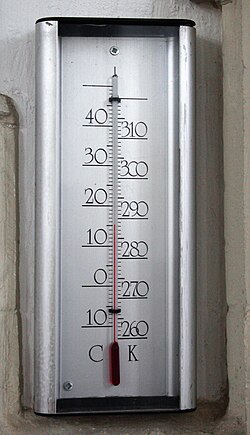
On a horizontal number line, positive numbers are to the right of 0 and negative numbers to the left. A thermometer is a vertical number line: up is positive and down is negative. The further right (or higher) a number is, the bigger it is. So −1 is bigger than −5, even though 5 is bigger than 1. Think of temperature: −1 °C is warmer than −5 °C.

A wall thermometer with a Celsius scale running from below zero up to about 40 degrees, and a kelvin scale beside it
Figure 2 – A thermometer is a vertical number line. Readings below the 0 mark are negative temperatures. Image: Martinvl, CC BY-SA 3.0, via Wikimedia Commons.

Adding and subtracting directed numbers

Picture yourself standing on the number line, facing the positive direction:

  • Adding a positive number: move to the right. −3 + 5 = 2.
  • Subtracting a positive number: move to the left. 4 − 9 = −5.
  • Adding a negative number is the same as subtracting: −2 + (−6) = −2 − 6 = −8.
  • Subtracting a negative number is the same as adding: 3 − (−5) = 3 + 5 = 8. (Taking away a debt makes you richer!)

A handy summary: two signs next to each other that are the same (+ + or − −) become +; two different signs (+ − or − +) become −. Brackets help keep the signs clear.

TRY ITDirected numbers on a number line

Choose a starting number, add or subtract, and choose a second number (it can be negative). The arrow shows the move along the number line.

Number line from −20 to 20

Worked examples

Example 1: Temperature rise

Question: The temperature at dawn is −4 °C. By noon it has risen by 7 degrees. What is the noon temperature?

  1. Rising means adding: −4 + 7.
  2. Start at −4 and move 7 to the right: −3, −2, −1, 0, 1, 2, 3.

Answer: 3 °C.

Example 2: Subtracting past zero

Question: Work out 4 − 9.

  1. Start at 4 and move 9 to the left.
  2. 4 steps take you to 0, and 5 more take you to −5.

Answer: −5.

Example 3: Adding a negative

Question: Work out −2 + (−6).

  1. + (−) becomes −, so this is −2 − 6.
  2. Start at −2 and move 6 to the left.

Answer: −8.

Example 4: Subtracting a negative

Question: Work out −7 − (−2).

  1. − (−) becomes +, so this is −7 + 2.
  2. Start at −7 and move 2 to the right.

Answer: −5.

Example 5: Ordering

Question: Put 3, −5, 0, −1, 4, −8 in order, smallest first.

  1. Negative numbers come first; the one furthest from zero is the smallest.
  2. Then 0, then the positive numbers.

Answer: −8, −5, −1, 0, 3, 4.

Example 6: Highest and lowest

Question: The top of Mount Everest is about 8,849 m above sea level, and the shore of the Dead Sea is about 430 m below sea level (−430 m). What is the difference in height?

  1. Difference = higher − lower = 8,849 − (−430).
  2. = 8,849 + 430.

Answer: About 9,279 m.

Common mistakes

  • Thinking −8 is bigger than −2. On the number line −8 is further left, so it is smaller.
  • Ignoring the second sign. 3 − (−5) is 8, not −2.
  • Losing the minus sign in the answer when you pass zero: 4 − 9 is −5, not 5.
  • Mixing up “negative” and “subtract”. The minus sign in −5 tells you the direction; the one in 8 − 5 tells you to subtract.

Practice questions

Try these yourself first, then open each answer to check your working.

1. Write in ascending order: −2, 6, −9, 0, 1.

Show answer

−9, −2, 0, 1, 6.

2. Work out:
(a) −6 + 4
(b) 5 − 8
(c) −3 − 4
(d) −1 + (−5)
(e) 2 − (−7)
(f) −8 − (−3).

Show answer

(a) −2
(b) −3
(c) −7
(d) −6
(e) 9
(f) −5.

3. At midnight it is −3 °C. By 9 a.m. it is 8 degrees warmer. What is the temperature at 9 a.m.?

Show answer

−3 + 8 = 5 °C.

4. Ravi’s bank balance is −$35 (he is overdrawn). He pays in $50. What is his new balance?

Show answer

−35 + 50 = $15.

5. What is the difference between 2 °C and −3 °C?

Show answer

2 − (−3) = 5 degrees.

6. A diver is 15 m below sea level (−15 m). She rises 9 m, then dives 6 m. Where is she now?

Show answer

−15 + 9 − 6 = −12, so 12 m below sea level.

Quick check

1. Which is warmer, −2 °C or −10 °C?

Show answer

−2 °C.

2. What is 0 − 6?

Show answer

−6.

3. Is subtracting −4 the same as adding 4?

Show answer

Yes.

Next: Multiplying and Dividing Directed Numbers, and Substituting Them into Expressions

Curriculum link: This post is relevant to the Trinidad and Tobago National Lower Secondary (NCSE) Mathematics Curriculum – Form 1, Term 2, Strand 1.1 Number Operations and Number Theory, Topic 1.1.3 Directed Numbers – Learning Outcomes 1.1.3.1 (understanding directed numbers), 1.1.3.2 (positive and negative numbers on the number line) and 1.1.3.3 (operations on directed numbers – addition and subtraction here; multiplication and division in the next lesson).

Attributions to media used in this post:

Elevator Negative Floor Numbers in Ireland (16785350923).jpg – Tony Webster from Minneapolis, Minnesota, United States – CC BY 2.0 (via Wikimedia Commons)

CelsiusKelvinThermometer.jpg – Martinvl – CC BY-SA 3.0 (via Wikimedia Commons)

Updates

2026/10/25

– Put each lettered part of the questions and answers on its own line.

© 2026 Vedesh Kungebeharry. All rights reserved.

Rounding Whole Numbers and Estimating Quantities (Nearest 10, 100, 1,000 and Million)

Rounding means replacing a number with a simpler, “rounder” number that is close to it. A newspaper might say a stadium held “about 27,000 people” when the exact count was 27,465. Rounded numbers are easier to remember, say and calculate with. Estimating means making a sensible guess at a quantity or an answer without counting or calculating everything exactly. In this lesson you will round whole numbers to the nearest 10, 100, 1,000 and up to the nearest million, and use benchmarks such as 100 to estimate large quantities.

You will need to be confident with place value first – see Place Value and Number Names.

The rounding rule

  1. Find the rounding place (for example the hundreds digit if you are rounding to the nearest 100).
  2. Look at the digit immediately to its right – this is the “decider” digit.
  3. If the decider is 5, 6, 7, 8 or 9, round up: add 1 to the rounding digit.
  4. If the decider is 0, 1, 2, 3 or 4, round down: leave the rounding digit as it is.
  5. Replace every digit to the right of the rounding place with 0. Digits to the left do not change (unless rounding up turns a 9 into 10 – then carry, just like in addition).

Why does 5 round up? A number ending in exactly 5 is halfway between the two round numbers, and the usual convention in school maths is to round halfway values up. On a number line you can see that numbers above the halfway point are nearer the higher round number.

TRY ITRounding on a number line

Type a number and choose the place to round to. The number line shows the two “round” numbers on either side, the halfway point, and which one is nearer. Use the step buttons to see exactly where the answer changes.

(steps move the number by one tenth of the rounding place)

Number line for rounding

Worked examples

Example 1: One number, three different roundings

Question: Round 3,746 to the nearest 10, the nearest 100 and the nearest 1,000.

  1. Nearest 10: the tens digit is 4 and the decider (ones) is 6. 6 ≥ 5, so round up: 4 tens become 5 tens → 3,750.
  2. Nearest 100: the hundreds digit is 7 and the decider (tens) is 4. 4 < 5, so round down → 3,700.
  3. Nearest 1,000: the thousands digit is 3 and the decider (hundreds) is 7. Round up → 4,000.

Answer: 3,750; 3,700; 4,000. Notice that the answer depends on which place you round to.

Example 2: A decider of exactly 5

Question: Round 48,650 to the nearest 100 and to the nearest 1,000.

  1. Nearest 100: hundreds digit 6, decider (tens) 5. 5 means round up: 6 hundreds → 7 hundreds → 48,700.
  2. Nearest 1,000: thousands digit 8, decider (hundreds) 6. Round up: 8 thousands → 9 thousands → 49,000.

Answer: 48,700 and 49,000.

Example 3: Rounding large numbers

Question: Round 2,495,318 to the nearest 10,000 and to the nearest million.

  1. Nearest 10,000: the ten-thousands digit is 9 and the decider (thousands) is 5, so round up. 9 ten-thousands + 1 = 10 ten-thousands, so carry 1 into the hundred-thousands place: 249 ten-thousands become 250 ten-thousands → 2,500,000.
  2. Nearest million: the millions digit is 2 and the decider (hundred thousands) is 4. Round down → 2,000,000.

Answer: 2,500,000 and 2,000,000.

Example 4: Rounding up past a 9

Question: Round 69,960 to the nearest 100.

  1. The hundreds digit is 9 and the decider (tens) is 6, so round up.
  2. 699 hundreds + 1 = 700 hundreds. Write 700 hundreds as 70,000.

Answer: 70,000. (It is not 69,1000 or 691,000!)

Estimating quantities with a benchmark of 100

How many people are in a big crowd? How many beans are in a jar? Counting every single one would take far too long, so we estimate using a benchmark – a group whose size we know. A benchmark of 100 works well:

  1. Count out 100 objects (or 100 people in one part of a photo) and notice how much space they take up.
  2. Mentally group the rest of the objects into chunks of about the same size.
  3. Count the chunks and multiply by 100.
  4. Verify: if you can, count the real total and see how close you were.

Example 5: Estimating a crowd

Question: A photo of a crowd is divided into equal sections. One section contains about 100 people, and the crowd fills about 12 sections. Estimate the size of the crowd.

  1. Benchmark: 1 section ≈ 100 people.
  2. 12 sections ≈ 12 × 100.

Answer: about 1,200 people.

Estimating answers and giving answers to a degree of accuracy

Before you calculate, round each number to make a quick estimate. If your exact answer is far from the estimate, check your working. For example, 412 × 29 ≈ 400 × 30 = 12,000. The exact answer is 11,948, which is close, so it is reasonable.

Sometimes a question asks you to give your answer “to the nearest thousand” or “correct to the nearest hundred dollars”. Work out the exact answer first, then round it once at the end. Example: a school fair raised $18,653. To the nearest hundred dollars this is $18,700 (the tens digit, 5, means round up).

Common mistakes

  • Rounding in a chain. To round 1,448 to the nearest 100, look only at the tens digit (4) → 1,400. Do not round to 1,450 first and then to 1,500.
  • Forgetting the zeros. 3,746 to the nearest 100 is 3,700, not 37.
  • Looking at the wrong digit. The decider is always the digit immediately to the right of the rounding place.
  • Changing digits on the left. When you round down, the digits to the left of the rounding place stay exactly the same.

Practice questions

Try these yourself first, then open each answer to check your working.

1. Round 8,362 to the nearest 10, the nearest 100 and the nearest 1,000.

Show answer

8,360 (decider 2); 8,400 (decider 6); 8,000 (decider 3).

2. Round 547,500 to the nearest 1,000.

Show answer

548,000. The decider (hundreds digit) is 5, so round up.

3. Round 13,952 to the nearest 100.

Show answer

14,000. The hundreds digit 9 rounds up to 10, so carry: 139 hundreds + 1 = 140 hundreds.

4. Round 7,649,999 to the nearest million and to the nearest 100,000.

Show answer

Nearest million: 8,000,000 (decider 6). Nearest 100,000: 7,600,000 (decider 4).

5. A whole number rounded to the nearest 10 is 250. What are the smallest and largest numbers it could be?

Show answer

Smallest 245, largest 254. (245 rounds up to 250; 255 would round up to 260.)

6. Estimate 4,812 + 3,197 by rounding each number to the nearest 1,000. Then find the exact answer.

Show answer

Estimate: 5,000 + 3,000 = 8,000. Exact: 8,009. Very close.

7. Estimate 58 × 21 by rounding each number to the nearest 10. Then find the exact answer.

Show answer

Estimate: 60 × 20 = 1,200. Exact: 1,218.

8. A photo of a beach is split into 20 equal squares. One square has about 100 people in it. Estimate the number of people on the beach.

Show answer

20 × 100 = about 2,000 people.

9. A builder needs 2,350 bricks. Write this number to the nearest hundred.

Show answer

2,400 (the decider, 5, rounds up).

Quick check

1. When rounding to the nearest 1,000, which digit decides whether you round up or down?

Show answer

The hundreds digit (the digit just to the right of the thousands place).

2. Does 45 round to 40 or 50 (nearest 10)?

Show answer

50. A decider of 5 always rounds up.

3. Why do we estimate before calculating?

Show answer

To get a rough idea of the answer, so we can tell if our exact answer is sensible.

4. What is a benchmark when estimating a quantity?

Show answer

A group of known size (such as 100 objects) used to judge how many there are altogether.

Next: Odd, Even, Prime, Composite, Square, Triangular and Rectangular Numbers

Curriculum link: This post is relevant to the Trinidad and Tobago National Lower Secondary (NCSE) Mathematics Curriculum – Form 1, Term 1, Strand 1.1 Number Operations and Number Theory, Topic 1.1.1 Whole Numbers – Learning Outcomes 1.1.1.4 (rounding to the nearest ten, hundred, thousand and up to millions), 1.1.1.5 (estimating a quantity using 100 as a benchmark and checking by counting) and 1.1.1.8 (solving whole-number problems and giving answers to a stated degree of accuracy).

© 2026 Vedesh Kungebeharry. All rights reserved.