Algebra Review: Variables, Word Statements and Substituting Integers

FORM 2 • TERM 1 • LESSON 08

In Form 1 you met algebra, variables and substitution. This lesson reviews those ideas and takes them further. You will think about what a variable really is, turn word statements with two operations into algebra and back, and substitute integers – including negative ones – into expressions and formulas. The integer sign rules from Lesson 2 will help you here.

Learning outcomes

By the end of this lesson you should be able to:

  • 2.6.1.1 – Explain what a variable is.
  • 2.6.1.2 – Translate between word statements and algebra, for statements with two operations.
  • 2.6.1.3 – Link concrete objects and pictures with abstract algebra symbols.
  • 2.6.1.4 – Substitute integers into algebraic expressions and formulas.

What is a variable? From objects to symbols

A variable is a letter (or symbol) that stands for a number. It is called a variable because the number can vary – change – from one situation to another, or because we do not know it yet.

  • With objects: imagine some cups, each holding the same unknown number of counters. Call the number in each cup x.
  • With pictures: 2 cups and 3 loose counters can be drawn like Figure 1.
  • With symbols: the same picture is written 2x + 3.
Two cups each holding x counters, and three loose counters x x 2 cups of x counters + 3 counters = 2x + 3
Figure 1 – Two cups, each holding x counters, plus 3 loose counters make 2x + 3 counters altogether.

If each cup holds 5 counters, there are 2 × 5 + 3 = 13 counters. If each holds 8, there are 19. The expression stays the same; the value changes as x changes. Going from real objects (concrete) to a drawing and then to symbols (abstract) is what algebra does: the letter lets us describe every case at once. Real examples: if mangoes cost $3 each, n mangoes cost 3n dollars; a taxi that charges $10 plus $4 per km costs 10 + 4k dollars for k km.

From words to algebra

WordsOperationExample in algebra
sum, plus, more than, increased by+n + 6
difference, minus, less than, decreased by, subtract … from−n − 6 (6 less than n)
product, times, multiplied by, double (× 2), triple (× 3)×6n
quotient, divided by, shared equally among, half of (÷ 2)÷n ÷ 6 or n/6
squaredpower 2n²

Many statements use two operations. The order of the words tells you the order of the operations, and you need brackets when an addition or subtraction is done before a multiplication or division.

  • “Double a number, then add 5” → 2n + 5.
  • “Add 5 to a number, then double the result” → 2(n + 5).
  • “Subtract 4 from a number, then multiply by 3” → 3(n − 4).
  • “The sum of a and b, divided by 2” → (a + b) ÷ 2.

Watch out for “less than” and “subtract … from”: “7 less than y” is y − 7, not 7 − y.

From algebra to words

To read an expression in words, say what happens to the letter, in order. There is often more than one correct way to say it.

  • 5x − 1 → “five times a number, minus one” or “one less than five times a number”.
  • (y + 3) ÷ 4 → “three more than a number, divided by four”.
  • a² + b → “the square of a, plus b”.

Substituting integers

To substitute means to replace each letter with its value, then work out the answer. With negative numbers, the safest habit is to put brackets around every negative value as you substitute, and then use the sign rules: a negative times a negative is positive, and a negative times a positive is negative.

For a = −3 and b = 4: 3a + 2b = 3 × (−3) + 2 × 4 = −9 + 8 = −1.

Be extra careful with squares: a² = (−3)² = (−3) × (−3) = 9, which is positive.

TRY ITSubstitute integers

Choose an expression and type integers from −10 to 10 for a and b (use – for a minus sign). The steps show the substitution with brackets round every negative number.

Worked examples

Example 1: Writing two-step statements

Question: Write an expression for:
(a) a number is multiplied by 4 and then 9 is subtracted
(b) 9 is subtracted from a number and the result is multiplied by 4.

  1. (a) Multiply first, then subtract: 4n − 9.
  2. (b) Subtract first, so it needs brackets: 4(n − 9).

Answer:
(a) 4n − 9
(b) 4(n − 9).

Example 2: A real-life expression

Question: A phone plan costs $45 a month plus $2 for each gigabyte (GB) of extra data. Write an expression for the cost in dollars of one month with g extra GB.

  1. The fixed part is 45.
  2. The changing part is 2 × g = 2g.

Answer: 45 + 2g dollars.

Example 3: Algebra to words

Question: Write in words:
(a) 3p + 8
(b) (k − 2) ÷ 5.

  1. (a) Multiply p by 3, then add 8.
  2. (b) Subtract 2 from k first, then divide by 5.

Answer:
(a) Eight more than three times a number.
(b) Two less than a number, divided by five.

Example 4: Substituting a negative number

Question: Find the value of 5x − 7 when x = −2.

  1. Put brackets round the negative: 5 × (−2) − 7.
  2. 5 × (−2) = −10, and −10 − 7 = −17.

Answer: −17.

Example 5: Two negative values

Question: If a = −3 and b = −5, find
(a) ab
(b) a − b
(c) 2a² − b.

  1. (a) (−3) × (−5) = 15.
  2. (b) (−3) − (−5) = −3 + 5 = 2.
  3. (c) 2 × (−3)² − (−5) = 2 × 9 + 5 = 23.

Answer:
(a) 15
(b) 2
(c) 23.

Example 6: Using a formula

Question: The formula F = 9C ÷ 5 + 32 changes a temperature in degrees Celsius (C) into degrees Fahrenheit (F). Find F when C = −10.

  1. Substitute: F = 9 × (−10) ÷ 5 + 32.
  2. 9 × (−10) = −90, and −90 ÷ 5 = −18.
  3. −18 + 32 = 14.

Answer: F = 14, so −10 °C is 14 °F.

Common mistakes

  • Forgetting brackets in two-step statements. “Add 5, then double” is 2(n + 5), not 2n + 5.
  • Turning “less than” round the wrong way. “7 less than y” is y − 7.
  • Squaring a negative to get a negative. (−3)² = 9, not −9.
  • Subtracting a negative incorrectly. a − b with b = −5 is a + 5.
  • Writing 3a as 3 and a side by side. When a = −2, 3a means 3 × (−2) = −6, not “3−2” = 1.

Practice questions

Try these yourself first, then open each answer to check your working.

1. Write an expression for:
(a) a number tripled, then decreased by 2
(b) 6 added to a number, then the result halved
(c) the product of x and y, increased by 10.

Show answer

(a) 3n − 2
(b) (n + 6) ÷ 2
(c) xy + 10.

2. Pencils cost $4 each and an eraser costs $3. Write an expression for the cost of p pencils and one eraser.

Show answer

4p + 3 dollars.

3. Write in words:
(a) 2m − 5
(b) 4(t + 1)
(c) x² − y.

Show answer

For example:
(a) five less than twice a number
(b) one more than a number, multiplied by four
(c) the square of x, minus y.

4. Find the value of 4k + 9 when
(a) k = 3
(b) k = −3
(c) k = −5.

Show answer

(a) 21
(b) −3
(c) −11.

5. If m = −4 and n = 2, find
(a) m + n
(b) mn
(c) n − m
(d) 3m − 2n.

Show answer

(a) −2
(b) −8
(c) 6
(d) −12 − 4 = −16.

6. If p = −2 and q = −6, find
(a) p²
(b) pq
(c) q ÷ p
(d) p² − q.

Show answer

(a) 4
(b) 12
(c) 3
(d) 4 + 6 = 10.

7. Find the value of 6(x − y) when x = −1 and y = 4.

Show answer

6 × (−5) = −30.

8. A diver’s depth in metres after t minutes is given by d = −3t. Find d when t = 7, and say what it means.

Show answer

d = −21: the diver is 21 m below the surface.

Quick check

1. What is a variable?

Show answer

A letter or symbol that stands for a number that can change or is unknown.

2. Write “3 less than double x” in algebra.

Show answer

2x − 3.

3. Find a² when a = −6.

Show answer

36.

Previous: Adding and Subtracting in Any Base (and Converting to a Common Base)

Next: Simplifying Algebraic Expressions: Terms, Coefficients, Like Terms and Algebra Tiles

Curriculum link: This post is relevant to the Trinidad and Tobago National Lower Secondary (NCSE) Mathematics Curriculum – Form 2, Term 1, Strand 2.6 Algebra, Topic 2.6.1 Substitution – Learning Outcomes 2.6.1.1 (the concept of a variable), 2.6.1.2 (translating between word statements and mathematical statements with two operations), 2.6.1.3 (the link between the concrete and the abstract) and 2.6.1.4 (substituting integers into expressions).

Updates

2026/10/23

– First version of this lesson.

2026/10/25

– Put each lettered part of the questions and answers on its own line.

© 2026 Vedesh Kungebeharry. All rights reserved.

Integer Calculations: Adding, Subtracting, Multiplying and Dividing Integers in Real Life

FORM 2 • TERM 1 • LESSON 02

In the last lesson you sorted numbers into natural numbers, whole numbers and integers, and put integers in order. Now we put integers to work. You will add, subtract, multiply and divide positive and negative integers, spot where integers are used in everyday life, and use them to solve problems about temperature, sea level, money and sport. Much of this builds on the Form 1 lessons on adding and subtracting and multiplying and dividing directed numbers.

Learning outcomes

By the end of this lesson you should be able to:

  • 2.1.1.3 – Add, subtract, multiply and divide with positive and negative integers.
  • 2.1.1.4 – Spot where integers show up in daily life (temperature, sea level, bank balances).
  • 2.1.1.5 – Work out simple real-life problems that use integers.

Integers in everyday life

Whenever a quantity can go above or below a starting point, integers are a natural way to describe it. Zero is the starting point.

SituationZero meansPositiveNegative
Temperature0 °C, the freezing point of waterabove freezingbelow freezing
Heightsea levelabove sea levelbelow sea level
Bank accountan empty accountmoney in the accountoverdrawn (money owed)
Businessbreaking evena profita loss
Golflevel parover parunder par
Lift buttonsthe ground floorfloors abovebasement levels
Footballequal goals for and againstpositive goal differencenegative goal difference
A green road sign reading Elevation Sea Level, in a desert valley with mountains behind
Figure 1 – A road sign in Death Valley, USA, marking sea level (0 m). Parts of this valley are below sea level, so their heights are negative integers. Image: Tuxyso, CC BY-SA 3.0, via Wikimedia Commons.

Adding and subtracting integers

  • Same signs: add the sizes and keep the sign. 5 + 3 = 8 and (−5) + (−3) = −8.
  • Different signs: subtract the smaller size from the larger, and keep the sign of the one with the larger size. (−9) + 4 = −5 and 9 + (−4) = 5.
  • Subtracting is the same as adding the opposite. 6 − 10 = 6 + (−10) = −4 and 3 − (−7) = 3 + 7 = 10.

If you are not sure, picture a number line: adding a positive moves you right, adding a negative moves you left.

Multiplying and dividing integers

Look at this pattern. Each answer is 3 less than the one before it, so the pattern carries on below zero:

3 × (−3) = −9
2 × (−3) = −6
1 × (−3) = −3
0 × (−3) = 0
(−1) × (−3) = 3
(−2) × (−3) = 6

Once the first number becomes negative the answers become positive. This gives the sign rules, which work the same way for division:

Signs× or ÷ givesExamples
positive and positivepositive4 × 5 = 20; 20 ÷ 5 = 4
negative and negativepositive(−4) × (−5) = 20; (−20) ÷ (−5) = 4
positive and negativenegative4 × (−5) = −20; 20 ÷ (−5) = −4
negative and positivenegative(−4) × 5 = −20; (−20) ÷ 5 = −4

In short: same signs give a positive answer, different signs give a negative answer. Work out the size of the answer as usual, then fix the sign.

Solving problems with integers

  1. Read the problem and decide where zero is (sea level, freezing point, an empty account…).
  2. Write the facts as integers, using negatives for “below”, “owed”, “loss” or “drop”.
  3. Calculate, using the rules above.
  4. Answer in words, and check that the answer makes sense (for example −25 dollars means overdrawn by $25).

Worked examples

Example 1: Adding with the same sign

Question: Work out (−8) + (−5).

  1. Both are negative, so add the sizes: 8 + 5 = 13.
  2. Keep the negative sign.

Answer: −13.

Example 2: Adding with different signs

Question: Work out 6 + (−11).

  1. The sizes are 6 and 11. Subtract: 11 − 6 = 5.
  2. 11 is the larger size and it is negative, so the answer is negative.

Answer: −5.

Example 3: Subtracting a negative

Question: Work out −4 − (−9).

  1. Subtracting −9 is the same as adding 9: −4 + 9.
  2. Different signs: 9 − 4 = 5, and 9 is positive.

Answer: 5.

Example 4: Multiplying and dividing

Question: Work out
(a) (−7) × 6
(b) (−7) × (−6)
(c) (−48) ÷ (−8)
(d) 36 ÷ (−4).

  1. (a) Different signs, so negative: 7 × 6 = 42, giving −42.
  2. (b) Same signs, so positive: 42.
  3. (c) Same signs, so positive: 48 ÷ 8 = 6.
  4. (d) Different signs, so negative: 36 ÷ 4 = 9, giving −9.

Answer:
(a) −42
(b) 42
(c) 6
(d) −9.

Example 5: Temperature rise

Question: At 6 a.m. the temperature on a mountain was −5 °C. At noon it was 9 °C. By how many degrees did the temperature rise?

  1. Rise = later temperature − earlier temperature = 9 − (−5).
  2. Subtracting a negative is adding: 9 + 5 = 14.

Answer: The temperature rose by 14 degrees.

Example 6: Below sea level

Question: A submarine is at −120 m (120 m below sea level). It rises 45 m, then dives 30 m. Where is it now?

  1. Rising is adding and diving is subtracting: −120 + 45 − 30.
  2. −120 + 45 = −75, then −75 − 30 = −105.

Answer: At −105 m, which is 105 m below sea level.

Example 7: A bank balance

Question: Keisha has $40 in her account. She withdraws $65, then deposits $100. What is her balance after each step?

  1. After the withdrawal: 40 − 65 = −25, so she is overdrawn by $25.
  2. After the deposit: −25 + 100 = 75.

Answer: −$25 (overdrawn), then $75.

Example 8: A steady drop

Question: The temperature is 4 °C and it falls by 3 degrees every hour for 5 hours. What is the temperature at the end?

  1. A fall of 3 degrees each hour is −3, five times: 5 × (−3) = −15.
  2. New temperature: 4 + (−15) = −11.

Answer: −11 °C.

Common mistakes

  • Using the multiplication rule for adding. (−6) + (−4) is −10, not +10. “Two negatives make a positive” is for × and ÷ only.
  • Forgetting the sign when you pass zero. 7 − 12 is −5, not 5.
  • Getting the sign of a product wrong. (−4) × (−5) is 20, and (−4) × 5 is −20.
  • Finding a difference by subtracting the sizes. The difference between 9 °C and −5 °C is 9 − (−5) = 14 degrees, not 4.
  • Leaving out the meaning. An answer of −25 in a money problem should be written in words: overdrawn by $25 (or $25 owed).

Practice questions

Try these yourself first, then open each answer to check your working.

1. Work out:
(a) −9 + 4
(b) −3 + (−8)
(c) 7 − 12
(d) −6 − (−10)
(e) 0 − (−5)
(f) −15 + 15.

Show answer

(a) −5
(b) −11
(c) −5
(d) 4
(e) 5
(f) 0.

2. Work out:
(a) (−6) × 4
(b) (−9) × (−3)
(c) 8 × (−7)
(d) (−56) ÷ 7
(e) (−63) ÷ (−9)
(f) 45 ÷ (−5).

Show answer

(a) −24
(b) 27
(c) −56
(d) −8
(e) 7
(f) −9.

3. Work out:
(a) (−2) × (−3) × (−4)
(b) (−20) ÷ 4 + 6
(c) 3 × (−5) − (−8).

Show answer

(a) 6 × (−4) = −24
(b) −5 + 6 = 1
(c) −15 + 8 = −7.

4. Write each of these as an integer:
(a) a fish 15 m below the surface
(b) a profit of $30
(c) 2 floors below the ground floor
(d) 4 strokes under par in golf.

Show answer

(a) −15
(b) 30
(c) −2
(d) −4.

5. A freezer is at −18 °C and the kitchen is at 27 °C. What is the difference in temperature?

Show answer

27 − (−18) = 27 + 18 = 45 degrees.

6. A diver is at −24 m. She rises 9 m, then dives 15 m. Where is she now?

Show answer

−24 + 9 − 15 = −30, so 30 m below sea level.

7. Marcus has $120 in his account. He withdraws $200, then deposits $50. What is his balance now?

Show answer

120 − 200 = −80, then −80 + 50 = −30. He is still overdrawn by $30.

8. The temperature is 2 °C. It falls by 4 degrees each hour for 3 hours. What is the temperature then?

Show answer

2 + 3 × (−4) = 2 − 12 = −10 °C.

9. A golfer’s scores against par for four rounds are −2, −1, +3 and −4.
(a) What is her total score?
(b) What is her mean (average) score per round?

Show answer

(a) −2 + (−1) + 3 + (−4) = −4, so 4 under par.
(b) −4 ÷ 4 = −1, so 1 under par per round.

10. A hiker walks from a valley floor 40 m below sea level to a hilltop 310 m above sea level. How far up did she climb?

Show answer

310 − (−40) = 310 + 40 = 350 m.

Quick check

1. What is (−5) × (−5)?

Show answer

25.

2. What is −3 − 7?

Show answer

−10.

3. Is a negative number divided by a positive number positive or negative?

Show answer

Negative.

Previous: Integers: Natural Numbers, Whole Numbers and Integers, and Ordering Them on the Number Line

Next: Laws of Numbers: Commutative, Associative and Distributive Laws, Closure, Identity and Inverse

Curriculum link: This post is relevant to the Trinidad and Tobago National Lower Secondary (NCSE) Mathematics Curriculum – Form 2, Term 1, Strand 2.1 Number Operations and Number Theory, Topic 2.1.1 Integers – Learning Outcomes 2.1.1.3 (the four basic operations on integers), 2.1.1.4 (integers in everyday life) and 2.1.1.5 (solving simple problems with integers).

Attributions to media used in this post:

Elevation Sea Level Sign Death Valley 2013.jpg – Tuxyso – CC BY-SA 3.0 (via Wikimedia Commons)

Updates

2026/10/23

– First version of this lesson.

2026/10/24

– Next lesson link now points to Lesson 3.

2026/10/25

– Put each lettered part of the questions and answers on its own line.

© 2026 Vedesh Kungebeharry. All rights reserved.

Integers: Natural Numbers, Whole Numbers and Integers, and Ordering Them on the Number Line

FORM 2 • TERM 1 • LESSON 01

When we first learn to count we use 1, 2, 3, 4 and so on. Later we add 0 for “nothing”, and in Form 1 we met negative numbers such as −5 °C or 20 m below sea level. In this lesson you will sort numbers into three families – natural numbers, whole numbers and integers – see how the families fit inside each other, and use a number line to put integers in order.

Learning outcomes

By the end of this lesson you should be able to:

  • 2.1.1.1 – Tell natural numbers, whole numbers and integers apart and see how they relate.
  • 2.1.1.2 – Put positive and negative integers in order, using a number line.

Three families of numbers

  • Natural numbers are the counting numbers: 1, 2, 3, 4, 5, … They go on for ever, but they start at 1.
  • Whole numbers are the natural numbers together with zero: 0, 1, 2, 3, 4, …
  • Integers are the whole numbers together with their negatives: …, −3, −2, −1, 0, 1, 2, 3, … They go on for ever in both directions.

So there are three kinds of integer: positive integers (1, 2, 3, …), zero, and negative integers (−1, −2, −3, …). Zero is neither positive nor negative. In Form 1 we called positive and negative numbers directed numbers; the directed numbers that have no fraction or decimal part are exactly the integers.

Numbers such as ½, 2.5 and −0.3 are not integers, because they lie between two integers on the number line.

NumberNatural number?Whole number?Integer?
7YesYesYes
0NoYesYes
−4NoNoYes
25YesYesYes
2.5NoNoNo

Look at the pattern in the table: every natural number is also a whole number, and every whole number is also an integer. The families fit inside each other, like boxes inside boxes:

Three nested sets: the natural numbers sit inside the whole numbers, which sit inside the integers Integers −3−20−1−7 Whole numbers 0 Natural numbers 123151008
Figure 1 – The natural numbers sit inside the whole numbers, and the whole numbers sit inside the integers.

The opposite is not true. 0 is a whole number but not a natural number, and −4 is an integer but not a whole number.

Integers on the number line

On a number line the integers are evenly spaced. Positive integers are to the right of 0 and negative integers are to the left. The rule for comparing is simple: the further right, the greater the number.

  • −3 is to the right of −8, so −3 is greater than −8. We write −3 > −8 (or −8 < −3).
  • Every positive integer is greater than 0, and 0 is greater than every negative integer.
  • Pairs such as 5 and −5 are opposites: they are the same distance from 0, on different sides.

Remember the symbols: < means “is less than” and > means “is greater than”. The open side always faces the greater number.

Putting integers in order

  1. Find the negative integers. The one furthest from zero is the smallest, so −11 comes before −9.
  2. Then comes 0 (if it is in the list).
  3. Then the positive integers, from smallest to largest.

This gives ascending order (smallest first). For descending order (largest first), write the same list backwards. A golf leaderboard is a real example: scores are written as integers compared with “par”, and the lowest score is in the lead.

A golf leaderboard listing players with scores of −2, −2, −1, −1 and −1 against par
Figure 2 – A golf leaderboard. Scores below par are negative integers, and the lowest score leads: −2 is ahead of −1. Image: Jonathan Palombo, CC BY 2.0, via Wikimedia Commons.

TRY ITSort and order integers

Type up to 10 integers from −20 to 20, separated by commas (use – for a minus sign). Choose an order. The number line marks each number, the answer puts them in order, and the table shows which ones are natural numbers, whole numbers and integers.

Number line from −20 to 20

Worked examples

Example 1: Sorting into families

Question: Here are five numbers: 9, −6, 0, 15, −1. Which are natural numbers, which are whole numbers and which are integers?

  1. Natural numbers are the counting numbers from 1 up: 9 and 15.
  2. Whole numbers add 0: 0, 9 and 15.
  3. Integers include the negatives too, so all five are integers.

Answer: Natural: 9, 15. Whole: 0, 9, 15. Integers: −6, −1, 0, 9, 15.

Example 2: Which is greater?

Question: Which is greater, −7 or −3?

  1. On the number line, −3 is to the right of −7.
  2. The further right, the greater.

Answer: −3 is greater (−3 > −7).

Example 3: Using < and >

Question: Put < or > between each pair:
(a) −2 ☐ 1
(b) −8 ☐ −10
(c) 0 ☐ −5.

  1. (a) Any negative is less than any positive, so −2 < 1.
  2. (b) −8 is to the right of −10, so −8 > −10.
  3. (c) 0 is to the right of every negative number, so 0 > −5.

Answer:
(a) −2 < 1
(b) −8 > −10
(c) 0 > −5.

Example 4: Ascending order

Question: Write 4, −9, 0, −2, 7, −11 in ascending order.

  1. Negatives first, furthest from zero first: −11, −9, −2.
  2. Then 0.
  3. Then the positives: 4, 7.

Answer: −11, −9, −2, 0, 4, 7.

Example 5: A golf leaderboard

Question: Five golfers finish with these scores against par: Anya −3, Ben +1, Chen −1, Dara 0, Ezra −5. The lowest score wins. List the golfers from first place to last.

  1. Order the scores from lowest to highest: −5, −3, −1, 0, +1.
  2. Match each score to its golfer.

Answer: Ezra (−5), Anya (−3), Chen (−1), Dara (0), Ben (+1). Ezra wins.

Example 6: Descending order of temperatures

Question: One January day the temperatures were: Port of Spain 31 °C, London 4 °C, Toronto −3 °C, Moscow −8 °C and Reykjavik −1 °C. List them from warmest to coldest.

  1. Warmest to coldest means descending order: largest first.
  2. Positives first: 31, 4. Then the negatives, closest to zero first: −1, −3, −8.

Answer: Port of Spain 31 °C, London 4 °C, Reykjavik −1 °C, Toronto −3 °C, Moscow −8 °C.

Common mistakes

  • Counting 0 as a natural number. In this course the natural numbers start at 1. Zero is a whole number and an integer, but not a natural number.
  • Calling a negative number a whole number. −4 is an integer, but it is not a whole number.
  • Thinking −8 is greater than −2 because 8 is greater than 2. On the number line −8 is further left, so it is smaller.
  • Calling 2.5 or ½ an integer. Integers have no fraction or decimal part.
  • Mixing up ascending and descending. Ascending goes up (smallest first); descending goes down (largest first).
  • Turning the < and > signs the wrong way. The open side faces the greater number: −5 < 2.

Practice questions

Try these yourself first, then open each answer to check your working.

1. From the list 12, −5, 0, 3, −20, 1, write down
(a) the natural numbers
(b) the whole numbers
(c) the integers that are not whole numbers.

Show answer

(a) 12, 3, 1
(b) 12, 0, 3, 1
(c) −5, −20.

2. True or false?
(a) Every whole number is an integer.
(b) Every integer is a whole number.
(c) 0 is a natural number.
(d) −1 is an integer.

Show answer

(a) True
(b) False – for example −3 is an integer but not a whole number
(c) False
(d) True.

3. Put < or > between each pair:
(a) −4 ☐ 2
(b) −6 ☐ −9
(c) 0 ☐ −1
(d) −15 ☐ −12.

Show answer

(a) −4 < 2
(b) −6 > −9
(c) 0 > −1
(d) −15 < −12.

4. Write in ascending order: 5, −3, 8, −7, 0, −1.

Show answer

−7, −3, −1, 0, 5, 8.

5. Write in descending order: −12, 4, −4, 0, 9, −20.

Show answer

9, 4, 0, −4, −12, −20.

6. List all the integers between −4 and 2 (not including −4 and 2).

Show answer

−3, −2, −1, 0, 1.

7. The lowest temperatures one week were: Monday −2 °C, Tuesday −6 °C, Wednesday 1 °C, Thursday −4 °C, Friday 0 °C.
(a) Which night was coldest?
(b) List the nights from coldest to warmest.

Show answer

(a) Tuesday (−6 °C).
(b) Tuesday (−6), Thursday (−4), Monday (−2), Friday (0), Wednesday (1).

8. (a) What is the smallest natural number?
(b) What is the smallest whole number?
(c) What is the greatest negative integer?

Show answer

(a) 1
(b) 0
(c) −1.

Quick check

1. Is 0 a natural number, a whole number or both?

Show answer

A whole number only (it is also an integer).

2. Which is smaller, −10 or −1?

Show answer

−10.

3. Is −7 an integer?

Show answer

Yes.

Next: Integer Calculations: Adding, Subtracting, Multiplying and Dividing Integers in Real Life

Curriculum link: This post is relevant to the Trinidad and Tobago National Lower Secondary (NCSE) Mathematics Curriculum – Form 2, Term 1, Strand 2.1 Number Operations and Number Theory, Topic 2.1.1 Integers – Learning Outcomes 2.1.1.1 (natural numbers, whole numbers and integers) and 2.1.1.2 (ordering integers).

Attributions to media used in this post:

Leaderboard (9368213575).jpg – Jonathan Palombo – CC BY 2.0 (via Wikimedia Commons)

Updates

2026/10/23

– First version of this lesson.

2026/10/25

– Put each lettered part of the questions and answers on its own line.

© 2026 Vedesh Kungebeharry. All rights reserved.

Directed Numbers: Negative Numbers on the Number Line, Adding and Subtracting

On a cold morning in Canada the temperature might be 7 degrees below zero. A diver might be 20 metres below sea level. A bank account can be overdrawn by $50. To describe amounts like these, we use numbers with a direction: positive numbers (above zero) and negative numbers (below zero). Together they are called directed numbers. In this lesson you will place them on a number line, put them in order, and add and subtract them.

What are directed numbers?

A negative number is written with a minus sign in front: −7 (“negative seven”). A positive number can be written with a plus sign, +7, or just as 7. Zero is neither positive nor negative. Directed numbers describe opposites:

SituationPositiveNegative
Temperatureabove 0 °Cbelow 0 °C
Heightabove sea levelbelow sea level
Moneya deposit or profita withdrawal, debt or loss
Floors in a buildingabove the ground floorbasement levels
Footballgoals scoredgoals conceded
Lift buttons labelled 3, 2, 1, 0 and −1, −2
Figure 1 – Lift buttons in a hotel: 0 is the ground (exit) floor, and −1 and −2 are basement levels below it. Image: Tony Webster from Minneapolis, Minnesota, United States, CC BY 2.0, via Wikimedia Commons.

Directed numbers on the number line

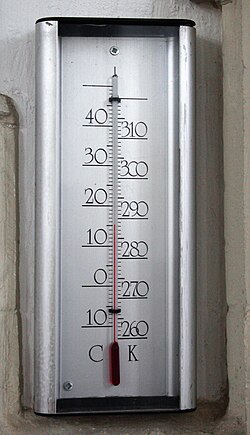
On a horizontal number line, positive numbers are to the right of 0 and negative numbers to the left. A thermometer is a vertical number line: up is positive and down is negative. The further right (or higher) a number is, the bigger it is. So −1 is bigger than −5, even though 5 is bigger than 1. Think of temperature: −1 °C is warmer than −5 °C.

A wall thermometer with a Celsius scale running from below zero up to about 40 degrees, and a kelvin scale beside it
Figure 2 – A thermometer is a vertical number line. Readings below the 0 mark are negative temperatures. Image: Martinvl, CC BY-SA 3.0, via Wikimedia Commons.

Adding and subtracting directed numbers

Picture yourself standing on the number line, facing the positive direction:

  • Adding a positive number: move to the right. −3 + 5 = 2.
  • Subtracting a positive number: move to the left. 4 − 9 = −5.
  • Adding a negative number is the same as subtracting: −2 + (−6) = −2 − 6 = −8.
  • Subtracting a negative number is the same as adding: 3 − (−5) = 3 + 5 = 8. (Taking away a debt makes you richer!)

A handy summary: two signs next to each other that are the same (+ + or − −) become +; two different signs (+ − or − +) become −. Brackets help keep the signs clear.

TRY ITDirected numbers on a number line

Choose a starting number, add or subtract, and choose a second number (it can be negative). The arrow shows the move along the number line.

Number line from −20 to 20

Worked examples

Example 1: Temperature rise

Question: The temperature at dawn is −4 °C. By noon it has risen by 7 degrees. What is the noon temperature?

  1. Rising means adding: −4 + 7.
  2. Start at −4 and move 7 to the right: −3, −2, −1, 0, 1, 2, 3.

Answer: 3 °C.

Example 2: Subtracting past zero

Question: Work out 4 − 9.

  1. Start at 4 and move 9 to the left.
  2. 4 steps take you to 0, and 5 more take you to −5.

Answer: −5.

Example 3: Adding a negative

Question: Work out −2 + (−6).

  1. + (−) becomes −, so this is −2 − 6.
  2. Start at −2 and move 6 to the left.

Answer: −8.

Example 4: Subtracting a negative

Question: Work out −7 − (−2).

  1. − (−) becomes +, so this is −7 + 2.
  2. Start at −7 and move 2 to the right.

Answer: −5.

Example 5: Ordering

Question: Put 3, −5, 0, −1, 4, −8 in order, smallest first.

  1. Negative numbers come first; the one furthest from zero is the smallest.
  2. Then 0, then the positive numbers.

Answer: −8, −5, −1, 0, 3, 4.

Example 6: Highest and lowest

Question: The top of Mount Everest is about 8,849 m above sea level, and the shore of the Dead Sea is about 430 m below sea level (−430 m). What is the difference in height?

  1. Difference = higher − lower = 8,849 − (−430).
  2. = 8,849 + 430.

Answer: About 9,279 m.

Common mistakes

  • Thinking −8 is bigger than −2. On the number line −8 is further left, so it is smaller.
  • Ignoring the second sign. 3 − (−5) is 8, not −2.
  • Losing the minus sign in the answer when you pass zero: 4 − 9 is −5, not 5.
  • Mixing up “negative” and “subtract”. The minus sign in −5 tells you the direction; the one in 8 − 5 tells you to subtract.

Practice questions

Try these yourself first, then open each answer to check your working.

1. Write in ascending order: −2, 6, −9, 0, 1.

Show answer

−9, −2, 0, 1, 6.

2. Work out:
(a) −6 + 4
(b) 5 − 8
(c) −3 − 4
(d) −1 + (−5)
(e) 2 − (−7)
(f) −8 − (−3).

Show answer

(a) −2
(b) −3
(c) −7
(d) −6
(e) 9
(f) −5.

3. At midnight it is −3 °C. By 9 a.m. it is 8 degrees warmer. What is the temperature at 9 a.m.?

Show answer

−3 + 8 = 5 °C.

4. Ravi’s bank balance is −$35 (he is overdrawn). He pays in $50. What is his new balance?

Show answer

−35 + 50 = $15.

5. What is the difference between 2 °C and −3 °C?

Show answer

2 − (−3) = 5 degrees.

6. A diver is 15 m below sea level (−15 m). She rises 9 m, then dives 6 m. Where is she now?

Show answer

−15 + 9 − 6 = −12, so 12 m below sea level.

Quick check

1. Which is warmer, −2 °C or −10 °C?

Show answer

−2 °C.

2. What is 0 − 6?

Show answer

−6.

3. Is subtracting −4 the same as adding 4?

Show answer

Yes.

Next: Multiplying and Dividing Directed Numbers, and Substituting Them into Expressions

Curriculum link: This post is relevant to the Trinidad and Tobago National Lower Secondary (NCSE) Mathematics Curriculum – Form 1, Term 2, Strand 1.1 Number Operations and Number Theory, Topic 1.1.3 Directed Numbers – Learning Outcomes 1.1.3.1 (understanding directed numbers), 1.1.3.2 (positive and negative numbers on the number line) and 1.1.3.3 (operations on directed numbers – addition and subtraction here; multiplication and division in the next lesson).

Attributions to media used in this post:

Elevator Negative Floor Numbers in Ireland (16785350923).jpg – Tony Webster from Minneapolis, Minnesota, United States – CC BY 2.0 (via Wikimedia Commons)

CelsiusKelvinThermometer.jpg – Martinvl – CC BY-SA 3.0 (via Wikimedia Commons)

Updates

2026/10/25

– Put each lettered part of the questions and answers on its own line.

© 2026 Vedesh Kungebeharry. All rights reserved.