Western Art Music Forms: Opera, Oratorio, Cantata, Chorale, Concerto, Sonata, Symphony, Minuet and Trio, and More

CSEC asks you to recognise the main styles and forms of Western art (classical) music, to know which period each belongs to, and to describe their features using the elements. This post brings them together in one place. For each form, try to remember three things: who performs it, how it is structured, and which period it is most associated with.

Vocal forms

FormWhat it isMain period(s)Example
Recitativespeech-like singing that tells the story, lightly accompaniedBaroque, Classicalrecitatives in Handel’s Messiah
Ariaa song for solo voice and orchestra expressing a character’s feelings; often da capo (ABA)Baroque, Classical“Der Hölle Rache” (Queen of the Night), Mozart
Choralea German Protestant hymn tune, usually harmonised in four partsBaroque, ClassicalBach’s chorale harmonisations
Cantataa work in several movements for voices and instruments – arias, recitatives, choruses and choralesBaroque to 20th centuryBach, Wachet auf, BWV 140
Oratorioa large religious drama for soloists, choir and orchestra, without acting or costumesBaroque (and later)Handel, Messiah; Haydn, The Creation
Operaa staged drama sung throughout, with costumes, scenery and orchestraBaroque, Classical, Romantic, 20th centuryMozart, The Magic Flute; Verdi, Aida
Music theatrea stage show mixing songs, spoken dialogue and danceRomantic operetta, 20th-century musicalsGershwin, Porgy and Bess; Bernstein, West Side Story

Listen: an aria

In Mozart’s opera The Magic Flute (1791), the furious Queen of the Night sings “Der Hölle Rache” (“Hell’s vengeance”). The aria shows off the soprano’s extreme range – up to a high F – with rapid, brilliant coloratura passages. It is sung in German, as CSEC notes is typical of Classical vocal music (non-English text).

A singer in a white costume playing a flute on stage beside a large, colourful bird puppet
Figure 1 – Prince Tamino plays his magic flute to charm the animals in a 2006 production of Mozart’s The Magic Flute by New Zealand Opera. Magic Flute 2006 NZO 02.jpg by Neil Mackenzie / NZOpera, CC BY-SA 4.0, via Wikimedia Commons

Instrumental forms

FormWhat it isMain period(s)
Concertoa soloist (or small group) contrasted with an orchestra; usually three movements, fast–slow–fast, with a cadenzaBaroque, Classical, Romantic, modern
Sonataa multi-movement work for a solo instrument or a soloist with pianoBaroque, Classical (and later)
Symphonya large work for orchestra, usually in four movementsClassical onwards
Minuet and trioa stately dance in 3/4 in ternary form: minuet – trio – minuetClassical
Rondoa main theme that keeps returning between contrasting episodes (ABACA)Baroque, Classical, Romantic
Theme and variationsa theme followed by changed versions of it (melody, rhythm, harmony, key or texture altered)Classical to 20th century
Waltza dance in 3/4 with an “oom-pah-pah” accompanimentClassical and Romantic (Strauss, Chopin)
Tone poema one-movement orchestral piece that tells a story (programme music)late Romantic, early 20th century
Serial musicmusic built from a twelve-tone row20th century
A pianist at a grand piano surrounded by members of a symphony orchestra on a concert stage
Figure 2 – A piano concerto in performance: the soloist, here also directing, faces the orchestra from the piano. Great Amber Concert Hall, Liepāja Symphony Orchestra, Matthias Manasi, Beethoven.jpg by SintaBerzins, CC0, via Wikimedia Commons

Theme and variations

In a theme and variations, the composer states a theme and then repeats it several times, changing something each time while keeping it recognisable. Common techniques are adding faster notes (decoration), changing to the minor key, changing the metre or tempo, adding a new accompaniment, or moving the tune to a different instrument.

Try it: theme and variations

TRY ITTheme and variations

The theme is the tune you may know as “Twinkle, Twinkle, Little Star” (the same tune Mozart used for his famous variations). Each variation keeps the tune recognisable but changes something.

Press Play to listen. Nothing plays until you press the button. Start with your volume low.

Mozart wrote twelve variations for piano on the French song “Ah, vous dirai-je, maman” (the tune of “Twinkle, Twinkle, Little Star”). Listen for the theme, then count the variations: one is in fast semiquavers, one uses the minor key, and one slows right down.

Listen: a symphony

Beethoven’s Fifth Symphony (1808) is built from one tiny four-note motif. In this performance, conductor Benjamin Zander and the Boston Philharmonic play the first movement, which is in sonata form – listen for the motif in the exposition, how it is passed around the orchestra in the development, and its return in the recapitulation.

The forms on the CSEC rotation lists

CSEC prescribes particular forms for each exam window. Check which list applies to your exam year:

  • 2025–2027: Baroque cantata; Classical/Romantic theme and variations; Classical minuet and trio; Romantic programme music; avant-garde aleatory music.
  • 2028–2030: Baroque oratorio; Baroque recitative and aria; Classical sonata; Classical rondo; Classical minuet; 20th-century music theatre.

Activity: form fact files

Make a fact card for each form on your exam’s rotation list: definition, performers, structure, period, one named example and composer, and two features you would hear.

Quick check

1. What is the difference between an oratorio and an opera?

Show answer

Both are large dramatic works for voices and orchestra, but an opera is staged with acting, costumes and scenery, while an oratorio (usually religious) is performed without them.

2. What is a cadenza?

Show answer

A brilliant solo passage in a concerto, often near the end of a movement, where the soloist plays alone.

3. What is the structure of a minuet and trio?

Show answer

Ternary form: minuet (A), trio (B), minuet again (A), in 3/4 time.

4. Give three ways a composer can vary a theme.

Show answer

Any three: faster decorative notes, change to the minor key, new rhythm or metre, new accompaniment, different instrument, different tempo.

5. Which vocal form is a German Protestant hymn tune?

Show answer

The chorale.

Previous: 20th-Century, Avant-Garde and Modern Music: Atonality, Serialism, Aleatory Music, Minimalism and Electronic Sound

Next: Jazz and Blues: The 12-Bar Blues, Swing, Bebop, Cool Jazz, Fusion and the Performers Who Shaped Them

Syllabus link: NCSE: not covered (CSEC only). CSEC® Music syllabus (CXC 31/G/SYLL 17), Section 1: Listening and Appraising – Music History and Theory: Specific Objectives 3 and 4 (evaluate and analyse compositions using established styles and forms); Content 3(a)(i) (vocal forms: aria and recitative, cantata, chorale, opera, oratorio) and 3(a)(ii) (instrumental forms: concerto, minuet and trio, rondo, sonata, symphony, theme and variations, waltz, music theatre, serial music, tone poem); rotation lists for 2025–2027 and 2028–2030.

Attributions to media used in this post:

Magic Flute 2006 NZO 02.jpg – Neil Mackenzie / NZOpera – CC BY-SA 4.0 (via Wikimedia Commons)

Great Amber Concert Hall, Liepāja Symphony Orchestra, Matthias Manasi, Beethoven.jpg – SintaBerzins – CC0 (via Wikimedia Commons)

© 2026 Vedesh Kungebeharry. All rights reserved.

The Baroque Period (c. 1600–1750): Ornaments, Basso Continuo, Purcell, Vivaldi, Bach and Handel

The word Baroque was first used as an insult, meaning over-decorated or “misshapen”. Today it names the period of European music from about 1600 to 1750 – from the birth of opera in Italy to the death of J. S. Bach. Baroque music is full of energy and decoration: running bass lines, ornamented melodies, interweaving parts and dramatic contrasts. It is also the music of churches and royal courts, where most composers worked.

Main characteristics of Baroque music

  • Lots of ornamentation – trills, turns, mordents and appoggiaturas decorate the melody. Performers were expected to add ornaments of their own.
  • Tonality firmly established – music is clearly in major or minor keys, with strong triads, seventh chords and even diminished-seventh chords for dramatic moments.
  • Basso continuo – a continuous bass line played by a low instrument (cello, bassoon) with a keyboard (harpsichord or organ) filling in the chords from a “figured bass”.
  • Polyphony – many pieces weave several independent melodies together, often in dense textures; the fugue is the high point of this style.
  • Terraced dynamics – loudness changes in sudden steps (loud, then soft echo) rather than gradual crescendos, partly because the harpsichord and organ could not make gradual changes.
  • Driving rhythm – a steady, “motor-like” pulse that keeps going through a whole movement, and usually one mood (affect) per movement.
  • Instruments – strings at the centre, recorders, oboes and bassoons, with occasional brass (natural trumpets and horns) and timpani for grand occasions.
A harpsichord with a decorated lid standing in a church
Figure 1 – A harpsichord. Its strings are plucked by small quills, so every note sounds at about the same volume – one reason for Baroque terraced dynamics. Harpsichord in a church.jpg by Tomwsulcer, CC0, via Wikimedia Commons

Try it: ornaments and terraced dynamics

Hear a short phrase plain, then decorated with different ornaments on the long note. The “terraced dynamics” option plays the phrase loud, then repeats it softly as an echo – exactly how Baroque musicians made contrast.

TRY ITBaroque ornaments and terraced dynamics

Hear a short phrase on a harpsichord-like sound, first plain and then decorated with an ornament on the long note. “Terraced dynamics” plays the phrase loud, then echoes it softly.

Press Play to listen. Nothing plays until you press the button. Start with your volume low.

Important Baroque forms

FormDescription
Operaa drama sung throughout, with costumes, scenery and orchestra; born in Italy around 1600
Recitative and ariain opera and oratorio, the recitative moves the story on in speech-like singing; the aria is a song that expresses a character’s feelings, often in da capo (ABA) form
Oratorioa large religious work for soloists, choir and orchestra, like an opera without acting or costumes – Handel’s Messiah is the most famous
Cantataa shorter work for voices and instruments in several movements; Bach wrote about 200 church cantatas for Sunday services in Leipzig
Choralea German Protestant hymn tune sung by the congregation; Bach harmonised hundreds in four parts
Concerto grosso and solo concertoa small group (concertino) or a soloist contrasted with the full string orchestra (ripieno or tutti)
Fuguea polyphonic piece in which a short subject enters in each voice in turn
Suitea set of dances (allemande, courante, sarabande, gigue, minuet) in the same key

Key composers

Henry Purcell (1659–1695)

England’s greatest Baroque composer, organist at Westminster Abbey. His opera Dido and Aeneas contains the lament “When I am laid in earth”, built over a repeating ground bass. Britten’s Young Person’s Guide to the Orchestra (post 7) is based on a Purcell theme.

Antonio Vivaldi (1678–1741)

A Venetian priest and violinist who taught music at an orphanage for girls, the Ospedale della Pietà. He wrote more than 500 concertos. The Four Seasons (1725) is four violin concertos, each describing a season – an early example of programme music. In “Spring”, listen for birdsong trills, a murmuring stream and a thunderstorm, and for the ritornello – the orchestra’s returning theme.

Johann Sebastian Bach (1685–1750)

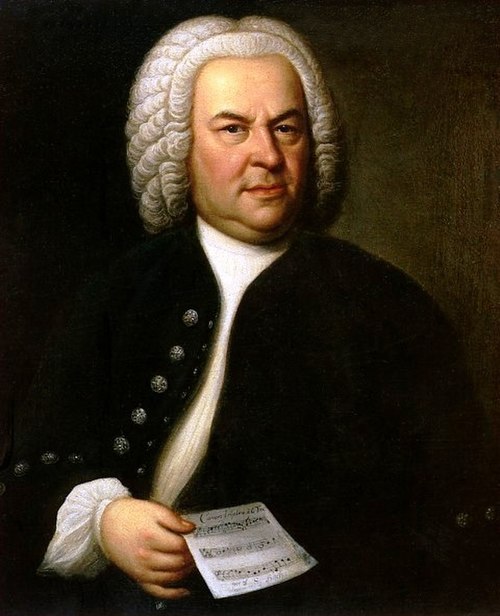
A German organist and church musician who spent his last 27 years in Leipzig. Bach brought polyphony to its peak in works such as The Well-Tempered Clavier, the Brandenburg Concertos, the St Matthew Passion, the Mass in B minor and his church cantatas, such as Wachet auf (“Sleepers, wake”, BWV 140), which ends with a chorale.

Oil portrait of J. S. Bach in a white wig and dark coat, holding a sheet of music
Figure 2 – Johann Sebastian Bach in 1748, painted by Elias Gottlob Haussmann. He is holding a puzzle canon he composed. Johann Sebastian Bach.jpg by Elias Gottlob Haussmann, Public domain, via Wikimedia Commons

George Frideric Handel (1685–1759)

Born in Germany in the same year as Bach, Handel made his career in London, writing Italian operas, the Water Music and Music for the Royal Fireworks, and English oratorios. Messiah (1742) ends its second part with the “Hallelujah” chorus, where you can hear homophonic sections (everyone in the same rhythm) alternate with polyphonic entries, and the trumpets and timpani join for the grand climax.

Activity: Baroque listening checklist

While listening to “Spring” or “Hallelujah”, tick each feature you hear and note the time: ornament (trill), basso continuo, polyphony, terraced dynamics, steady driving rhythm, trumpets and timpani, harpsichord or organ.

Quick check

1. Give approximate dates for the Baroque period.

Show answer

About 1600 to 1750.

2. What is basso continuo?

Show answer

A continuous bass line played by a low instrument together with a keyboard (harpsichord or organ) that fills in the chords.

3. What are terraced dynamics?

Show answer

Sudden changes between loud and soft levels (like steps), rather than gradual crescendos and diminuendos.

4. What is the difference between a recitative and an aria?

Show answer

A recitative is speech-like singing that moves the story on; an aria is a song that expresses a character’s feelings.

5. Name a famous oratorio and its composer.

Show answer

Messiah by George Frideric Handel (1742).

Previous: Music Through Time: The Style Periods and the Forces That Change Music

Next: The Classical Period (c. 1750–1820): Balanced Phrases, Clear Cadences, Haydn, Mozart and Beethoven

Syllabus link: NCSE: not covered (CSEC only). CSEC® Music syllabus (CXC 31/G/SYLL 17), Section 1: Listening and Appraising – Music History and Theory: Specific Objectives 1, 2 and 6; Content 2(a)(i)–(v) (Baroque characteristics), 3(a)(i) (cantata, chorale, opera, oratorio, recitative and aria) and 3(a)(ii) (concerto, sonata, rondo), and 6(a) (Purcell, Vivaldi, J. S. Bach, Handel); listed styles: Baroque cantata (2025–2027), oratorio and recitative and aria (2028–2030).

Attributions to media used in this post:

Harpsichord in a church.jpg – Tomwsulcer – CC0 (via Wikimedia Commons)

Johann Sebastian Bach.jpg – Elias Gottlob Haussmann – Public domain (via Wikimedia Commons)

© 2026 Vedesh Kungebeharry. All rights reserved.