Harmony and Texture: Chords, Consonance and Dissonance, and Monophonic, Homophonic and Polyphonic Music

A melody on its own is like a single line drawing. Add notes sounding together and you add colour and depth – that is harmony. The way all the lines in a piece are layered and woven together is called texture. In CSEC, harmony and texture are key evidence for telling the style periods apart: dense Baroque polyphony, clear Classical textures, lush Romantic chords and the dissonance of 20th-century music.

Chords and triads

A chord is three or more notes played at the same time. The basic chord in Western and most popular music is the triad: a root note plus the notes a third and a fifth above it. Built on C, that gives C–E–G.

  • A major triad (C–E–G) sounds bright and stable.
  • A minor triad (C–E♭–G) sounds darker.
  • A diminished triad (C–E♭–G♭) sounds tense.
  • A seventh chord adds a fourth note; the dominant seventh (G–B–D–F in C major) pulls strongly back to the tonic chord.

Chords built on each note of a scale are numbered with Roman numerals. In C major, chord I is C major, IV is F major and V is G major. These three “primary chords” are enough to accompany thousands of folk songs, calypsos, hymns and blues.

Six triads on a treble staff labelled I, ii, iii, IV, V and vi with chord names below
Figure 1 – The six basic chords of C major: I (C major), ii (D minor), iii (E minor), IV (F major), V (G major) and vi (A minor). Capital numerals are major chords; small numerals are minor. SixBasicChordsInCMajor.PNG by Opus33, Public domain, via Wikimedia Commons

A broken chord or arpeggio plays the notes of a chord one after another instead of together – the Form 2 curriculum asks you to play and recognise arpeggios.

Consonance and dissonance

Consonant chords and intervals (such as the octave, perfect fifth and major third) sound stable and restful. Dissonant ones (such as the minor second or the tritone) sound tense, as if they want to move somewhere. Most music creates interest by moving from dissonance to consonance – tension and release. Twentieth-century composers sometimes left dissonances unresolved on purpose.

Try it: chord and interval player

TRY ITChord and interval player

Hear a chord one note at a time (arpeggio) and then all together (block chord). Compare major with minor, and consonant intervals with dissonant ones.

Press Play to listen. Nothing plays until you press the button. Start with your volume low.

Texture: how the layers fit together

TextureWhat you hearExample
MonophonicA single melody line with no accompanimentone person singing alone; plainchant
Unison / octavesSeveral performers on the same melody at the same pitch (or in octaves)a class singing a national song in unison
HomophonicOne main melody with chordal accompaniment, or all parts moving together in the same rhythma singer with guitar; a hymn sung in four parts
Polyphonic (contrapuntal)Two or more independent melodies at the same timea round; a Bach fugue; Pachelbel’s Canon
HeterophonicSeveral performers playing slightly different versions of the same tune togethermany folk traditions, including some Indian and Caribbean styles

We also describe texture as thin (few layers) or thick (many layers). A canon or round is a simple kind of polyphony: every part sings the same tune but starts at a different time.

Try it: texture explorer

The folk round “Frère Jacques” is played four ways. Listen for the moment each new line enters in the polyphonic version.

TRY ITTexture explorer: one voice to three

The folk song “Frère Jacques” is played four ways. Count how many independent lines you can hear.

Press Play to listen. Nothing plays until you press the button. Start with your volume low.

Listen: harmony and polyphony in Pachelbel’s Canon

Johann Pachelbel’s Canon in D (late 1600s) repeats the same eight-note bass line and chord progression over and over (a ground bass), while three violins play the same melody in canon, each starting two bars after the last. This performance by Voices of Music uses period instruments, so you can also hear the Baroque basso continuo.

Activity: texture spotting

Listen to the first minute of three different pieces – for example a solo folk song, a pop song and a choir. For each, write the texture (monophonic, homophonic or polyphonic) and give one piece of evidence.

Quick check

1. Which notes make up a C major triad?

Show answer

C, E and G (root, third and fifth).

2. What is an arpeggio?

Show answer

The notes of a chord played one after another rather than together.

3. What is the difference between homophonic and polyphonic texture?

Show answer

Homophonic is one main melody with accompaniment (or parts moving together); polyphonic has two or more independent melodies at once.

4. Is a round such as “Frère Jacques” monophonic or polyphonic when sung in parts?

Show answer

Polyphonic – the same tune overlaps itself at different times.

5. Which chords are the primary chords in C major?

Show answer

I (C major), IV (F major) and V (G major).

Previous: Melody and Pitch: The Staff, Clefs, Scales, Solfa, Sargam and Accidentals

Next: Timbre and Instruments: Orchestral Families, Steelpan, Tassa, Tabla, Harmonium and the Voice

Syllabus link: T&T Lower Secondary (NCSE) Visual and Performing Arts curriculum – Music, Forms 1–3: Harmony 3.2.29–3.2.30 (homophonic and polyphonic music) and 3.3.27; Texture 3.1.37–3.1.38 (unison, monophonic), 3.2.33 and 3.3.32. CSEC® Music syllabus (CXC 31/G/SYLL 17), Section 1: Listening and Appraising – Music History and Theory: Appendix I – harmony and texture; Content 2(a)(ii) and (iv) – clear triads, seventh chords and dense polyphony in the Baroque; 2(c)(ii) – less dense Classical textures; 2(d)(ii) – thicker Romantic harmony; 2(e)(iii) – dissonance, polytonality and atonality.

Attributions to media used in this post:

SixBasicChordsInCMajor.PNG – Opus33 – Public domain (via Wikimedia Commons)

© 2026 Vedesh Kungebeharry. All rights reserved.

Melody and Pitch: The Staff, Clefs, Scales, Solfa, Sargam and Accidentals

A melody is a series of single notes that our ears hear as one musical line – the part you sing or whistle. Each note has a pitch: how high or low it sounds. To write melodies down and talk about them, musicians use the staff, clefs, scales and singing systems such as solfa (do re mi) and the Indian sargam (Sa Re Ga).

The staff and clefs

The staff (or stave) has five lines and four spaces. The higher a note sits on the staff, the higher it sounds. A clef at the start fixes which line is which note:

  • The treble clef (G clef) curls around the second line from the bottom, which is G above middle C. It is used for higher instruments and voices – recorder, flute, violin, tenor pan, soprano voice.
  • The bass clef (F clef) has two dots around the fourth line, which is F below middle C. It is used for lower instruments – bass guitar, cello, bass pans, the left hand of the piano.

Memory aids for the treble clef: the lines from the bottom are E G B D F (“Every Good Boy Deserves Fruit”) and the spaces spell F A C E. In the bass clef, the lines are G B D F A (“Good Boys Deserve Fruit Always”) and the spaces are A C E G (“All Cows Eat Grass”).

A treble clef followed by notes rising one step at a time through the lines and spaces of the staff
Figure 1 – Notes climbing step by step on a treble-clef staff. Each step moves from a line to a space or from a space to a line. Treble Clef Notes.JPG by Adam Arredondo, Public domain, via Wikimedia Commons

Scales, keys and the tonic

A scale is a set of notes arranged in order of pitch. The first and most important note is the tonic (the “home” note); a melody usually feels finished when it returns to the tonic. The tonic gives its name to the key: a song in G major uses the G major scale and feels at home on G.

A major scale follows the pattern of tones (T, whole steps) and semitones (S, half steps): T T S T T T S. Starting on C gives C D E F G A B C – all white notes on the piano. Starting on G needs one sharp (F♯) to keep the pattern; D major needs two (F♯, C♯); F major needs one flat (B♭); B♭ major needs two (B♭, E♭). These five keys are the ones listed for Forms 1 and 2.

A minor scale has a lowered third note, which gives it a darker or sadder colour. The natural minor pattern is T S T T S T T; the harmonic minor raises the seventh note to give a strong pull back to the tonic.

Two staves comparing the C major scale and the C natural minor scale, with the three changed notes highlighted in red
Figure 2 – C major (top) and C minor (bottom). The minor scale lowers the 3rd, 6th and 7th notes (E♭, A♭ and B♭), shown in red. Major and minor scales enhanced.png by Hyacinth (Sibelius 5 engraving; enhanced version), CC0, via Wikimedia Commons

An arpeggio is a chord played one note at a time. A major arpeggio uses the 1st, 3rd and 5th notes of the scale and then the top tonic – in solfa, d–m–s–d′. Practise these with their scales, and choose “Arpeggio” in the Try it box below to hear them:

KeyArpeggio (going up)
C majorC – E – G – C
G majorG – B – D – G
D majorD – F♯ – A – D
F majorF – A – C – F
B♭ majorB♭ – D – F – B♭

Accidentals

  • A sharp (♯) raises a note by a semitone.
  • A flat (♭) lowers a note by a semitone.
  • A natural (♮) cancels a sharp or flat.

Sharps or flats written at the start of every line form the key signature; those written next to individual notes are accidentals and last until the end of the bar.

Solfa and sargam

Tonic solfa gives each degree of the major scale a syllable: do re mi fa so la ti do. Because “do” is always the tonic, solfa works in any key. The Indian classical system uses sargam: Sa Re Ga Ma Pa Dha Ni Sa. Sargam is used in Trinidad and Tobago by singers and musicians in the East Indian classical and chutney traditions, so the curriculum includes it alongside solfa.

Melodic shape: steps, leaps and range

  • Conjunct motion – the melody moves by step to the next note (like “Mary Had a Little Lamb”).
  • Disjunct motion – the melody leaps over notes (like the start of “Somewhere Over the Rainbow”).
  • Range – the distance between the lowest and highest notes. Folk songs often have a narrow range so everyone can sing them.
  • Sequence – a short melodic pattern repeated at a higher or lower pitch.

Other scales you will meet

  • The pentatonic scale has five notes (C D E G A). It is used in folk music all over the world, including the Caribbean.
  • The blues scale adds “blue notes” (a flattened 3rd, 5th and 7th) – see the jazz and blues post.
  • The chromatic scale uses all twelve semitones.
  • The whole-tone scale uses only whole tones; Debussy loved its dreamy sound (see the 20th-century post).

Try it: scale and melody player

Choose a key and a scale, and choose letter names, solfa or sargam labels. Compare major with minor in the same key, then try the pentatonic and blues scales, and the two short tunes that move by step and by leap.

TRY ITScale and melody player

Choose a key and a scale. The boxes show the note names (or solfa/sargam for major scales). Compare major and minor, then try the pentatonic and blues scales, and the “steps” and “leaps” tunes.

100 BPM

Press Play to listen. Nothing plays until you press the button. Start with your volume low.

Solfa and sargam labels are shown for major scales and arpeggios only.

Activity: compose a four-bar melody

  1. Use only the C major pentatonic scale (C D E G A).
  2. Write four bars in 4/4, mostly moving by step, with one leap.
  3. End on C (the tonic). Play it on recorder, keyboard or pan, or sing it in solfa.
  4. Add dynamics to each phrase (for example mp for the first and f for the second) and at least one hairpin (crescendo or diminuendo). Then perform your melody with the expression.

Quick check

1. Which note sits on the second line of the treble clef?

Show answer

G (the treble clef is also called the G clef).

2. What is the pattern of tones and semitones in a major scale?

Show answer

T T S T T T S.

3. Which key has one sharp, and what is it?

Show answer

G major; the sharp is F♯.

4. What is the tonic?

Show answer

The first and “home” note of a scale or key; melodies usually end on it.

5. Give the sargam syllables for a major scale.

Show answer

Sa Re Ga Ma Pa Dha Ni Sa.

Previous: Tempo, Dynamics and Articulation: The Italian Terms Every Music Student Needs

Next: Harmony and Texture: Chords, Consonance and Dissonance, and Monophonic, Homophonic and Polyphonic Music

Syllabus link: T&T Lower Secondary (NCSE) Visual and Performing Arts curriculum – Music, Forms 1–3: Melody 3.1.26–3.1.34 (staff, clefs, C and G major, solfa, accidentals), 3.2.20–3.2.28 (D, F and B♭ major, arpeggios, Sargam, melodies in verse–chorus and strophic songs) and 3.3.18–3.3.26 (melodies in binary and ternary form, the tonic). CSEC® Music syllabus (CXC 31/G/SYLL 17), Section 1: Listening and Appraising – Music History and Theory: Appendix I – pitch, melody, scales and keys; Content 4(a)(i) – bent “blue” notes, and 4(d)(v) – pentatonic, diatonic and raga-based melodies in Caribbean folk music.

Attributions to media used in this post:

Treble Clef Notes.JPG – Adam Arredondo – Public domain (via Wikimedia Commons)

Major and minor scales enhanced.png – Hyacinth (Sibelius 5 engraving; enhanced version) – CC0 (via Wikimedia Commons)

Updates

2026/10/04

– Added the major arpeggios of C, G, D, F and B♭ (with solfa), and an Arpeggio option in the scale player.

– Added activity step 4: add dynamics and a hairpin to your melody.

© 2026 Vedesh Kungebeharry. All rights reserved.

Tempo, Dynamics and Articulation: The Italian Terms Every Music Student Needs

Two performers can play exactly the same notes and still make them sound completely different. One plays slowly and softly with smooth, joined notes; the other plays fast, loud and short. The elements that make the difference are tempo (speed), dynamics (loudness) and articulation (how notes are attacked and joined). Composers write instructions for all three, usually in Italian, because Italy was the centre of European music when these terms became standard in the 1600s and 1700s.

Tempo: how fast?

Tempo is measured in beats per minute (BPM). A metronome marking such as ♩ = 120 means 120 crotchet beats per minute – two beats every second. The Italian terms give a general speed and often a mood as well.

TermMeaningApproximate BPM
Largovery slow and broad40–60
Adagioslow, at ease66–76
Andanteat a walking pace76–108
Moderatomoderate108–120
Allegrofast, lively, cheerful120–156
Vivacelively and quick156–176
Prestovery fast168–200

Tempo can also change: accelerando (accel.) means gradually getting faster; ritardando (rit.) or rallentando (rall.) means gradually getting slower; a tempo means return to the original speed; and rubato means pushing and pulling the tempo slightly for expression.

Dynamics: how loud?

SymbolItalianMeaning
pppianissimovery soft
ppianosoft
mpmezzo pianomoderately soft
mfmezzo fortemoderately loud
fforteloud
fffortissimovery loud
< (hairpin) or cresc.crescendogradually getting louder
> (hairpin) or dim./decresc.diminuendo / decrescendogradually getting softer
sfzsforzandoa sudden strong accent

The piano got its name from dynamics: its full name, pianoforte, means “soft-loud”, because – unlike the harpsichord before it – the player could control loudness by how hard the keys were struck.

A late 18th-century wooden grand piano with a raised lid
Figure 1 – An Austrian grand piano from about 1790. Early pianos like this let players make gradual crescendos and diminuendos, which harpsichords could not. Grand Piano MET DT687a.jpg by The Metropolitan Museum of Art (instrument by Ferdinand Hofmann), CC0, via Wikimedia Commons

Articulation: how are the notes joined?

  • Legato – smooth and connected, shown by a curved slur over the notes.
  • Staccato – short and detached, shown by a dot above or below the note.
  • Accent (>) – the note is played with extra force.
  • Tenuto (a short line) – hold the note for its full value, slightly leaning on it.

Other words and signs you will often see on a score:

  • Maestoso – majestically, in a stately way.
  • Cantabile – in a singing style.
  • Dolce – sweetly and gently.
  • Poco a poco – little by little (for example, cresc. poco a poco: get louder gradually).
  • Subito – suddenly (for example, subito p: suddenly soft).
  • Fermata (the pause sign: a dot under a curve) – hold the note or rest for longer than its written value.

Try it: change the expression

This box plays the opening of Beethoven’s “Ode to Joy”. Change one setting at a time. Try accelerando and ritardando, crescendo and diminuendo, and compare legato with staccato.

TRY ITTempo, dynamics and articulation

Play the opening of Beethoven’s “Ode to Joy”. Change one setting at a time and describe what you hear using the Italian terms.

Press Play to listen. Nothing plays until you press the button. Start with your volume low.

Listen: accelerando and crescendo together

Edvard Grieg’s “In the Hall of the Mountain King” (1875) starts pianissimo and slow, then repeats the same short tune again and again, getting faster (accelerando) and louder (crescendo) until it ends fortissimo. It is the perfect piece for hearing tempo and dynamics change.

Activity: be the conductor

  1. Choose a simple song your class knows (a national song or a folk song works well).
  2. Write tempo and dynamic markings for each line, for example: line 1 andante, p; line 2 crescendo; line 3 allegro, f; last line rit., pp.
  3. Lead the class in singing your version, then explain how the markings change the mood.

Quick check

1. What does “andante” mean?

Show answer

At a walking pace (a moderately slow tempo).

2. Which is louder: mezzo forte or mezzo piano?

Show answer

Mezzo forte (moderately loud).

3. What is the difference between accelerando and crescendo?

Show answer

Accelerando means gradually getting faster (tempo); crescendo means gradually getting louder (dynamics).

4. How is staccato shown in notation, and how does it sound?

Show answer

With a dot above or below the note; the notes sound short and detached.

5. Why is the piano called a “pianoforte”?

Show answer

Because the player could play both soft (piano) and loud (forte) by changing how hard the keys were struck.

Previous: Metre and Time Signatures: Simple and Compound Time, Marches and Waltzes

Next: Melody and Pitch: The Staff, Clefs, Scales, Solfa, Sargam and Accidentals

Syllabus link: T&T Lower Secondary (NCSE) Visual and Performing Arts curriculum – Music, Forms 1–3: Tempo 3.1.12–3.1.14, 3.2.10–3.2.12 (Italian tempo terms) and 3.3.9–3.3.10; Dynamics 3.1.20–3.1.25, 3.2.16–3.2.19 and 3.3.13–3.3.17. CSEC® Music syllabus (CXC 31/G/SYLL 17), Section 1: Listening and Appraising – Music History and Theory: Appendix I – tempo, dynamics and articulation; Content 2(a)(i) and 2(d)(iv) – expressive features such as terraced dynamics (Baroque) and wide dynamic range (Romantic).

Attributions to media used in this post:

Grand Piano MET DT687a.jpg – The Metropolitan Museum of Art (instrument by Ferdinand Hofmann) – CC0 (via Wikimedia Commons)

Updates

2026/10/04

– Added more score terms: maestoso, cantabile, dolce, poco a poco, subito and the fermata (pause sign).

© 2026 Vedesh Kungebeharry. All rights reserved.

Metre and Time Signatures: Simple and Compound Time, Marches and Waltzes

Beats rarely come in an endless, even stream. Our ears naturally group them into twos, threes or fours, with a stronger beat at the start of each group. This grouping is called metre, each group is a bar (or measure), and the time signature at the start of the music tells you how the beats are grouped. Recognising metre is one of the first listening skills in Form 1 – and it keeps coming back all the way to CSEC, where you need to tell a waltz from a march or a minuet.

Reading a time signature

A time signature is two numbers, one above the other:

  • The top number tells you how many beats (or counts) there are in each bar.
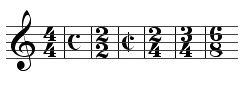
  • The bottom number tells you what kind of note is counted: 4 = crotchets, 2 = minims, 8 = quavers.
A treble staff showing the time signatures four-four, common time C, two-two, cut-time C with a line, two-four, three-four and six-eight
Figure 1 – Common time signatures: 4/4 (also written as C for “common time”), 2/2 (also written as cut time), 2/4, 3/4 and 6/8. Common time signatures.gif by Wahoofive at English Wikipedia, Public domain, via Wikimedia Commons

Simple time

In simple time each beat divides naturally into two equal halves (“1-and-2-and”).

Time signatureBeats per barFeelTypical music
2/42 crotchetsstrong–weakmarches, polkas, many folk dances
3/43 crotchetsstrong–weak–weakwaltzes, minuets, some hymns
4/44 crotchetsstrong–weak–medium–weakmost pop, reggae, calypso, soca, rock
2/2 (cut time)2 minimsstrong–weak, but each beat is longfast marches, some show tunes

Two less common simple signatures appear in Form 2: 3/8 (three quavers in a bar – a fast, light triple time) and 2/8 (two quavers in a bar).

In 3/8 and 2/8 the quaver is the beat. So 3/8 feels like a quicker, lighter 3/4 (three beats in a bar), and 2/8 like a quicker 2/4 (two beats in a bar). When 3/8 is very fast, musicians often count just one beat in each bar. Here are some ways to fill one bar:

Time signatureOne bar could be
3/8three quavers; a crotchet and a quaver; or a dotted crotchet
2/8two quavers; four semiquavers; or one crotchet

Compound time

In compound time each beat divides into three. The most common compound signature is 6/8: six quavers in a bar, grouped as two dotted-crotchet beats (“1-2-3-4-5-6”). It has a lilting, rocking feel, and you hear it in jigs, lullabies, sea shanties and many Caribbean folk songs. 9/8 (three beats) and 12/8 (four beats) are also compound, and 12/8 is the usual metre of slow blues and many gospel ballads.

Try it: metronome with time signatures

Choose a time signature and listen for the accented first beat of each bar. Tick “Add oom-pah accompaniment” to hear how composers use metre: a bass note on beat 1 and chords on the other beats. In 3/4 that gives the famous waltz pattern OOM-pah-pah; in 2/4 and 4/4 it gives a march-style OOM-pah.

TRY ITMetronome with time signatures

Choose a time signature and tempo. The first beat of every bar is accented (higher and louder). Count along out loud. Tick the box to add an accompaniment: “oom-pah” for 2/4 and 4/4, “oom-pah-pah” for a 3/4 waltz.

90 BPM

Press Play to listen. Nothing plays until you press the button. Start with your volume low.

For 3/8 and 2/8 the tempo counts quavers, because the quaver is the beat.

Listen: a waltz in 3/4

Johann Strauss II’s The Blue Danube (1866) is perhaps the most famous waltz ever written. Count “1-2-3, 1-2-3” and notice the low note on 1 and the lighter chords on 2 and 3. Because it is a dance, the Vienna Philharmonic even lets dancers appear in parts of this film.

Listen: a march in 2

John Philip Sousa’s The Stars and Stripes Forever (1896), played by the United States Marine Band, is a march in cut time. You could march to it – left, right, left, right – which is exactly what two beats in a bar feels like.

A tall, narrow wooden metronome with a pendulum rod, from about 1821
Figure 2 – An early metronome by Johann Nepomuk Maelzel (about 1821). A metronome clicks a steady beat at a chosen number of beats per minute (BPM). Metronome MET 215848.jpg by The Metropolitan Museum of Art (metronome by Johann Nepomuk Maelzel), CC0, via Wikimedia Commons

Activity: find the metre

  1. Listen to three songs you know well.
  2. For each, find the beat, then count until the pattern of strong beats repeats. Is it in 2, 3 or 4? Does each beat split into two (simple) or three (compound)?
  3. Conduct along: down–up for 2; down–out–up for 3; down–in–out–up for 4.
  4. Compose four bars in 3/4 and four bars in 6/8 using the note values from post 2. Clap them for a partner: can they tell which is simple triple time and which is compound duple time?

Quick check

1. What does the top number of a time signature tell you?

Show answer

How many beats there are in each bar.

2. What does the bottom number 4 mean?

Show answer

The beat is counted in crotchets (quarter notes).

3. What is the difference between simple and compound time?

Show answer

In simple time each beat divides into two; in compound time each beat divides into three.

4. Which time signature does a waltz use, and what is its accompaniment pattern?

Show answer

3/4 – “oom-pah-pah”, with a bass note on beat 1 and chords on beats 2 and 3.

5. How many beats in a bar of 6/8, and what kind of note is each beat?

Show answer

Two beats, each a dotted crotchet (three quavers).

Previous: Rhythm and Beat: Note Values, Rests, Dotted Notes, Off-Beats and Syncopation

Next: Tempo, Dynamics and Articulation: The Italian Terms Every Music Student Needs

Syllabus link: T&T Lower Secondary (NCSE) Visual and Performing Arts curriculum – Music, Forms 1–3: Metre/time signature 3.1.9–3.1.11 (2/4, 3/4, 4/4), 3.2.8–3.2.9 and 3.2.3 (2/2, 2/8, 3/8), and 3.3.7–3.3.8 (simple and compound time). CSEC® Music syllabus (CXC 31/G/SYLL 17), Section 1: Listening and Appraising – Music History and Theory: Appendix I – metre and time signatures; Content 3(a)(ii) – the waltz (Classical) and minuet and trio in triple time.

Attributions to media used in this post:

Common time signatures.gif – Wahoofive at English Wikipedia – Public domain (via Wikimedia Commons)

Metronome MET 215848.jpg – The Metropolitan Museum of Art (metronome by Johann Nepomuk Maelzel) – CC0 (via Wikimedia Commons)

Updates

2026/10/04

– Added an explanation of 3/8 and 2/8 (the quaver is the beat) with a table of what fills a bar.

– Added 3/8 and 2/8 to the metronome Try it box.

– Added activity step 4: compose four bars in 3/4 and four bars in 6/8.

© 2026 Vedesh Kungebeharry. All rights reserved.
Rhythm and Beat: Note Values, Rests, Dotted Notes, Off-Beats and Syncopation

Tap your foot to a song and you are feeling the beat. Clap the words of the song and you are clapping its rhythm. These two ideas are easy to mix up, but musicians keep them apart: the beat is the steady pulse underneath, and the rhythm is the pattern of long and short sounds that sits on top of it. In this post you will learn to read and hear the basic note values, rests and dotted notes, and the exciting rhythms that play against the beat: off-beats, syncopation and swing.

Beat versus rhythm

  • The beat (or pulse) is regular, like a heartbeat or a clock. It does not change from one bar to the next unless the tempo changes.
  • The rhythm is the pattern of durations – some notes last one beat, some last half a beat, some last several beats, and some beats are silent.
  • A strong beat is one that is naturally stressed (usually beat 1 of each bar). A weak beat is unstressed.

A famous example is Queen’s “We Will Rock You”: the stamp–stamp–clap pattern repeats over a completely steady beat. Count “1, 2, 3, 4” as you watch: the two quick stamps are two quavers on beat 1, the clap falls on beat 2 and is followed by a short rest, and the pattern repeats on beats 3 and 4.

Note values and rests

Each note shape tells you how long the note lasts compared with the beat. In most simple time signatures the crotchet (quarter note) is one beat. The British names are used in the Caribbean and in CSEC; the American names are in brackets.

NoteBeats (when a crotchet = 1 beat)Matching rest
Semibreve (whole note)4Semibreve rest – hangs below a line
Minim (half note)2Minim rest – sits on a line
Crotchet (quarter note)1Crotchet rest – a zigzag
Quaver (eighth note)½Quaver rest – like a 7
Semiquaver (sixteenth note)¼Semiquaver rest – a 7 with two flags
A row of note symbols labelled breve, semibreve, minim, crotchet, quaver, semiquaver and demisemiquaver, with their rests
Figure 1 – Note values from the breve down to the demisemiquaver. Each note lasts twice as long as the next one to its right. Chambers 1908 Music Notes.png by Chambers’s Twentieth Century Dictionary (1908), ed. Thomas Davidson, Public domain, via Wikimedia Commons

A rest is a silence of a measured length. Rests are part of the rhythm – a well-placed silence is often what makes a rhythm catchy.

Rhythm names (French time names)

Many Caribbean classrooms use spoken rhythm names to read rhythms aloud: ta for a crotchet, ta-te (or ti-ti) for two quavers, ta-a for a minim, ta-fa-te-fe for four semiquavers. Saying the names while clapping helps you feel the durations.

Chart showing semiquavers, quavers, crotchet, minim and semibreve with spoken rhythm syllables under each
Figure 2 – Rhythm syllables used in the Kodály method, from semiquavers (ta-fa-te-fe) to the semibreve (taa-aa-aa-aa). Teaching rhythm in music education.jpg by Flabbergastedflamingoes, CC BY-SA 4.0, via Wikimedia Commons

Dotted notes

A dot after a note adds half of the note’s value again. So a dotted minim lasts 2 + 1 = 3 beats, and a dotted crotchet lasts 1 + ½ = 1½ beats. The pattern dotted crotchet + quaver (long–short) is one of the most common rhythms in music; you hear it in marches, hymns and national anthems.

Off-beats, syncopation and swing

  • An off-beat is a note that falls between the main beats – on the “and” when you count “1 and 2 and”. Reggae guitar chops and the hand-claps in gospel music are classic off-beats.
  • Syncopation is when an accent falls on a weak beat or off-beat, or when a note starts off the beat and is held across the next beat. It makes music feel like it is pushing forward. Calypso, soca, jazz and Latin music are full of it.
  • Swing is a way of playing pairs of quavers unevenly: the first of each pair is longer and the second shorter, in a ratio of about 2 : 1 (like the first and third notes of a triplet). Jazz and blues are usually swung.

Try it: the rhythm pattern player

Choose a pattern and press Play. The click track plays the beat (beat 1 is higher), and the claps play the rhythm. Try “Syncopation”, then try “Quavers” with and without swing – can you hear the long–short feel?

TRY ITRhythm pattern player

Pick a pattern and press Play. The highlighted box shows which note is sounding. Tick “Play the beat” to hear a click on every beat (beat 1 is higher) so you can feel how the rhythm fits over the steady beat.

90 BPM

Press Play to listen. Nothing plays until you press the button. Start with your volume low.

The tempo slider changes the speed on the very next beat, so you can practise slowly and then speed up. The timing is worked out from the tempo exactly: at 60 BPM a crotchet lasts one second; at 120 BPM it lasts half a second.

Activity: rhythm dictation

  1. Work with a partner. One person claps a four-beat rhythm using crotchets, quavers and crotchet rests.
  2. The other writes it down using note values (or rhythm names).
  3. Swap. Then try including one dotted crotchet + quaver and one syncopated pattern.
  4. Compose your own four-bar rhythm in 4/4 using semibreves, minims and crotchets, then write a second version that adds quavers and a crotchet rest. Say it in rhythm names, clap it with “Play the beat” switched on in the Try it box, and swap with a partner to perform each other’s rhythms.

Quick check

1. What is the difference between the beat and the rhythm?

Show answer

The beat is the steady, regular pulse; the rhythm is the pattern of long and short sounds (and silences) played over it.

2. How many beats is a dotted minim worth when the crotchet is the beat?

Show answer

Three beats (2 + 1).

3. Which note is worth half a crotchet?

Show answer

The quaver (eighth note).

4. What is syncopation?

Show answer

Accenting a weak beat or off-beat, or starting a note off the beat and holding it over the next beat, so the rhythm goes “against” the pulse.

5. In swing, how are pairs of quavers played?

Show answer

Unevenly – long then short – in roughly a 2 : 1 ratio, like the first and last notes of a triplet.

Previous: The Elements of Music and How to Listen Like a Musician

Next: Metre and Time Signatures: Simple and Compound Time, Marches and Waltzes

Syllabus link: T&T Lower Secondary (NCSE) Visual and Performing Arts curriculum – Music, Forms 1–3: Rhythm patterns 3.1.1–3.1.5, 3.2.1–3.2.4 and 3.3.1–3.3.3 (including dotted notes); Beat 3.1.6–3.1.8, 3.2.5–3.2.7 (off-beat) and 3.3.4–3.3.6; Duration 3.1.15–3.1.19, 3.2.13–3.2.15 and 3.3.11–3.3.12. CSEC® Music syllabus (CXC 31/G/SYLL 17), Section 1: Listening and Appraising – Music History and Theory: Appendix I – rhythm and duration (note values, rests, dotted notes, syncopation); Content 4(a)(ii) – syncopated and swung rhythms in jazz and blues, and 4(d)(iv) – off-beat and syncopation in Caribbean folk music.

Attributions to media used in this post:

Chambers 1908 Music Notes.png – Chambers’s Twentieth Century Dictionary (1908), ed. Thomas Davidson – Public domain (via Wikimedia Commons)

Teaching rhythm in music education.jpg – Flabbergastedflamingoes – CC BY-SA 4.0 (via Wikimedia Commons)

Updates

2026/10/04

– Added activity step 4: compose your own four-bar rhythm and perform it with a partner.

© 2026 Vedesh Kungebeharry. All rights reserved.

The Elements of Music and How to Listen Like a Musician

Every piece of music you have ever heard – a calypso on the radio, a hymn in church, a film score or a Mozart symphony – is built from the same small set of ingredients called the elements of music. If you learn to hear these elements and name them, you can describe, compare and judge any music, from any place or time. That skill is called listening and appraising, and it is the foundation of lower secondary (NCSE) music and of the CSEC Music History and Theory section.

The seven elements of music

Music teachers group the elements in slightly different ways, but most lists contain the seven below. The Trinidad and Tobago lower secondary curriculum uses exactly these seven and splits rhythm into five smaller parts: rhythm patterns, beat, metre (time signature), tempo and duration.

ElementWhat it meansWords you can use
RhythmHow sounds are organised in time: the beat, the patterns of long and short notes, the metre and the speed (tempo)steady beat, syncopated, swung, fast, slow, in 3/4
Melody (pitch)A line of single notes heard one after another – the “tune”high, low, steps, leaps, wide or narrow range, major, minor
HarmonyNotes sounding together, usually as chordsconsonant, dissonant, major chord, minor chord, simple, rich
TextureHow many layers of sound there are and how they fit togethermonophonic, homophonic, polyphonic, thin, thick
DynamicsHow loud or soft the music ispiano, forte, crescendo, diminuendo, accents
Timbre (tone colour)The “colour” of a sound that lets you tell a steel pan from a violin playing the same notebright, mellow, brassy, breathy, metallic
Form (structure)How a piece is organised into sectionsphrase, verse, chorus, AB, ABA, rondo

Two more ideas often appear alongside the elements: articulation (how notes are attacked and joined – smooth legato or detached staccato) and style (the typical way the elements are combined in a period or genre, such as Baroque, reggae or gospel).

A large youth orchestra performing on the stage of a concert hall with an organ behind them
Figure 1 – A youth orchestra in concert. Every element is at work here: timbre (strings, wind, brass, percussion), texture (many layers), dynamics, rhythm, melody and harmony. CBSO Youth Orchestra in Symphony Hall – geograph.org.uk – 7422392.jpg by Roger D Kidd, CC BY-SA 2.0, via Wikimedia Commons

Hear the elements for yourself

The box below plays the same short tune twice. Each time, only one element changes. Listen and describe the difference using the words in the table above.

TRY ITHear the elements of music

Choose an element. You will hear the same short tune twice (A then B), changing only that element. Listen for what changes.

Press Play to listen. Nothing plays until you press the button. Start with your volume low.

How to listen and appraise: a four-step method

When an examiner (or a friend) asks you to “comment on” a piece of music, a simple routine keeps your answer organised:

  1. Describe what you hear, element by element. Is the tempo fast or slow? Which instruments (timbres) can you name? Is there one melody or several lines?
  2. Analyse how the elements work together. Does the music get louder as it gets faster? Is the bass line repeated? Where does the melody return?
  3. Interpret the mood, purpose or meaning. Is it a dance, a lullaby, a protest song, a hymn? What in the music tells you this?
  4. Evaluate and place it in context. When and where does it probably come from, and why? Give reasons based on the elements, not just “I like it”.

A useful trick is to listen more than once, focusing on a different element each time: first the beat and tempo, then the melody, then the instruments, and so on.

A model answer

“The piece is in a fast tempo with a strong, steady beat in four. The melody is played on a steel pan and moves mostly by step in a major key. Underneath, a bass guitar and drum kit play a repeated syncopated pattern. The texture is homophonic – one tune with accompaniment – and the dynamics stay loud throughout. The bright timbre, syncopation and party mood suggest it is a soca or calypso from Trinidad and Tobago.”

Notice how every claim is backed by an element. That is exactly what CSEC means by analysing music “with reference to musical elements”.

Watch: the elements of music in five minutes

This short lesson video gives a quick tour of the elements with on-screen examples. Pause after each element and think of a song you know that shows it clearly.

How this series is organised

Posts 1–8 cover the elements one by one (the core of Forms 1–3). Post 9 is a timeline of style periods and the forces that change music. Posts 10–14 cover Western art music, from Baroque to the 20th century. Posts 15–18 cover jazz and blues, gospel, and Caribbean folk and popular music. Each post has an interactive Try it box or a carefully chosen video, a quick check, and a syllabus link for NCSE and CSEC.

Activity: an element detective sheet

Choose any song you like. Copy the table of seven elements into your book and write one sentence for each element about your song. Then swap with a classmate who chose a very different song and compare.

Quick check

1. Name the seven elements of music used in the lower secondary curriculum.

Show answer

Rhythm, melody, harmony, texture, dynamics, timbre and form.

2. Which element lets you tell a trumpet from a flute when both play the same note at the same loudness?

Show answer

Timbre (tone colour).

3. What is the difference between melody and harmony?

Show answer

Melody is a line of single notes heard one after another; harmony is notes sounding together, usually as chords.

4. What are the four steps of the listening and appraising method in this post?

Show answer

Describe, analyse, interpret, evaluate.

5. Why is “I like it because it is nice” a weak appraisal?

Show answer

It gives no evidence. A strong answer refers to specific elements (tempo, timbre, texture and so on) to support each point.

Previous: Music History and Theory notes – all lessons

Next: Rhythm and Beat: Note Values, Rests, Dotted Notes, Off-Beats and Syncopation

Syllabus link: T&T Lower Secondary (NCSE) Visual and Performing Arts curriculum – Music, Forms 1–3: Music Curriculum Framework – the seven elements (Rhythm, Melody, Harmony, Texture, Dynamics, Timbre, Form) that organise every outcome from Form 1 to Form 3; listening outcomes 3.1.43, 3.2.39 and 3.3.39 (appreciating music through listening). CSEC® Music syllabus (CXC 31/G/SYLL 17), Section 1: Listening and Appraising – Music History and Theory: Specific Objectives 3 and 4 (evaluate and analyse music with reference to the musical elements); Appendix I – the elements of music.

Attributions to media used in this post:

CBSO Youth Orchestra in Symphony Hall – geograph.org.uk – 7422392.jpg – Roger D Kidd – CC BY-SA 2.0 (via Wikimedia Commons)

© 2026 Vedesh Kungebeharry. All rights reserved.